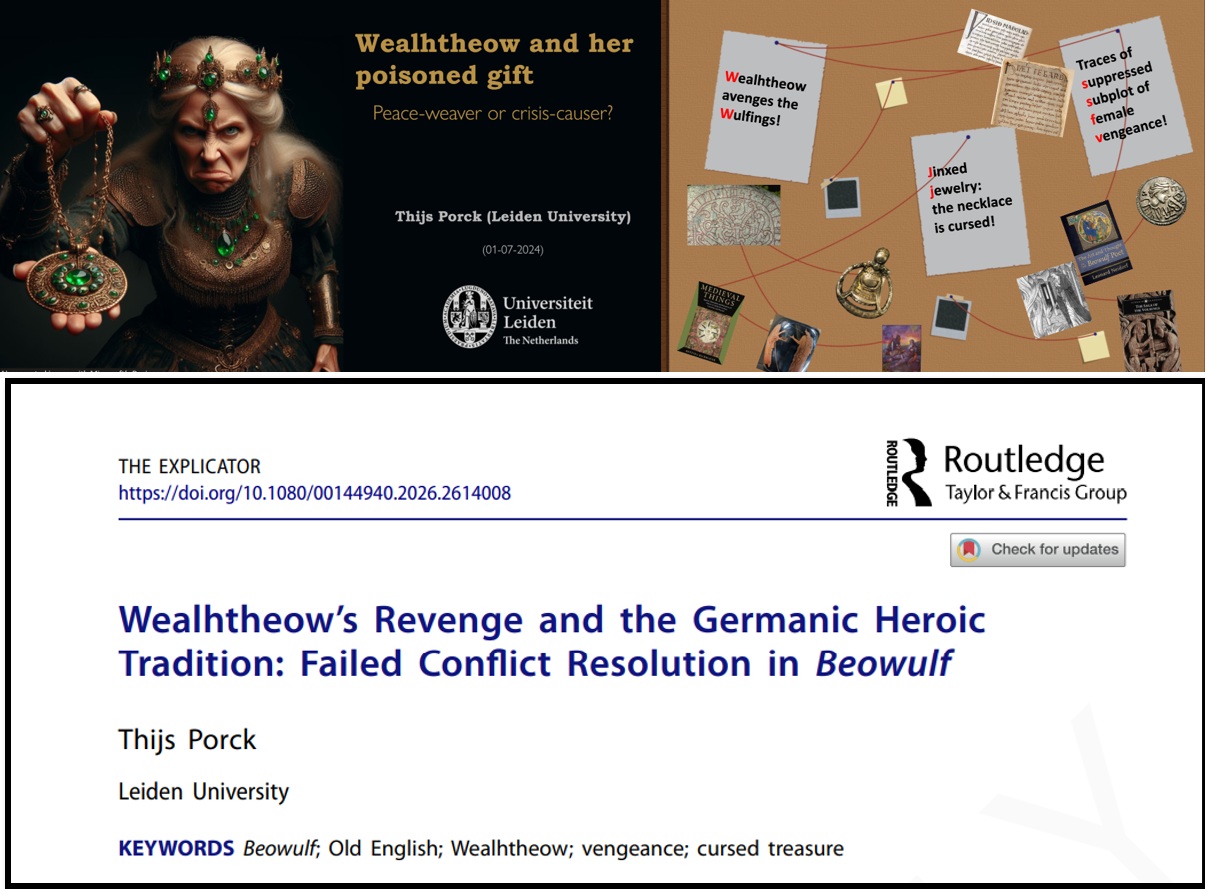
What if Wealhtheow, the gracious queen in Beowulf, wasn’t just handing out mead cups to guests and giving politically savy speeches? What if she was harbouring vengeful feelings and set in motion a secret murder plot? In a recently published article, I have tried to unveil something of a Beowulf ‘conspiracy theory’. You can read the article here in Open Access:
The Lord of the Rings: The War of the Rohirrim (2024) is an anime film that tells the story of Helm Hammerhand, King of Rohan, and his daughter Héra. The movie is based on the Appendices of J. R. R. Tolkien’s The Lord of the Rings and contains many references to Old English, especially in the film’s sound track. This blog post discusses the film’s Neo-Old English lyrics!
Gone with the wind: Where is “The Rider”?
“Where is the horse? Where is the rider?”, the opening lyrics of “Hama’s Song” in The War of the Rohirrim (2024) will remind many a Tolkien fan of “The Lament of the Rohirrim” which Aragorn recites in the chapter “The King of the Golden Hall” in The Lord of the Rings: The Two Towers. In Aragorn’s poem, the opening lines run as follows: “Where now the horse and the rider? Where is the horn that was blowing?”. Tolkien, a Professor of Anglo-Saxon (Old English) at the Universities of Leeds and Oxford, based Aragorn’s poem on the Old English elegy The Wanderer, which uses the so-called ubi sunt motif (‘where are they now?’) to express the fleeting nature of worldly pleasures (the answer to the rhetorical questions being “they are no more”). As it turns out, “Hama’s Song” of the new movie is closer to the Old English original poem, which has the line: “hwær cwom mearg, hwær cwom mago” [Where is the horse? Where is the man?].
Ubi sunt (or ‘hwær cwom’) lines in The Wanderer. Exeter Book, fol. 77v
The context of “Hama’s Song” makes clear that “the rider” referred to is the movie’s heroine Héra, who is also the subject of the movie’s credits song by Paris Paloma called “The Rider”. If you listen carefully to this song, you will notice that there is a very clear Old English lyric at 0:41 (and again at 2:01 and 3:01): “Heo is se wind, heo is se wind” [she is the wind, she is the wind]:
More Old English lyrics! A speculative transcription of “The Lament for Helm”
A single line in an (otherwise pretty epic) song is nice and all, but it would have been even better if the full song were in Old English, of course! In that regard, the best song of the film may be “The Lament for Helm”, sung by Lorraine Ashbourne (who also voices the character Olwyn). This entire song is in Neo-Old English verse and it is pretty amazing:
At the moment of writing this blog post (16 December, 2024), the lyrics to this song have not been made available. So, the following transcription is mostly speculative (and I am indebted to Leiden University colleagues Rachel Fletcher, Suzanne Klare and Amos van Baalen for their invaluable input):
… Beadu-cwealm* hafað fægne frean forð onsended giedd sculon singan gleomenn* sorgiende on ealdum eodorum* þæt he eorla wære his leode leofost ond land-frymena hiehst*. Beadu-cwealm*…
[… Battle-death has sent forth the fated lord sorrowing minstrels must sing a song in old enclosures, that he was of warriors the dearest to his people and the highest of land-lords. Battle-death…]
The words marked with an asterisk * have been slightly emended from what we can hear in the song for linguistic accuracy:
*Beadu-cwealm ‘Battle-death’ – we can clearly hear ‘Beado-cwealm’, but the dictionary form of this word is beadu-cwealm – the word occurs only once in the existing Old English corpus, in the Old English poem Andreas. The pronunciation with the “o” is probably influenced by The Lament for Théodred (for which, see below).
*gleomenn‘minstrel’ – we can clearly hear “gleomann” [minstrel], but the plural verb “sculon” suggests that we need the plural “gleomenn” [minstrels].
*eodorum ‘(in) enclosures’. This sounds like “edoran” in the song, but “edoran” cannot be the right form: we need an “-um” to match the dative plural “ealdum”+ Old English eodor ‘wall, enclosure’ is a strong noun and “-an” is a weak nominal ending. “Edorum” rather than “eodorum” is possible (the Old English poem Genesis A, for instance, has “edoras” for expected eodoras, which matches the spelling of Edoras, the capital of Rohan, based on the same Old English word!).
*hiehst ‘highest’. We can hear “heahst”, but superlatives are usually affected by i-mutation, so heah > hiehst. That said, heahst is occassionally attested, e.g. in the Old English gloss of the Liber Scintillarum.
What is impressive about this Neo-Old English song is that its author has managed to abide by the rules of alliterative Old English verse, which connects half lines through alliteration on stressed syllables: fæg… frean forþ … | giedd … gleo (and in the same line “sing … sorg“) | eald … eo … eor… | leo…leo…land.
The inclusion of a Neo-Old English song in The War of the Rohirrim does not come out of the blue: Tolkien himself was known to compose his own Old English poetry and, in doing so, also inspired an eerily similar Neo-Old English song that was included in the extended edition of Peter Jackson’s The Lord of the Rings: The Two Towers (2002): Éowyn’s Lament for Théodred (written by Philippa Boyens and translated into Old English by David Salo).
The Lament for Helm vs. Éowyn’s Lament for Théodred: A comparison
While Éowyn’s song (LfT) appears to have a lot in common with The Lament for Helm (LfH), attentive listeners can spot a number of differences, which are listed below, line per line:
LfH: Beadu-cwealm hafað | LfT: Bealo-cwealm hafað
Éowyn uses the word Bealo-cwealm ‘evil death’ rather than Beadu-cwealm ‘Battle-death’. The word comes from the Old English poem Beowulf, ll. 2265b-2266:
London, British Library, Cotton Vitellius A.xv, fol. 183r
Bealo-cwealm hafað | fela feorhcynna forð onsended [Evil death has sent forth many of the living].
Clearly, the half line “forð onsended” (sent forth), found in both lamentations, is also based on Beowulf, but both songs provide a different first half line. For Théodred, Éowyn uses “freone frecan” [the noble warrior] – this phrase was not an option for The Lament for Helm, given the fact that the movie also features an unlikable character called Freca (named after the Old English word for ‘warrior’, of course!). The phrase “fægne frean” means something along the lines of “lord doomed/fated to die”, which is very apt for the character of Helm.
LfH + LfT: giedd sculon singan gleomenn sorgiende
Both laments have the same line here, with double alliteration on g and s.
LfH: on ealdum eodorum þæt he eorla wære | LfT: on Meduselde þæt he manna wære
In Éowyn’s song, the minstrels are singing in Meduseld (the hall of the kings of Rohan; medu-seld is an Old English word meaning ‘mead-hall’) and so she alliterates on the m with “manna” [of men]. When The Lament for Helm is sung, they are (crucially) not in Meduseld, but in the Hornburg (later: Helm’s Deep), a somewhat dilapidated place, so “ealdum eodorum” [old enclosures] seems suitable and triggers an alliteration with “eorla” [of warriors].
LfH: his leode leofost ond land-frymena hiehst | LfT: his dryhtne dierest and maga deorost
Here we see a clear distinction between Helm Hammerhand, a king, and Théodred, a prince. The former is “dearest to his people and highest of the land-lords”, while Théodred is “dearest to his lord [i.e. his father Théoden] and bravest of kinsmen”. The alliteration in The Lament for Helm sticks closer to the ‘rules’ than Éowyn’s Lament for Théodred here, since the last stressed syllable of a line rarely participates in the structural alliteration in Old English verse (but in LfT “deorost” alliterates with “dryhtne” and “dierest”).
All in all, then, while the laments are certainly similar (and the one must be based on the other!), there are also clear differences, prompted by the differing contexts in which they are sung. A medievalist would call this mouvance, a concept Tolkien also played around with in his fiction, but that is a story for another blog post. For now, I hope you have enjoyed this little foray into the world of Neo-Old English – if you want to learn more about the topic, there is a whole book about it: Old English Medievalism: Reception and Recreation in the 20th and 21st Centuries!
If you liked this post, you may also be interested in:
This blog post introduces four new knowledge clips about an interesting topic: cultural contacts between ‘the East’ and ‘the West’ in the Early Middle Ages!
How much contact was there between early medieval England and the Middle East?
Fatima al Moufridji (one of my students at Leiden University, now doing her MA Viking and Early Medieval English Studies in Nottingham) was wondering about this very question, when she was introduced to a special coin from 8th-century England. The coin bears the name of the Anglo-Saxon king Offa of Mercia (757-796) but also has an inscription in Arabic; how did that happen and what other traces of cultural contact between England and Arabic speaking regions might be found? To find answers to these questions, Fatima and I applied for some funding from Leiden University’s Justice, Equity, Diversity and Inclusion (JEDI) fund. Our application was granted and we set out to make four short educational videos with the help of Leiden University’s Thomas Vorisek to spread awareness of the fact that early medieval England was not as isolated as one might think.
The links to the four videos are available at the bottom of this blog post, but just to peak your interest and give you a taste of the kind of texts, objects and individuals you might find in these videos, we each share our ‘top fives’ below!
Fatima al Moufridji’s top five
The Wonders of the East: “In our third video, we describe the Old English texts in the Beowulf manuscript that are not Beowulf – intriguingly, all these texts deal with the areas we now refer to as Northern Africa and the Middle East. My favourite one is ‘The Wonders of the East’, an Old English text that describes a wide variety of weird beings and monsters that live out in ‘the East’, ranging from headless monsters to exploding chickens! Being a Pokémon fan helps put this in the 1st spot, since it is basically an early medieval Pokedex.”
Theodore & Hadrian: “Our iconic duo! I think not crediting these two easterners for all they started in early Medieval England would be a crime: hailing from Northern Africa and the Middle East, Theodore and Hadrian established a famous school in England near the end of the seventh century, as we discuss in our fourth video. And what is interesting is that at Leiden University, we actually have an early medieval manuscript that can be linked to their educational efforts!”
Anglo-Saxon dreambook: “Did Anglo-Saxons really dream about exotic animals like camels and lions? And what did they think these dreams meant? It was interesting to see what kind of predictions people came up with when it comes to their dreams, one of the things that fascinated me the most about this aspect. And guess where they got their information from?”
Hygeburg (fl. 760-780): “A nun, responsible for writing down the travel stories of the Anglo-Saxon pilgrim Willibald who travelled through the Holy Land. Even though she did not write down her own experiences, she did give us a great piece of evidence for our second video, on people travelling long distances. I personally do suspect that she may have had a little crush on Willibald, whom she showers in praise!”
Bede’s Ecclesiastical history of the English people: “Our videos are full of tongue-twisters, with quotations in Old English, Latin and Arabic, but somehow the word I struggled most with was “ecclesiastical”, part of the title of one of our favourite and most important sources: Bede’s Ecclesiastical History of the English People – loved pronouncing that!”
Thijs Porck’s top five
Offa coin: “The Offa coin with its Arabic inscription is such an interesting object and really epitomizes the idea behind our videos: there was contact between these distant regions! It was really cool to listen to Fatima read out the inscription and see her pointing out some of the errors that the Anglo-Saxon die-cutter made in our first video.”
Leofwine silk: “I have a particular fascination for the Anglo-Saxon missionaries that brought Christianity to the Low Countries, people like Willibrord, Boniface and Leofwine (Lebuinus). So, I was pleasantly surprised that we could include some of these inspiring people in our videos: as it turns out, Boniface had a thing for exotic gifts and the bones of Leofwine were preserved in an piece of fabric that would have come in via the famous Silk Road. The Leofwine silk also allowed us to make one (of several) silly jokes.”
The Leiden Glossary: “Leiden University has the biggest collection of medieval manuscripts in the Netherlands and we also have a number of Old English manuscripts. Being able to showcase one of these with a link to the famous school of Theodore and Hadrian was a particular delight in making our fourth video!”
Willibald: “Willibald travelled all the way to the Holy Land and thanks to Hygeburg we know quite a lot about his experiences. One of the challenges of making our second video about this super-interesting text was the lack of illustrations, so I had a go at drawing scenes from his journeys myself!”
Cynocephali: “Dog-headed people! What a strange and awkward idea, but, apparently, pretty common in Anglo-Saxon imaginations of the East. We were surprised (and Fatima slightly annoyed) at how often these beings seemed to recur in the Beowulf manuscript!”
Want to find out more about all these interesting objects, texts and individuals? Watch our videos below or via this playlist on YouTube!
Video 1: Traces of trade between early medieval England and the Middle East: Coins, cloth and condiments
What are all these Arabic coins doing in early medieval England? What did Anglo-Saxons use exotic silks for and where did they get their spices? Join us as we explore some traces of trade between the East and the West in the early Middle Ages!
Video 2: Early medieval encounters: Travelling Arabs and Anglo-Saxons
Did you know that people travelled long distances in the Early Middle Ages? Learn more about a tenth-century Arabic description of Britain, the travels of St. Willibald through the Middle East and some pro-tips on using a calabash!
Video 3: Old English imaginations of the East: The other texts in the Beowulf manuscript
Beowulf is awesome! But the other Old English texts in the Beowulf manuscript are interesting as well – not in the least because they give us an idea of how Anglo-Saxons imagined areas including Northern Africa and the Middle East.
Video 4: Anglo-Saxon learning and intellectual import from the Middle East and Northern Africa
Learn more about the inspiring story of Theodore and Hadrian, two scholars from Northern Africa and the Middle East, who made their way to early medieval England! We also discuss the origins of some Anglo-Saxon medical texts (what’s up with all the snakes!?) and the engimatic prognostic texts!
A special find has been made in the Alkmaar Regional Archive: a number of 17th-century book bindings contained pieces of parchment from a manuscript from the 11th century. This discovery is a possible key to a European mystery: pieces of the same manuscript were previously found in England, Germany and Poland. The original manuscript may have belonged to a princess who fled England after the Norman Conquest.
Alkmaar fragments of Old English fixed to book block (photo: Thijs Porck)
Recycling of medieval manuscripts in early modern bindings
Many books were printed and bound in the sixteenth and seventeenth centuries. Bookbinders used parchment to strengthen their book bindings; that material was expensive and therefore people often chose to cut up old, medieval manuscripts. This often involved manuscripts that had lost their value: books that were too Catholic or were written in a language that could no longer be read. Something very special was found in a number of book bindings in the Alkmaar Regional Archive: twenty-one fragments of a manuscript from the 11th century, an almost 1000-year-old Latin psalter with Old English glosses. I was fortunate enough to be involved in the find and analyzed the text and provenance of the fragments.
Reading between the lines: Old English glosses in a Latin psalter
Old English psalter glosses are fascinating, as I have discussed in this blog post: ‘You are truly the same’: The Varied Nature of Old English Glossed Psalters. The newly discovered fragments in Alkmaar belong to this tradition and provide an Old English translation above every Latin word: “ælce dæg” above tota die [every day]; “utgang wætera” above exitus aquarum [outpouring of waters]; and “halig” above sanctus [holy]. These Old English glosses probably had a didactic purpose: with this translation aid between the lines, the user of this psalter could learn Latin. The discovery in Alkmaar adds a total of more than 500 Old English glosses to the Old English corpus and is of significant value for our knowledge of the language of early medieval England – for example, the fragments contain a number of word forms that occur nowhere else, including the word “gewændunga” for the Latin commotionem ‘movement’.
Alkmaar fragments that formed part of the same bifolium (photo: Regional Archive, Alkmaar)
A European mystery: Fragments scattered throughout Europe
The find in Alkmaar is spectacular in and of itself, but the discovery has an extra dimension because fragments of the same manuscript have previously been found in book bindings throughout Europe: in Cambridge (England), Haarlem (The Netherlands), Sondershausen (Germany) and Elbląg (Poland). By comparing the script, decoration, language and content of the fragments, it can be determined that they all come from the same 11th-century psalter. I even managed to reconstruct that one of the Alkmaar fragments must have been cut from the same double leaf as the fragment found in a Haarlem book: where the text stops on the Alkmaar fragment, it continues in the Haarlem fragment.
How were fragments of that one manuscript spread throughout Europe? The find in Alkmaar seems to provide part of the answer to this: a city account shows that the books with the fragments were purchased in Leiden in the year 1601. They were probably also bound there, because a number of other books with fragments of this same manuscript appear to have a link with Leiden. For example, the books in Poland belonged to a Polish nobleman who studied at Leiden University between 1600 and 1602 and the fragment that is now in Haarlem also appears to come from a book that was purchased in Leiden at an auction in the year 1601. The fact that parts of the 11th-century manuscript were also incorporated into books that are now in England and Germany may be explained by the many international students who came to Leiden in the 17th century.
This does not yet completely solve the mystery: around the year 1600, dozens of bookbinders were active in Leiden. I am now collaborating with my Polish colleague Monika Opalińska (who discovered the fragments in Poland) to find out whether they can identify the precise binder – if they succeed, they hope to find more fragments of the 11th-century psalter with Old English glosses.
Alkmaar fragments that formed part of the same bifolium (photo: Regional Archive, Alkmaar)
Original owner of the manuscript: A refugee princess?
That only leaves the question of how a Leiden bookbinder around 1600 came to own an English manuscript from the 11th century. It is known that around the mid-16th century, manuscripts from England were shipped to the continent by boatloads, so that they could be reused by bookbinders and soap makers. It is quite possible that the manuscript with the Old English glosses was included amongst these, but there is also a second theory. It could well be the long-lost psalter with Old English glosses that belonged to Gunhild, an English princess who fled to the continent after the Norman Conquest of 1066, taking her psalter with Old English glosses with her. Gunhild died in Bruges in the year 1087 and donated her psalter and other treasures to the St. Donaas Church. There, her psalter was last seen in the year 1561 and described as a psalter with English glosses “which one cannot properly understand here”. Since then, every trace of Gunhild’s psalter has been lost, but I did manage to find out that the books of the Donaas Church were confiscated by Calvinists in the year 1580: with the useful books they founded a public library, but other, unnecessary books were sold. A psalter with incomprehensible glosses must have belonged to the latter category – is this how the psalter ultimately ended up in the hands of a Leiden bookbinder? It just might be. Perhaps the fragments which have been found in the Alkmaar book bindings belonged to a royal book!
Porck’s article, with analysis, edition and images of the Alkmaar fragments, appeared this week in the peer-reviewed journal Anglo-Saxon England (Cambridge University Press) and can be consulted online for free via: https://doi.org/10.1017/S0263675123000121.Images of the fragments are available for viewing on Fragmentarium.ms.
One of the most important liturgical books in early medieval England was the Psalter. Some thirty Anglo-Saxon manuscripts containing the complete Psalter have survived, including no fewer than fifteen with (partial or complete) Old English interlinear glosses (that is: a word-for-word English translation between the Latin lines). While multiple manuscripts of the same well-known text may seem like a rather dull topic, the Old English glossed Psalters are fascinatingly different, as this blog post will demonstrate.
Different versions of the same Psalm verse (101:28)
To illustrate some of the diversity among the Old English glossed Psalters, here is the same Psalm verse (101:28 “Tu autem ipse es et anni tui non deficient”; You are truly the same and your years will not fail) in four different manuscripts with Old English glosses.
Psalm 101:28 in four different glossed Psalters. N.B. It is common practice to refer to these Old English glossed Psalters with their names, like ‘Vespasian Psalter’ or sigla (letter codes) A-P rather than the full manuscript shelf marks (a full list is provided at the bottom of this blog post.
One clear difference between these Old English glossed Psalters is the scripts that the scribes used. The eighth-century Vespasian Psalter, for instance, uses an uncial script for the Latin text and is accompanied by a later, ninth-century Old English gloss in a much smaller minuscule script. In the Winchcombe Psalter (1025-1050), the same scribe was responsible for both the Latin and the Old English text, using a round insular minuscule for the Old English and a Caroline minuscule for the Latin, as well as alternating coloured inks (red for Old English; black for Latin). A similar combination of Caroline and insular scripts, though without the alternating colours, was used by the scribe of the mid-tenth-century Royal Psalter. The early-eleventh-century scribe of the Lambeth Psalter added a third layer of glosses, the dots underneath.
There are more differences if we turn to what the letters actually spell out. They each give the same Latin text (“tu autem idem ipse es et anni tui non deficient”), although there are some differences in abbreviations (e.g., the Vespasian Psalter and Winchcombe Psalter spell out “autem” in full; but the Royal Psalter and the Lambeth Psalter give “aut” with an abreviation mark; the latter also provides the ampersand “&” while the others give “et”). The Old English translations show more profound differences:
Vespasian Psalter: ðu soðlice se ilca earð 7 ger ðin ne aspringað Winchcombe Psalter: þu soðlice se ylca iert 7 ger þine ne ateoriað Royal Psalter: se ilca selfa eart 7 gear þine na geteoriað Lambeth Psalter: þu soðlice se ilca sylf eart 7 gæres ðine ne ateoriað
These four Old English translations of the same Latin line clearly differ in spelling (ger, gear, gæres) and word choice (aspringað, ateoriað, geteoriað) – these differences are linguistically significant as we will explore further below.
Old English language through timeand place
One variation factor among the Old English glossed Psalters is that they were written at different times and places, which means we can see diachronic and dialectal differences between them. A clear example is found in the Old English glosses for Latin “anni” [years] in Ps. 101:28 above: the Vespasian and Winchcombe Psalters give the form “ger”, the Royal Psalter gives “gear”, while the Lambeth Psalter gives “gæres”. The difference between the Vespasian and Winchcombe Psalter on the one hand and the Royal Psalter on the other is one of dialect: the Royal Psalter’s “gear” shows ‘palatal diphthongization’ (a singular vowel sound changes into a combination of two vowels, when preceded by a /j/-sound), which is a feature of the West Saxon dialect of Old English, while the Vespasian and Winchcombe Psalters give the Mercian dialect form without diphthongization: “ger”.
The Lambeth Psalter’s form “gæres” is actually grammatically incorrect and this form reveals that this gloss is later than the other ones. The -es ending here indicates that the word is plural, but this plural form is ‘not according to Old English grammar rules’. Here is a complex explanation: in ‘proper Old English’, the word “gear/ger” is a strong neuter noun with a long stem, which does not get an ending to mark the plural (just like modern English sheep: one sheep, two sheep; NOT two sheep-s). By the end of the Old English period, when the Lambeth Psalter was made, the grammatical system of Old English was starting to change and eventually the -s plural (originally reserved for strong masculine nouns) came to be used for all nouns with few exceptions (e.g., Modern English sheep~sheep, ox~oxen), because of a process called ‘analogy’ (frequently used forms become the norm). Long story short, the Lambeth Psalter’s “gæres” is a late form anticipating Modern English year-s, while the “ger/gear” form represents earlier Old English (this also explains why the Lambeth Psalter gives the vowel “æ”, which is a later development from West Saxon “ea”).
Other linguistic differences stem from word choice, which may be influenced by dialect or time of composition, but could also be due to the glossator’s personal preference. In Ps. 101:28, for instance, the glossator of the Vespasian Psalter decided to translate Latin “deficient” with a form of apsringan ‘to fall, cease, fall away’, while the other Psalters have a form of ateorian/geteorian ‘to fail, come to an end’. Either synonym works fine as a translation of the Latin. There are also cases where glossators gave multiple synonyms for one Latin word, such as the following example from the Arundel Psalter, which may come in handy if all this linguistic stuff has made you a little drowsy:
A triple gloss for the Latin word “dormitationem” (Ps. 131:4) in the Arundel Psalter. The three glosses are separated with the abbreviation mark “ł”which stands for Latin “uel” [or].
Rather than giving just one translation for the Latin word “dormitationem”, the glossator provides three alternatives: “hnappunge”, “slæp” and “reste” – nap, sleep or rest. This glossator certainly was not asleep on the job!
To gloss or not to gloss: Glossing techniques
Another fundamental difference between the Old English glossed Psalters lies in their differing glossing techniques. For instance, there are Psalters in which every individual Latin word is glossed, as in the Vespasian Psalter, Winchcombe Psalter and Lambeth Psalter, while other Psalters tend not to gloss personal and place names or common words. In the gloss for Ps. 101:28 in the Royal Psalter, the words “tu” and “autem” are not glossed as the glossator apparently assumed the reader would have been familiar with these basic words.
Another issue that is dealt with in different ways in various Old English glossed Psalters is the Latin syntax. The typical word order of Latin differs from that of Old English – for example, in Latin, the possesive pronouns often follow the nouns they modify, whereas in Old English they would typically precede the nouns: Latin “anni tui” (lit. ‘years your’) would be “þine gear” in Old English, ‘your years’. In most Old English glossed Psalters, the Old English glosses follow the Latin word order and, therefore, result in unnatural Old English phrases, such as “gear þine” in the Royal Psalter. However, the scribe of the Lambeth Psalter found a solution to this problem: he added so-called ‘dot glosses’ underneath the Latin words that indicated the Old English word order (I explain this system here: Reading between the lines in early medieval England: Old English interlinear glosses).
Other Old English glossators simply rearranged the word order of the glosses, like the one responsible for this Old English gloss of Ps. 121:2 (‘Our feet were standing in your courtyards, Jerusalem’) in the Junius Psalter:
Psalm 121:2 in the Junius Psalter
Here the Old English glosses for the Latin phrases ‘pedes nostri’ and ‘atriis tuis’ have been ‘normalised’ to ‘ure fet’ and ‘þinum cafertunum’. You can also see that this glossator did not think it was useful to gloss the name Jerusalem.
Beatus-ful illuminations!
But it is not just linguistics that makes the Old English glossed Psalter fascinating things to look at: some of them are beautifully decorated! The opening lines of Psalms 1, 51 and 101, in particular, got additional artistic attention as they marked the beginning of three sections of fifty Psalms. Have a look at the opening of Psalm 1, which starts with ‘Beatus uir’ [‘Blessed man’], in three of the Old English glossed Psalters, below:
Beatus pages in three Old English Glossed Psalters.
These so-called ‘Beatus pages’ give the Psalters a stunning opening and the page often comes with the creative use of different coloured inks. Note how the Bosworth Psalter alternates between blue and red lines, while the Arundel Psalter has letters in red, blue and green. The decorated border of the Tiberius Psalter is so thick that there is little room for text in the middle; the Arundel Psalter, meanwhile, has a thinner border but a bigger capital B; a so-called ‘historiated initial’, depicting King David (who was assumed the be the author of many Psalms):
King David in the historiated initial of the Arundel Psalter
While King David plays the harp in the historiated initial of the Arundel Psalter, to the right of the initial we find the Latin words ‘Beatus uir’, accompanied by the Old English gloss ‘eadi wer’ [blessed man].
Mis-en-page to avoid mess-on-page
Arranging a manuscript page for lines of Latin text that left enough room for the accompanying layer of Old English glosses required careful planning. Here are two examples of planned-out ‘mis-en-page’ (the way text appears on the page), as well as one example of a page on which there was not enough space for the huge amount of glossing (in this case explanatory glosses that were added later) :
Varying text and gloss arrangements in three Old English glossed Psalters.
The third example clearly has a more messy appearance, since the planned space for glossing was smaller than it needed to be.
While correctly planning out a singular Latin text and one layer of Old English gloss was no mean feat, Eadwine, a twelfth-century monk from Canterbury, took on an even bigger challenge: the so-callled ‘Eadwine Psalter’ for which he was responsible is home to three different Latin versions of the Psalter, each accompanied with a different gloss, -and- a series of Psalter illustrations:
The Opening of Psalm 23 in the Eadwine Psalter
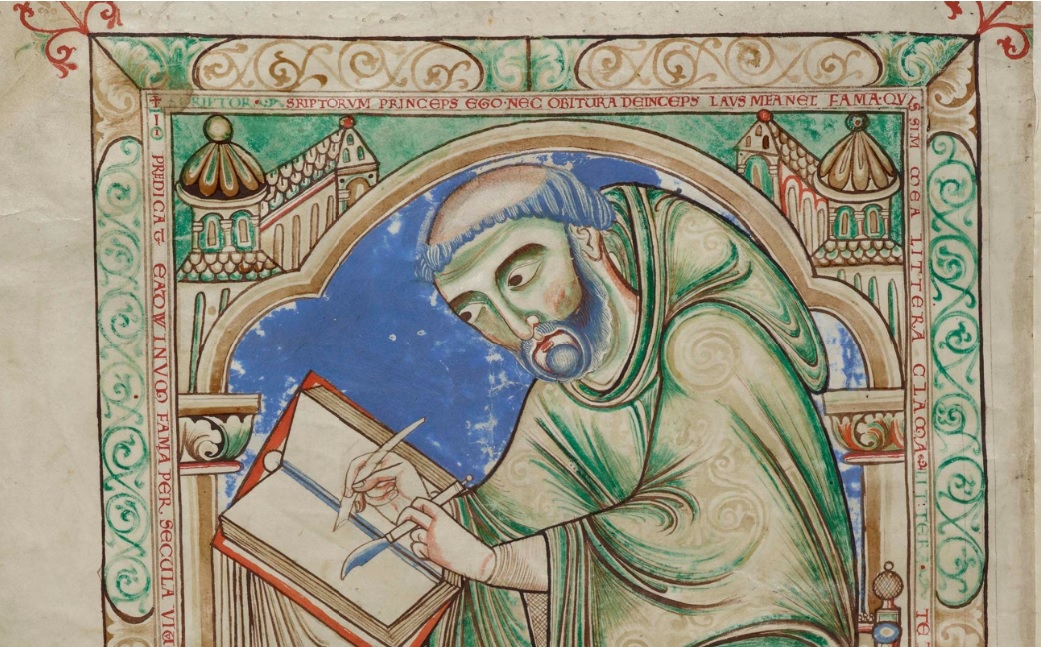
The broadly spaced Latin text on the outer edges of the left- and right-hand page is the Gallican version of the Psalter (marked “Gall.” on the bottom of the left page and on the top of the right page), with explanatory glosses in Latin between the lines and in bother margins. The second more narrow narrow column (marked “Rom.”) is the Romanum version of the Latin Psalter, with Old English interlinear glosses, while the column closest to the middle of the book (rightmost on the left page; leftmost on the right page) gives the Hebraicum version of the Latin Psalter, with Anglo-Norman interlinear glosses. Psalter-ception! Making sure that each page gave corresponding passages in the three Latin versions of the Psalter as well as making enough room for the glossing required Eadwine to carefully adjust the sizes of scripts, spacing and distribution of the text on the page. Managing all this, Eadwine certainly deserves the epithet of ‘s[c]riptorum princeps’ [master of scribes] with which he was described in the text surrounding his famous ‘author-portrait’ at the end of the Psalter that bears his name.
Portrait of Eadwine, part of the text surrounding this portrait reads: “SRIPTORUM PRINCEPS EGO NEC OBITURA DEINCEPS LAVS MEA NEC FAMA” [I am the chief of scribes.; neither my praise nor my fame will die one after the other]. Ironically, there is a scribal error in the word “sriptorum”, which should read “scriptorum”. Eadwine Psalter (E), fol. 283v.
The language, glossing technique, illuminations and mis-en-page are but some of the fascinating aspects of the Old English glossed Psalters (others include annotations by later users, scribes making mistakes, curious initials and so on); in future blog updates, I hope to devote posts to individual Old English Psalters to create a fifteen-part series, starting with the Vespasian Psalter (A). Stay tuned!
If you want to be alerted to subsequent blog posts, make sure to subscribe to this blog, using the box below. If you can’t wait for a next blog post to appear, check out the following related blog posts:
Stowe Psalter (F): London, British Library, Stowe 2
Vitellius Psalter (G): London, British Library, Cotton Vitellius E.xviii
Tiberius Psalter (H): London, British Library, Cotton Tiberius C.vi
Lambeth Psalter (I): London, Lambeth Palace, MS 427
Arundel Psalter (J): London, British Library, Arundel 60
Salisbury Psalter (K): Salisbury, Cathedral Library, MS 150
Bosworth Psalter (L): London, British Library, Additional 37517
Blickling Psalter (M): New York, Pierpont Morgan Library, M. 776
Fragments of Old English glossed Psalter (N): Cambridge, Pembroke College, 312, C, 1-2; Haarlem, Noord-Hollands Archief, 188 F 53; Sondershausen, Schlossmuseum, Lat. liturg. IX 1
Paris, Biblitohèque Nationale, Lat. 8846 (O)
Paris Psalter (P): Paris, Bibliothèque Nationale, Lat. 8824 (not a glossed Psalter; but a Psalter with facing Old English translation, see this blog post)
Relevant literature on the Old English glossed Psalters
Philip Pulsiano, ‘Psalters’, in The Liturgical Books of Anglo-Saxon England, ed. R. W. Pfaff (Kalamazoo, 1995), 61-86.
This blog post introduces a new online tool to explore the vocabulary of the Old English poem Beowulf. The tool is freely available and can offer unique new insights into the vocabulary of early medieval England’s best-known epic.
When a poet unlocks his word-hoard: The vocabulary of Beowulf
“word hord onleace” [unlocked the word hoard] in the Beowulf manuscript.
When Beowulf arrives in Denmark, he introduces himself and his men to a coast guard. The poet describes this action with the words “word hord onleac” [he unlocked his word hoard], creating the stunning image of an individual’s vocabulary as a treasure chest that can be unlocked. Over the years, many scholars have tried to access the Beowulf-poet’s own ‘word-hoard’ (consisting of over 3000 words) in order to open it up for analysis. Arthur Brodeur, in his classic study The Art of Beowulf (Berkeley, 1959), for instance praised the poet’s diction as “more vigorous, stately, and beautiful than that of any other Old English poem” (p. 38). In particular, scholars have praised the poet’s use of compound words, noting that a substantial number of these (over 600) are not found in any other Old English text (they are so-called hapax legomona).These hapaxes include morþor-bed ‘murder-bed’, sadol-beorht ‘made bright by a saddle’, fore-snotor ‘very intelligent’ and, my personal favourite, hleor-bolster ‘pillow; lit. cheek-bed’. A conventional approach to the vocabulary of Beowulf is to focus on words that belong to one given semantic field, e.g., ‘monster’, ‘sea’, ‘hall’ or ‘warrior’, and discuss how the poet’s treatment of the words denoting that concept differs from other texts in the Old English corpus. Such traditional analyses are highly insightful but they all rely on intensive, manual labour; essentially, one needs to leaf through a paper glossary of the text and mark words by hand. However, there is now a digital solution!
Introducing the Beowulf Thesaurus!
Do you want to know how many and which words the Beowulf poet used for such concepts as the colour black, affection, anger and a bench? The brand-new digital Beowulf Thesaurus can easily help you answer these questions: 3 words denoting black/blackness (blæc, sweart and wann), 5 words with the sense ‘love, affection, care’ (frēod, lufu, mōdlufu, myne and heahlufu), 3 words for ‘anger, wrath, fury’ (ierre, torn and wielm) and another 5 words that mean ‘bench, seat’ (benc, bencþel, sess, setl, ealubenc and medubenc)! These may seem like basic questions and answers, but they can be the starting point for interesting analyses of the poem: which emotion is best represented in the poem’s diction? How about animals, colours and actions? You can find it out for yourselves because the Beowulf Thesaurus is freely available online.
So, how does the Beowulf Thesaurus actually work?
You can go to its landing page http://evoke.ullet.net/content/beowulf/ , skip some of the technical description and scroll down to ‘ACCESS’ and click on ‘Explore in Evoke (alongside a Thesaurus of Old English)’. Evoke is a web application developed by Sander Stolk that allows you to browse (and analyse and annotate) thesaurus contents (see his non-technical explanation here; if you want more technical information see this Open Access article). You can use the search box in the top-right corner or browse the thesaurus by clicking on the ‘semantic tree’ with yellow blobs. To find words denoting the concept of ‘affection’, you type ‘affection’ in the search box and click on ‘Love, affection, care’ or you can click your way through the semantic tree via ‘Feelings’ > ‘Heart, spirit, mood, disposition’ > ‘Disposition towards others’ to “Love, affection, care”. Once you’ve done that, you will be given an overview of all Old English words denoting that particular concept along with usage information (e.g., whether that word is mostly used in poetry) – all of this data is taken from Glasgow’s Thesaurus of Old English. If you are using tie Beowulf Thesaurus in Evoke, you can also see which words occur in Beowulf, see the screenshot below:
A screenshot from the Beowulf Thesaurus, showing all words that can denote the concept ‘Love, affection, care’ in Old English – the ones that occur in the poem Beowulf have the tag ‘Beowulf’ on the right.
This overview tells you what words were available to denote the concept ‘Love, affection, care’; it tells you which words are considered ‘rare’ (e.g., mæglufu, lufræden and mægensibb), which words are restricted to poetry or glosses and, crucially, which words are found in Beowulf! And you can do the same for any concept imaginable, ranging from weapons to water, from horses to humility, and from actions to armpits (though the two Old English words for ‘armpit’, ōcusta and ōxn, are only found in glosses and not in Beowulf). Go out and explore the Beowulf Thesaurus yourself! http://evoke.ullet.net/content/beowulf/
Do more than just explore: Evoke as a research tool
Exploring the vocabulary of Beowulf by looking up words for concepts is only one way of using the application Evoke to learn more about Old English vocabulary. Within the same application, we have also made available digital thesauri of the Old English poem Andreasand the Old English Martyrology and using Evoke’s statistical tools one can also compare the words in these different texts and bring to the surface new and unnoticed patterns of vocabulary use. I wrote an article about this kind of research which is freely available – you can read it by clicking on the image below (but be warned: there will be graphs, tables and numbers!):
Click on the image to get access to Thijs Porck, “Onomasiological Profiles of Old English Texts: Analysing the Vocabulary of Beowulf, Andreas and the Old English Martyrology through Linguistic Linked Data“, in Exploring Early Medieval English Eloquence: A Digital Humanities Approach with A Thesaurus of Old English and Evoke, ed. Thijs Porck and Sander Stolk, special issue of Amsterdamer Beiträge zur älteren Germanistik 81: 3-4 (2021), 359–383.
This kind of statistical analysis may not be for everyone, but I do hope you will give browsing the digital Beowulf Thesaurus a try! We also hope to make available a series of online lessons to help you explore the vocabulary of Old English (as well as individual Old English texts) via the web application Evoke – so watch this space and, for now, enjoy unlocking the word-hoard and exploring the epic!
In the 9th century, an anonymous scribe copied a poem attributed to the Irish missionary Columbanus (540-615) and made a crucial mistake. He accidentally omitted one line from the poem. Since this 9th-century manuscript is the only extant copy of the 120-line poem, modern editors of the poem have been forced to leave this line in the poem blank. This blog post reports on the fact that this missing line has been found(!), as I reveal in a new Open Access publication (see the link available at the end of this blog post).
Left: Fresco of Columbanus in the Cathedral of Brugnato (Italy) [source]; Right: Opening lines of De mundi transitu, with marginal attribution to Columbanus (Zürich, Zentralbibliothek, Ms. C 78, fol. 159r)
A missing line in Columbanus’s De mundi transitu
The Irish missionary Columbanus (540-615) founded monasteries in France and Italy and was also known to have written pieces in verse. His De mundi transitu is a short but highly wrought poem, written in a style that is typical for Hiberno-Latin poets of the early Middle Ages. It consists of 120 heptasyllabic lines, divided into thirty stanzas of four lines each. In addition to rhyme, which occasionally extends to three syllables, the poem also features alliteration. The topic of the poem is the fleeting nature of earthly delights; everything that is joyful in this life (beauty; wealth; youth) passes:
Cottidie decrescit Vita praesens quam amant; Indeficiens manebit Sibi poena quam parant.
[The present life that they love declines daily; the penalty they prepare for themselves remains unfailingly.]
Columbanus, “De mundi transitu”, ll. 21-24.
Therefore, Columbanus (540-615) holds, a true Christian should focus on the permanence found in Heaven.
This beautiful and powerful poem survives in only one manuscript, which was copied in the 9th century in the Abbey of Saint Gall, Switzerland. When the 9th-century scribe copied the poem, he made a crucial error. Rather than copying line 106 of the poem, his eyes skipped across the page of his exemplar and he accidentally copied out the last part of the wrong line: line 102, which now occurs twice in the manuscript, but does not make any sense in the second instance (a description of Heaven):
Zürich, Zentralbibliothek, Ms. C 78, fol. 160r (underlined, in read, the repeated part of line 102)
Ubi cibo superno Plebs caelestis pascitur, Ubi nemo moritur Quia nemo nascitur, Ubi aula regia caelestis pascitur In qua male resonans Nulla vox audita est
[Where on celestial food the heavenly folk are fed; where no one dies because no one is born; where the royal hall the heavenly … are fed, in which no voice is heard resounding evil]
Columbanus, “De mundi transitu”, ll. 101-108.
The erroneous repetition of part of line 102 on the place of 106 may have been triggered by the fact that both lines 101 and 105 start with the same word: ‘Ubi’. The scribe did not notice their mistake, but later editors of the poem, who could only rely on this faulty manuscript, have been forced to leave open line 106 or come up with their own lines. However, during my research, I chanced upon a partial copy of Columbanus’s poem in another manuscript, which contains the missing line 106! But before I can talk about that part of the story, I need to talk about the fact that old people do not groan in Heaven.
Heaven is a place where the old man does not groan
When I read the poem De mundi transitu for the first time, I was struck by one of its descriptions of Heaven. According to Columbanus, Heaven is a place “Ubi senex non gemat, / Neque infans vagiat” [where the old man does not groan and the infant does not cry]. In my research into early medieval ideas about old age, I found that Heaven was typically described as a place where old age was absent (see Heaven is a place without old age: Age and the afterlife in early medieval England) and I knew of only one other text that described Heaven in the same terms as Columbanus had done: an anonymous Old English homily, found in a twelfth-century manuscript. This Old English text described Heaven as a place “þær eald ne graneð, ne child ne scræmeð” [where the old one does not groan and the child does not scream]. The phrasing was eerily similar to Columbanus’s De mundi transitu and, upon closer investigation, I found that the Old English homily featured a near-translation of some fifty lines of the poem – something that no one else had noticed!
Oxford, Bodleian Library, MS Bodley 343 – a manuscript with Old English homilies
Finding a Latin source for an Old English text is rare and such a substantial one offers all sorts of opportunities for research (how did the Old English homilist adapt his source; what did he leave out; what did he add, etc.) – I was able to write a 23-page chapter about this find (see the link to the full article below). Unfortunately, the Old English homilist did not include a literal translation of the last lines of Columbanus’s poem (including line 106). He did give a near-literal translation of lines 103 and 104 (“Ubi nemo moritur / Quia nemo nascitur”) as “ne þær nan ne swæltæð, for þam ðe þær ne byð nan acenned” [where no one dies, because no one is born there], but what follows seems more of a paraphrase. However, whilst researching this homily and the poem, I found additional and crucial traces of the missing line 106 of Columbanus’s De mundi transitu.
Since I wanted to make sure that the Old English homilist had not used another Latin text as its source, I did some detective work to see if any other texts mentioned old people not groaning in Heaven (and various other phrases found in both Columbanus’s poem and the Old English homily). When I searched for variants of the line “ubi senex non gemat” [where the old man does not groan] in an online database with medieval Latin texts (Brepols’s Library of Latin Texts), I found a text that contained a version of that line, along with some fourteen other lines of Columbanus’s De mundi transitu, including (YES!) line 106 – it turned out to be the work of another person from Ireland: Sedulius Scottus.
An Irish teacher’s notebook: Sedulius Scottus’s Collectaneum Miscellaneum
Left: Fresco of Columbanus in the Cathedral of Brugnato (Italy) [source]; Right: Sedulius Scottus [source]
Sedulius Scottus (fl. 840-860) was a 9th-century Irish teacher, scribe and poet, who fled Ireland after the Viking raids and ended up in continental Europe, where he certainly stayed in Liège (present-day Belgium) and later possibly moved to Milan (Italy). Scottus wrote various works, including poems and biblical commentaries. One of his works, commonly referred to as the Collectaneum Miscellaneum, is a collection of quotes from mostly biblical and patristic sources (a florilegium). For some passages, names of source authors have been added in the margins of the manuscript, but the origin of some strings of text in Scottus’s notebook are still unknown. On one of the pages of his notebook, Sedulius included some lines of Columbanus’ poem De mundi transitu. The passage from Columbanus’s poem was included between two quotes from Church Father Augustine (354-430) and the entire passage is attributed to ‘AVGVSTINVS’ in the manuscript of the Collectaneum:
Passage from Columbanus in Sedulius Scottus’s Collectaneum Miscellaneum (edition by Dean Simpson, 1998), underlined in red ‘ubi senex non gemit’ [where the old man does not groan]
The misattribution to Augustine of the entire passage (the lines from Columbanus are located in between two Augustinian quotes) has probably resulted in this passage having gone unnoticed in the scholarship on Columbanus’s De mundi transitu. This is unfortunate, since Sedulius Scottus seems to have had access to a copy of the poem that was complete, or, at the very least, did contain line 106 that is missing from the only extant 9th-century manuscript of the full poem!
Here are the lines from the poem in the 9th-century manuscript (without line 106) and the equivalent lines in Sedulius Scottus’ notebook (with line 106!):
Columbanus, De mundi transitu, lines 101-112 and the corresponding lines in Sedulius Scottus’s Collectaneum
It looks as if Sedulius Scottus decided to copy out the lines from Columbanus’s poem that describe Heaven and, crucially, Sedulius’s version of the poem does not appear to have had the scribal error of the 9th-century manuscript from Saint Gall. His version of lines 105-108 read “Ubi aula regia / regis summi sita est, / in qua male resonans / nulla uox audita est”, the meaning of which makes perfect sense: “Where the royal hall of the highest king is located, in which no voice is heard resounding ill”. The line “regis summi sita est” is also a perfect fit with the rest of Columbanus’s poem – it has seven syllables (like all the other lines), there is alliteration with the last word of line 105 (“regia / regis”) as well as alliteration within the line it self (“summi sita”); and it rhymes with line 108 (“sita est […] audita est”). In other words, it is very likely that the line “regis summi sita est” indeed belonged to the original poem by Columbanus! Thus, by sheer chance and some detective work, the line that was lost by the carelessness of a 9th-century scribe in Saint Gall can now be restored and Columbanus’s poem is once more complete!
From the Viking mead drinking in Valhalla to the unending punishments of the Greek underworld, the afterlife has always been an imaginative place. In this blog post, I survey how the afterlife was conceptualised in early medieval England, in particular with reference to ‘old age’.
Heaven is a place without old age
The prime place to look for descriptions of Heaven are Old English homilies. As I have pointed out in another blog post (“Men þa leofestan!” Manuscript variations of an Old English formula), these homilies are highly formulaic and, indeed, various descriptions of Paradise look very much alike. In fact, similar descriptions of ‘The Seven Joys of Heaven’ are found in no fewer than eleven Old English homilies. They are easy to spot, since they use the recurring formula ‘þær is x butan y’, where both x and y are antonyms, to describe what is present and what is absent from Paradise. A typical example is found in one of the homilies of the Vercelli Book:
Þær is ece med, 7 þær is lif butan deaðe 7 geogoð butan ylde 7 leoht butan þystrum 7 gefea butan unrotnesse 7 sybb butan ungeþwærnesse 7 orsorhnes butan deaþes ege to lybbenne, 7 þær is ece gesælignesse mid fæder 7 mid þam suna 7 mid þam haligan gaste a butan ende, amen.
[There is the eternal reward and there is life without death and youth without old age and light without darkness and joy without sadness and peace without violence and carelesness without living in fear of death, and there is the eternal happiness with the Father and with the Son and with the Holy Ghost, always, without end, Amen.]
(Vercelli Homily XIX)
A more poetic version of this topos is found in the Old English poem Christ III, which describes Heaven as follows:
[There is the love of beloved ones, life without death, a joyous troop of men, youth without old age, glory of heavenly hosts, health without pain, rest without toil for the well-doers, day without darkness for the renowned ones, bright full of glory, bliss without sorrows, peace between friends without envy, happy in harmony, peace without envy, among the saints]
(Christ III, ll. 1652-1660)
In these iterations of Heaven, old age is again and again notably absent. Apparently, spending eternity in an aged body was regarded as the antithesis of a joyful afterlife. Indeed, similar descriptions of Hell include old age among its horrors.
The road to Hell is paved with grey hairs
The description of Hell in the Old English homily “Be heofonwarum 7 be helwarum” [about the Heaven-dwellers and the Hell-dwellers] is almost a complete reversal of the stock description of Heaven:
Þær byð hunger 7 þurst. Þær bið ungemet cyles, and hætan IX siðan hatre þonne domesdæges fyr. Ðar syndan þa ytemestan þystro butan leohte, þar byð yld butan geoguðe.
[There is hunger and thirst. There is unmeasurable cold and heat nine times hotter than the fire of Doomsday, there is the utmost darkness without light, there is old age without youth.]
(“Be heofonwarum 7 be helwarum”)
Here, old age is clearly presented as one of the ‘horrors of Hell’, one that does not even need a qualifier like ‘unmeasurable’, ‘utmost’ or ‘nine times hotter than the fire of Doomsday’.
Rather more expressively, another Old English homilist lists ‘old age’ as one of the five ‘prefigurations of Hell’, along with pain, torture, death and the grave:
Þonne is þære æfteran helle onlicnes genemned oferyldo, for þan him amolsniaþ þa eagan for þære oferyldo þa þe wæron gleawe on gesyhþe, 7 þa earan adimmiaþ þa þe ær meahton gehyran fægere sangas, and sio tunge awlispaþ þe ær hæfde gerade spræce, 7 þa fet aslapaþ þe ær wæron ful swifte 7 hræde to gange, 7 þa handa aþindaþ þe ær hæfdon ful hwate fingras, 7 þæt feax afealleþ þe ær wæs on fullere wæstme, 7 þa teþ ageolewiaþ þa þe ær wæron hwite on hywe, 7 þæt oroþ afulaþ þe wæs ær swete on stence.
[Then is the second prefiguration of Hell named ‘old age’, because for him the eyes weaken because of old age, those that had been keen of sight, and the ears become dim, those that had been able to hear beautiful songs, and the tongue stammers, that had had skilful speech, and the feet sleep, those that had been very swift and quick in movement, and the hands become swollen, that had had fully active fingers, and the hair falls out, that had been full of abundance, and the teeth become yellow, those that had been white in appearance, and that breath, which had been sweet of smell, becomes foul.]
(Vercelli Homily IX)
Want to know what Hell is like? Grow old!
Saint Guthlac being draffed to Hell – Note the wrinkles and beards of some of the souls in the Hell Mouth! London, British Library, Harley Roll Y.6
The magical number is 33
So if one was not old in Heaven, how ‘young’ would one be? The answer is 33. The homilist Ælfric of Eynsham noted that, according to the Apostle Paul, everyone would be resurrected on Doomsday at the same age at which Christ was crucified:
Se apostol paulus cwæð þæt we sceolon arisan of deaðe on þære ylde þe crist wæs þa ða he þrowade þæt is ymbe þreo and þrittig geara. Đeah cyld forðfare oððe forwerod mann þeahhwæðre hi cumað to ðære ylde þe we ær cwædon hæfð þeah gehwa his agenne westm þe he on þisum life hæfde.oððe habban sceolde gif he his gebide.
[The Apostle Paul said that we shall arise from death at the age that Christ was when he suffered, that is around thirty-three years. Eventhough a child or a worn-out old man departs, nevertheless they will arise at the age we said before; nevertheless everyone will have his own growth which he had in this life or should have had if he had experienced it.]
(Ælfric of Eynsham, Catholic Homilies I, 16)
Coincidentally, a 20212 study showed that the age of 33 is still the age at which people are at their happiest (source). Judging by the descriptions of Heaven and Hell above, however, this restoration of human bodies to their prime on Doomsday only lasted for those who would go to Heaven; for the souls assigned to the Abyss, their regained physical prime would turn out to be short-lived – they would spend the rest of eternity in the withered, hairless, yellow-teethed and foul-breathed body of an old person.
Want to know more about old age in early medieval England? You are in luck: Boydell and Brewer are offering a 40% discount on my book Old Age in Early Medieval England: A Cultural History (2019) – see the code in the Tweet below(valid until 31 December, 2020!):
“Men þa leofestan!” “Men ða leofestan!” “Men þa leofestan!” This blog post dealswith the ways in which a very common Old English phrase was differentiated by early medieval English scribes.
Men þa leofestan! An opening formula of many Old English homilies
If you were to go to church in early medieval England, it is very likely that you would hear the words “Men þa leofestan!” [Dearest people!]. The phrase is found more than 200 times in Old English homilies. In fact, it was the most common way for priests to start their sermons. This is reflected in various medieval manuscripts which feature embellished versions of the phrase to indicate where a new homily began. But if several homilies in the same manuscript started with the same phrase, how would you be able to tell these homilies apart?
Intriguingly, scribes appear to have been aware of this potential difficulty and, as a result, they show a striking variability when it comes to decorating this initial Old English formula. A case in point are the six homilies that start with this phrase in the following 12th-century manuscript:
Six “Men þa leofestan” in London, British Library, Cotton Faustina A.ix
Each phrase is uniquely handled. The initial M’s, for instance, are all clearly different: some are fully green, others are red with green foliage-like decorations, while the last M is fully red and has a quirky little face. Aside from the different initials, the capitalisation of the rest of the phrase also differs: some capitalise the full first word (MEN), while others capitalize the second word as well (MEN ÐA).
More dramatic variation is found in the various Old English homilies of the late tenth-century Vercelli Book that start with the phrase “Men þa leofestan”:
Six “Men þa leofestan” in the Vercelli Book
Here too the scribe differentiates in what parts of the phrase are written in capitals: MEN ÐA LEOFESTAN; MEN ÐA; MEN ÐA LEO; MEN; MEN; MENN Ð(A). The two homilies that start with the lavishly decorated initial M (complete with monstrous head in the middle and little hand? on the left) are strikingly differentiated from the others, while the last of the six homilies (bottom right) uniquely appears to feature two capital M’s and an E that were erased (possibly to leave room for a larger decoration that was never added) – the scribe also seems to have miscalulated how much space was left on the page as he had to add the A inside the Ð to form the word ÐA.
In these ways, the scribes of Cotton Faustina A.ix and the Vercelli Book clearly differentiated between homilies that started in exactly the same way: “Men þa leofestan”.
“Men þa leofestan” in the margins of the Old English Bede
Even when homilies were added to the margins of a manuscript, attempts appear to have been made to differentiate between those homilies that had the same opening formula. This much becomes clear from a manuscript of the Old English translation of Bede’s Ecclesiastical History of the English People.
Each homily starts with the same phrase, but they clearly have different capitals. Note how the second homily (bottom left) simply writes “Men ð. l.” – the scribe clearly assumed that his reader was familiar with the phrase!
One “M” too many: “Men þa leofestan” in the Blickling Homilies
Another manuscript with many instances of the initial formula “Men þa leofestan” is the tenth/eleventh-century ‘Blickling Homilies’. Whoever was responsible for the illustrated initials in this manuscript appears to have made a great effort to make different kinds of M’s:
Nine “Men þa leofestan” in the Blickling Homilies
Every capital M here is unique! Unfortunately, our Anglo-Saxon M-artist appears to have been a little overzealous in this manuscript, as he accidentally introduced an M where it should not have been:
“M heraþ nu men þa leofestan!” [M hear now, dearest people]. This homily appears to have deviated from the standard pattern of the ‘Blickling Homilies’ by first introducing the verb “heraþ” (or possibly “geheraþ” – you can see a trace of the e in the M), but the scribe was so used to writing variations of the capital M that he added one there by default. Oops!
Men þa leofestan! I hope you have enjoyed this blog post; if you did, please consider subscribing for regular blog updates and/or read the following blog posts:
The Anglo-Saxon Chronicle is a fascinating collection of Old English annals that survives in multiple manuscripts and manuscript fragments. This blog post demonstrates that the manuscripts show a fascinating variety even in those annals for which there was little to nothing to report.
The Anglo-Saxon Chronicle: From Julius Caesar to William the Conqueror and beyond
The Anglo-Saxon Chronicle starts its history of England in the year 60 BC, with the failed invasion of Britain by Julius Caesar. Annals that follow report on the arrival of the Germanic tribes, led by Hengest and Horsa, genealogies of various Anglo-Saxon kings and the battles between the Vikings and Alfred the Great. It was probably at the behest of Alfred that the first stretch of annals (from 60 BC to 892 AD) was composed and this ‘Common Stock’ is found in all extant (complete) manuscripts of The Anglo-Saxon Chronicle. However, each manuscript version of The Anglo-Saxon Chronicle tells a unique story, having been copied in different places and at different times, leading to scribes adding, altering and omitting information in the transmission of the text. One manuscript (the Peterborough Chronicle) continues the annals up until the year 1154. The relationship between the manuscripts and related (Latin) chronicles is highly complex as the following diagram from a great article by Simon Keynes demonstrates:
Overview of The Anglo-Saxon Chronicle from Simon Keynes, “Manuscripts of The Anglo-Saxon Chronicle,” in The Cambridge History of the Book in Britain, I: c. 400–1100, ed, Richard Gameson, 537–52. Cambridge: Cambridge University Press, 2011.
The contents of The Anglo-Saxon Chronicle is fascinatingly varied, ranging from relatively dry information (this king died; that king died) to exciting heroic narrative (the story of Cynewulf and Cyneheard), impressive genealogies (often including the names of people from Germanic Legend) and actual Old English poetry (e.g., The Battle of Brunanburh). In previous blog posts, I have dealt with two remarkable events recorded in these Old English annals: #NotMyConqueror: Gytha and the Anglo-Saxon Women’s March against William the Conqueror and An Anglo-Saxon Anecdote: The Battle of the Birds, 671. In this blog post, I want to call attention to the years 190 to 381, during which, according to one manuscript of The Anglo-Saxon Chronicle, literally nothing happened.
Manuscript B: Nothing to see here!
Annals 190 to 381 in manuscript B of The Anglo-Saxon Chronicle
AN. CXC, AN. CXCI, AN. CXCII, AN. CXCIII, AN. CXCIIII, AN. CXCV, AN. CXCVI, etc. We have to admire the diligence of the scribe of MS B of The Anglo-Saxon Chronicle who wrote these ‘entries’ for the years 190 to 381. Apparently, there was nothing to report for these years, but the scribe did feel that it was necessary to write out the full numbers and the abbreviations “AN.” for “anno” 191 times. This must have been a tiring task and we can see that the scribe actually noticed a mistake along the way: he had copied the year 356 twice and found out when he had reached 360. At this point, he went back to correct the second 356 to 357 by adding a little I above the last Roman numeral CCCLUI; he did the same for 358 and 359 and erased whatever stood between 359 and 360. That is dedication! Regardless, one mistake was left unnoticed: for the year 379 he accidentally left out a C [AN. CCCLXXUIII, AN. CCLXXIX, AN. CCCLXXXI], but can we really blame him?
Mistakes in the annals in Manuscript B of The Anglo-Saxon Chronicle
Manuscript A: Room for ‘exciting’ additions!
The same range of annals (190 to 381) looks a lot more impressive in the Parker Chronicle (manuscript A):
Admittedly, the way that the scribe of manuscript B handled this series of annals is more economical, but manuscript A at least allows for some room for potential additions. The additions that were made within the range 190 to 381, however, are not the most informative ones: for the year 200, someone added “twa hund gæra” [two hundred years] and for the year 300, the same person added “þreo hund gæra” [three hundred years] – great facts, guys! For the year 283, the death of St Alban is reported: “her þrowade sanctus Albanus martyr” [in this year, the martyr saint Alban suffered].
Manuscript C: Colour patterns!
Manuscript C follows Manuscript B in not reporting anything of note in the range 190 to 381 and, instead, just lists all the years + AN. To make the page still somewhat exciting, the scribe uses a different colour ink for every line:
But even the neat colour patterning did not withhold this scribe from making an error: the pattern breaks when he accidentally copies out two lines in red, which he then follows up by two lines in black, before returning to one line of red:
Manuscript D: Parchment to spare
Whoever was responsible for the layout of manuscript D of The Anglo-Saxon Chronicle had parchment to spare: rather than writing out all the years consecutively, like MSS B and C, or writing out the years in two columns like manuscrpt A, Manuscript D gives the years in one column. As a result, the range 190 to 260 alone already spans three pages. The next folios have been lost and they are replaced with 16th-century ‘supply-leaves’ (giving the text of folios that are now missing):
The sixteenth-century hand, belonging to John Jocelyn (1529-1603), seems to have taken some effort to reproduce all the year numbers, although he gives up at the year 286, for which he now gives the death of St. Alban “Her ðrowade santus Albanus martyr”.
Note also the original scribes colour patterning, using blue and red ink.
Manuscript E: A creepy little hand
Manuscript E brings us back to the two-column layout of manuscript A. This is combined with different colour ink for the year numbers and the textual entries. It seems as if this copy of The Anglo-Saxon Chronicle had some more things to say for the years 190 to 381, but they still look like two boring centuries:
Clearly, the death of St Alban (here in the year 286, as in Manuscript D, but unlike Manuscript A which had it down in 283) was considered the most important event, since it is called attention to by a little hand (manicula) with a creepily long and wavy index finger:
Manuscript F: The years are fading away!
There is not much to say about manuscript F of The Anglo-Saxon Chronicle other than that its bilingual nature (it gives the text of the entries in Old English and Latin) did not affect the way that the year numbers are presented on the page – manuscript F follows B and C in writing the year numbers consecutively, even if this scribe did not bother to copy out the abbreviation “AN.” 191 times! Unfortunately, red ink was used for the year numbers and this has all but faded away. For the ‘textual entries’, the scribe used black ink, which means we can still read the entry for the death of St Alban, which, in this manuscript, appears to have taken place in the year 287, unless the scribe copied the year 286 twice.
The death of Saint Alban, reported in Old English and Latin. The year number above Latin “hic” is clearly CCLXXXV (285); a year number is started to the right of it (286); and another is found before the black “Her” (287? or 286 again).
Looking back at this blog post, we can draw two conclusions:
1) Even for stretches of time in which almost nothing happened, the manuscripts of The Anglo-Saxon Chronicleshow a fascinating diversity.
2) Nobody knew exactly when St Alban died. Manuscript A has 283; D and E opt for 286 and F seems to put it at 287. Wikipedia(The Anglo-Saxon Chronicle of the modern age) suggests the death of St Alban either happened in c. 251 or 304 – so I guess we still don’t know.
If you liked this blog post, consider signing up for regular blog updates and/or check out these posts: