
This blog post features an Anglo-Saxon trivia quiz that will test (and/or increase) your knowledge about magical medicine in early medieval England.
A bad reputation for early medieval medicine
Whereas the bulk of early medieval English medicine consists of herbal and botanical remedies, some of the more fanciful ways to alleviate various ailments border on witchcraft. These remedies involve incantations, love potions, occult rituals and references to supernatural beings including dwarfs and elves. According to some early scholars, there was a fine line between magic and medicine and, as a result, much of early medieval English medicine should be regarded as little more than nonsense:
Surveying the mass of folly and credulity that makes up Anglo-Saxon leechdoms, it may be asked “Is there any rational element here? Is the material based on anything that we may describe as experience?” The answer must be “Very little”
(J. H. G. Grattan and C. J. Singer, Anglo-Saxon Magic and Medicine (Oxford, 1952), p. 92)
Indeed, it is not hard to find examples of seemingly irrational, magical medicine in Anglo-Saxon sources, as the following trivia quiz will illustrate.
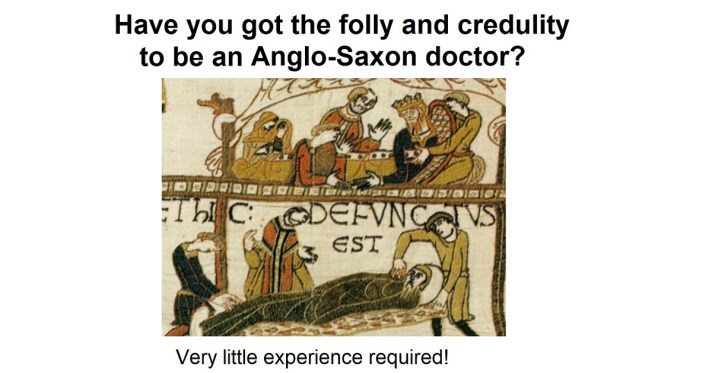
Have you got the folly and credulity to be an Anglo-Saxon doctor?

The following 10-question-quiz introduces some characteristics and intriguing examples of ‘magical medicine’ from Anglo-Saxon England. Each multiple-choice question has at least one right answer and clicking this will reveal an explanation with further information. Good luck! N.B. Unfortunately the quiz does not work in all mobile browsers (such as the Twitter browser), if you see all the explanations expanded, better use another browser!
 “Hundes Heafod” (Small snapdragon) in London, British Library, Cotton Vitellius C.iii, fol. 45v.
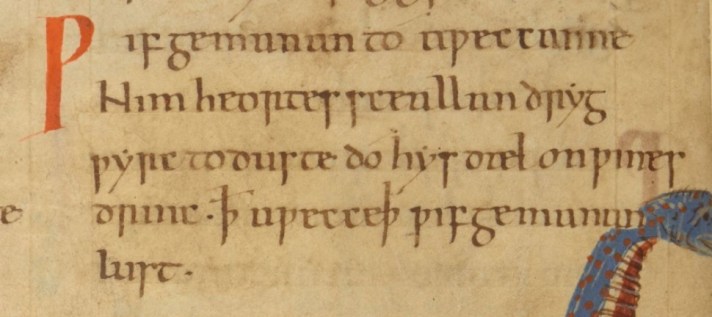 Wif gemanan to aweccanne, nim heortes sceallan, dryg, wyrc to duste, do hys dæl on wines drinc. Þæt awecceþ wif gemanan lust. (London, British Library, Cotton Vitellius C.iii, fol. 76v.) [To arouse a woman for sexual intercourse, take the testicles of a deer, dry them, grind them to dust, do a part of this in a drink of wine. That will arouse a woman with the lust for intercourse.] Read more about Anglo-Saxon aphrodisiacs here: Anglo-Saxon aphrodisiacs: How to arouse someone from the early Middle Ages?
 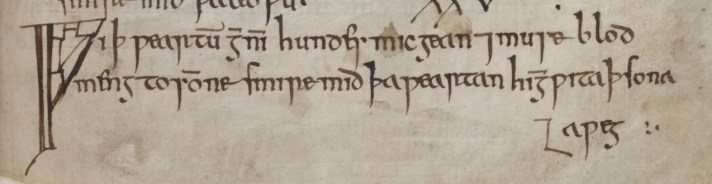 “Wiþ weartum. Genim hundes micgean 7 muse blod, meng to somne, smire mid þa weartan, hig witaþ sona aweg.” (British Library, Royal 12 D XVII, fol. 116r) [Against warts. Take the urine of a dog and mouse blood, mix together, rub the warts with it, they will immediately go away.]
  Gif sinwe syn forcorfene nim renwyrmas, gecnuwa wel, lege on oþ þæt hi hale synd.” (British Library, Royal 12 D XVII, fol. 118r) [If the sinews are cut, take earthworms (lit. rain-worms), pound them wel, lay them on until they are whole.
 “Gyf hwylc wif seteð hire bearn ofer rof oððe on ofen for hwilcere untrymðe hælo .vii. gear fæste” (Brussels, Bibliothéque royale, 8558-63, fol. 152v) [If any woman sets her child on a roof or in an oven for the cure of any illness, fast for seven years].
“Gyf hwylc wif seteð hire bearn ofer rof oððe on ofen for hwilcere untrymðe hælo .vii. gear fæste” (Brussels, Bibliothéque royale, 8558-63, fol. 152v) [If any woman sets her child on a roof or in an oven for the cure of any illness, fast for seven years].
“Gyf hwylc wif seteð hire bearn ofer rof oððe on ofen for hwilcere untrymðe hælo .vii. gear fæste” (Brussels, Bibliothéque royale, 8558-63, fol. 152v) [If any woman sets her child on a roof or in an oven for the cure of any illness, fast for seven years].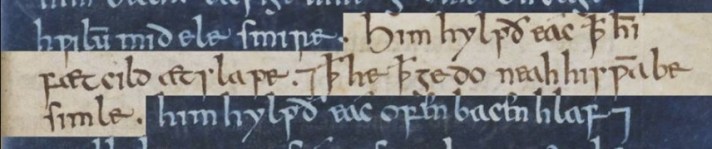 “Him hylpð eac þæt him fæt cild æt slape 7 þæt he þæt gedo neah his wambe simle”(British Library, Royal 12 D XVII, fol. 83r) [It also helps him that a fat child should sleep by him, and that he should put it always near his (stomach).]
 “nim mereswines fel, wyrc to swipan, swing mid þone man sona bið sel. Amen.” (British Library, Royal 12 D XVII, fol. 120r) [take the skin of a dolphin, make into a whip, hit the man with it. He is immediately healthy. Amen.] Note that the ‘Amen’ was added by a later hand!
  “Gif mist sie fore eagum nim cildes hlond 7 huniges tear meng tosomne begea emfela smire mid þa eagan innan” (British Library, Royal 12 D XVII, fol. 112r) [If a mist is before the eyes take a child’s urine and a drop of honey, mix them both together equally, smear it into the eyes].
Does early medieval English medicine deserve its bad reputation?
While the quiz above may suggest that Grattan and Singer were justified in rejecting Anglo-Saxon medicine as folly and credulity, more recent scholarship has suggested this harsh criticism is undeserved. Treatments with magical and irrational elements only make up about fifteen percent of all early medieval English remedies. The majority can be categorised as herbal medicine, an alternaive form of medicine still practised today. M. L. Cameron tested out some of the ingredients in Anglo-Saxon remedies and concluded:
Did ancient and medieval physicians use ingredients and methods which were likely to have had beneficial effects on the patients whose ailments they treated?… I think the answer is “Yes, and their prescriptions were about as good as anything prescribed before the mid-twentieth century”. (M. L. Cameron, Anglo-Saxon Medicine (Cambridge, 1993), p. 117)
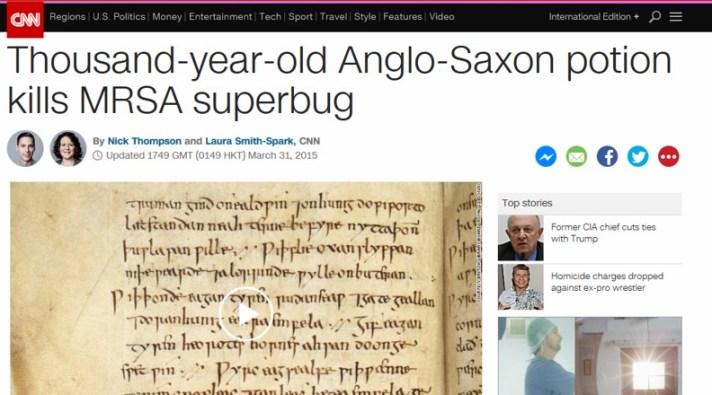
In other words, Anglo-Saxon medicine may not have been as ineffectual as it might seem. In fact, a few years ago, an Anglo-Saxon remedy for eye stye shocked the world by being able to succeed where modern antibiotics had failed:
Perhaps, then, Anglo-Saxon medicine deserves more than a silly trivia quiz, but that’s something for future blog posts!
If you liked this blog post, you may also enjoy:
- How to cook your dragon and a medieval cure for old age
- Passion, Piles and a Pebble: What Ailed Alfred the Great?
- Anglo-Saxon aphrodisiacs: How to arouse someone from the early Middle Ages?
© Thijs Porck and Dutch Anglo-Saxonist Blog, 2018. Unauthorised use and/or duplication of this material without express and written permission from this site’s author and/or owner is strictly prohibited. Excerpts and links may be used, provided that full and clear credit is given to Thijs Porck and Dutch Anglo-Saxonist Blog with appropriate and specific direction to the original content.
 Thijs Porck
Would you consider bestowing læce-diplomas to those of us who pass your quiz? One can never have too many qualifications in today’s competitive job market!
LikeLiked by 1 person
Love this!
LikeLike
excellent!
LikeLike
the magic symbolism of the number nine.. is linked with ancient german culture?? with woden or vodan??? nine days and nine nights suspended on yggdrasill??
LikeLike