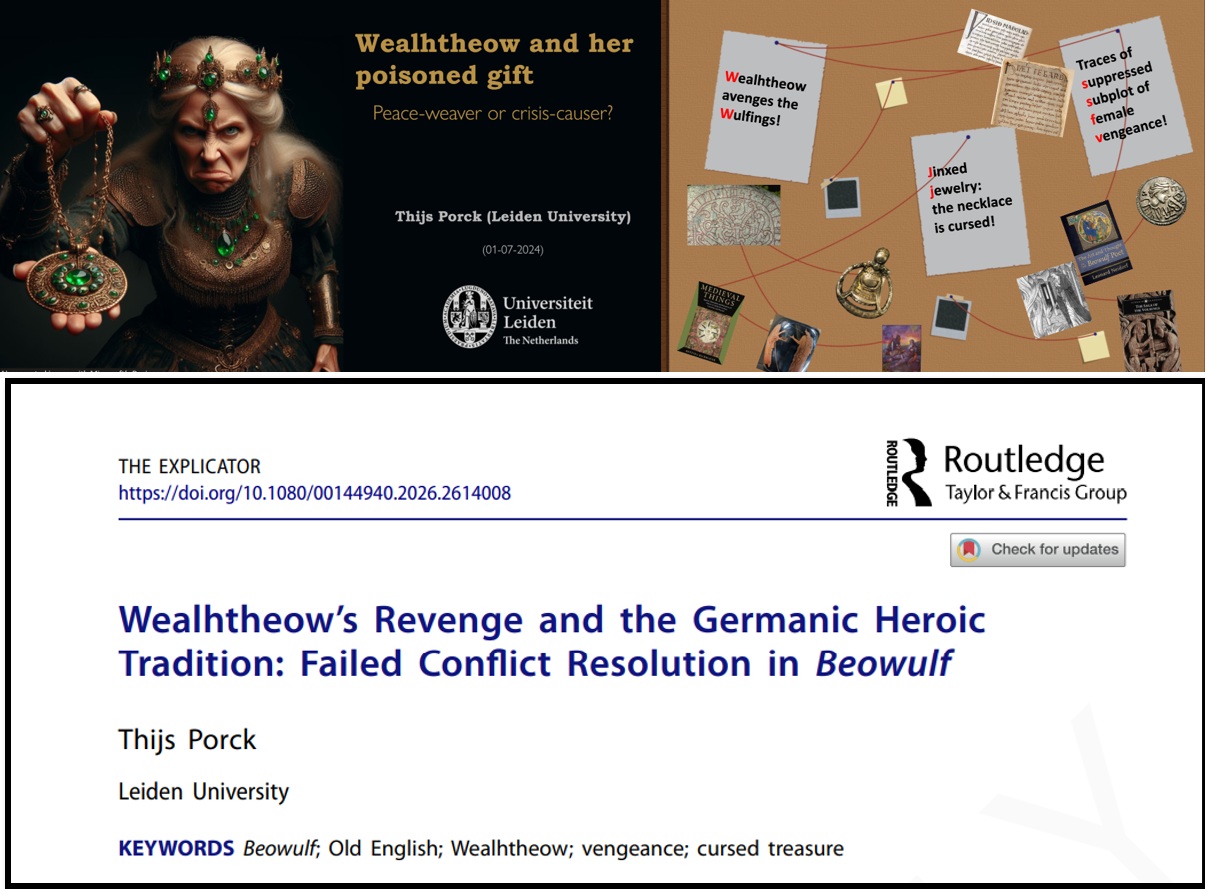
What if Wealhtheow, the gracious queen in Beowulf, wasn’t just handing out mead cups to guests and giving politically savy speeches? What if she was harbouring vengeful feelings and set in motion a secret murder plot? In a recently published article, I have tried to unveil something of a Beowulf ‘conspiracy theory’. You can read the article here in Open Access:
The Lord of the Rings: The War of the Rohirrim (2024) is an anime film that tells the story of Helm Hammerhand, King of Rohan, and his daughter Héra. The movie is based on the Appendices of J. R. R. Tolkien’s The Lord of the Rings and contains many references to Old English, especially in the film’s sound track. This blog post discusses the film’s Neo-Old English lyrics!
Gone with the wind: Where is “The Rider”?
“Where is the horse? Where is the rider?”, the opening lyrics of “Hama’s Song” in The War of the Rohirrim (2024) will remind many a Tolkien fan of “The Lament of the Rohirrim” which Aragorn recites in the chapter “The King of the Golden Hall” in The Lord of the Rings: The Two Towers. In Aragorn’s poem, the opening lines run as follows: “Where now the horse and the rider? Where is the horn that was blowing?”. Tolkien, a Professor of Anglo-Saxon (Old English) at the Universities of Leeds and Oxford, based Aragorn’s poem on the Old English elegy The Wanderer, which uses the so-called ubi sunt motif (‘where are they now?’) to express the fleeting nature of worldly pleasures (the answer to the rhetorical questions being “they are no more”). As it turns out, “Hama’s Song” of the new movie is closer to the Old English original poem, which has the line: “hwær cwom mearg, hwær cwom mago” [Where is the horse? Where is the man?].
Ubi sunt (or ‘hwær cwom’) lines in The Wanderer. Exeter Book, fol. 77v
The context of “Hama’s Song” makes clear that “the rider” referred to is the movie’s heroine Héra, who is also the subject of the movie’s credits song by Paris Paloma called “The Rider”. If you listen carefully to this song, you will notice that there is a very clear Old English lyric at 0:41 (and again at 2:01 and 3:01): “Heo is se wind, heo is se wind” [she is the wind, she is the wind]:
More Old English lyrics! A speculative transcription of “The Lament for Helm”
A single line in an (otherwise pretty epic) song is nice and all, but it would have been even better if the full song were in Old English, of course! In that regard, the best song of the film may be “The Lament for Helm”, sung by Lorraine Ashbourne (who also voices the character Olwyn). This entire song is in Neo-Old English verse and it is pretty amazing:
At the moment of writing this blog post (16 December, 2024), the lyrics to this song have not been made available. So, the following transcription is mostly speculative (and I am indebted to Leiden University colleagues Rachel Fletcher, Suzanne Klare and Amos van Baalen for their invaluable input):
… Beadu-cwealm* hafað fægne frean forð onsended giedd sculon singan gleomenn* sorgiende on ealdum eodorum* þæt he eorla wære his leode leofost ond land-frymena hiehst*. Beadu-cwealm*…
[… Battle-death has sent forth the fated lord sorrowing minstrels must sing a song in old enclosures, that he was of warriors the dearest to his people and the highest of land-lords. Battle-death…]
The words marked with an asterisk * have been slightly emended from what we can hear in the song for linguistic accuracy:
*Beadu-cwealm ‘Battle-death’ – we can clearly hear ‘Beado-cwealm’, but the dictionary form of this word is beadu-cwealm – the word occurs only once in the existing Old English corpus, in the Old English poem Andreas. The pronunciation with the “o” is probably influenced by The Lament for Théodred (for which, see below).
*gleomenn‘minstrel’ – we can clearly hear “gleomann” [minstrel], but the plural verb “sculon” suggests that we need the plural “gleomenn” [minstrels].
*eodorum ‘(in) enclosures’. This sounds like “edoran” in the song, but “edoran” cannot be the right form: we need an “-um” to match the dative plural “ealdum”+ Old English eodor ‘wall, enclosure’ is a strong noun and “-an” is a weak nominal ending. “Edorum” rather than “eodorum” is possible (the Old English poem Genesis A, for instance, has “edoras” for expected eodoras, which matches the spelling of Edoras, the capital of Rohan, based on the same Old English word!).
*hiehst ‘highest’. We can hear “heahst”, but superlatives are usually affected by i-mutation, so heah > hiehst. That said, heahst is occassionally attested, e.g. in the Old English gloss of the Liber Scintillarum.
What is impressive about this Neo-Old English song is that its author has managed to abide by the rules of alliterative Old English verse, which connects half lines through alliteration on stressed syllables: fæg… frean forþ … | giedd … gleo (and in the same line “sing … sorg“) | eald … eo … eor… | leo…leo…land.
The inclusion of a Neo-Old English song in The War of the Rohirrim does not come out of the blue: Tolkien himself was known to compose his own Old English poetry and, in doing so, also inspired an eerily similar Neo-Old English song that was included in the extended edition of Peter Jackson’s The Lord of the Rings: The Two Towers (2002): Éowyn’s Lament for Théodred (written by Philippa Boyens and translated into Old English by David Salo).
The Lament for Helm vs. Éowyn’s Lament for Théodred: A comparison
While Éowyn’s song (LfT) appears to have a lot in common with The Lament for Helm (LfH), attentive listeners can spot a number of differences, which are listed below, line per line:
LfH: Beadu-cwealm hafað | LfT: Bealo-cwealm hafað
Éowyn uses the word Bealo-cwealm ‘evil death’ rather than Beadu-cwealm ‘Battle-death’. The word comes from the Old English poem Beowulf, ll. 2265b-2266:
London, British Library, Cotton Vitellius A.xv, fol. 183r
Bealo-cwealm hafað | fela feorhcynna forð onsended [Evil death has sent forth many of the living].
Clearly, the half line “forð onsended” (sent forth), found in both lamentations, is also based on Beowulf, but both songs provide a different first half line. For Théodred, Éowyn uses “freone frecan” [the noble warrior] – this phrase was not an option for The Lament for Helm, given the fact that the movie also features an unlikable character called Freca (named after the Old English word for ‘warrior’, of course!). The phrase “fægne frean” means something along the lines of “lord doomed/fated to die”, which is very apt for the character of Helm.
LfH + LfT: giedd sculon singan gleomenn sorgiende
Both laments have the same line here, with double alliteration on g and s.
LfH: on ealdum eodorum þæt he eorla wære | LfT: on Meduselde þæt he manna wære
In Éowyn’s song, the minstrels are singing in Meduseld (the hall of the kings of Rohan; medu-seld is an Old English word meaning ‘mead-hall’) and so she alliterates on the m with “manna” [of men]. When The Lament for Helm is sung, they are (crucially) not in Meduseld, but in the Hornburg (later: Helm’s Deep), a somewhat dilapidated place, so “ealdum eodorum” [old enclosures] seems suitable and triggers an alliteration with “eorla” [of warriors].
LfH: his leode leofost ond land-frymena hiehst | LfT: his dryhtne dierest and maga deorost
Here we see a clear distinction between Helm Hammerhand, a king, and Théodred, a prince. The former is “dearest to his people and highest of the land-lords”, while Théodred is “dearest to his lord [i.e. his father Théoden] and bravest of kinsmen”. The alliteration in The Lament for Helm sticks closer to the ‘rules’ than Éowyn’s Lament for Théodred here, since the last stressed syllable of a line rarely participates in the structural alliteration in Old English verse (but in LfT “deorost” alliterates with “dryhtne” and “dierest”).
All in all, then, while the laments are certainly similar (and the one must be based on the other!), there are also clear differences, prompted by the differing contexts in which they are sung. A medievalist would call this mouvance, a concept Tolkien also played around with in his fiction, but that is a story for another blog post. For now, I hope you have enjoyed this little foray into the world of Neo-Old English – if you want to learn more about the topic, there is a whole book about it: Old English Medievalism: Reception and Recreation in the 20th and 21st Centuries!
If you liked this post, you may also be interested in:
This blog post introduces four new knowledge clips about an interesting topic: cultural contacts between ‘the East’ and ‘the West’ in the Early Middle Ages!
How much contact was there between early medieval England and the Middle East?
Fatima al Moufridji (one of my students at Leiden University, now doing her MA Viking and Early Medieval English Studies in Nottingham) was wondering about this very question, when she was introduced to a special coin from 8th-century England. The coin bears the name of the Anglo-Saxon king Offa of Mercia (757-796) but also has an inscription in Arabic; how did that happen and what other traces of cultural contact between England and Arabic speaking regions might be found? To find answers to these questions, Fatima and I applied for some funding from Leiden University’s Justice, Equity, Diversity and Inclusion (JEDI) fund. Our application was granted and we set out to make four short educational videos with the help of Leiden University’s Thomas Vorisek to spread awareness of the fact that early medieval England was not as isolated as one might think.
The links to the four videos are available at the bottom of this blog post, but just to peak your interest and give you a taste of the kind of texts, objects and individuals you might find in these videos, we each share our ‘top fives’ below!
Fatima al Moufridji’s top five
The Wonders of the East: “In our third video, we describe the Old English texts in the Beowulf manuscript that are not Beowulf – intriguingly, all these texts deal with the areas we now refer to as Northern Africa and the Middle East. My favourite one is ‘The Wonders of the East’, an Old English text that describes a wide variety of weird beings and monsters that live out in ‘the East’, ranging from headless monsters to exploding chickens! Being a Pokémon fan helps put this in the 1st spot, since it is basically an early medieval Pokedex.”
Theodore & Hadrian: “Our iconic duo! I think not crediting these two easterners for all they started in early Medieval England would be a crime: hailing from Northern Africa and the Middle East, Theodore and Hadrian established a famous school in England near the end of the seventh century, as we discuss in our fourth video. And what is interesting is that at Leiden University, we actually have an early medieval manuscript that can be linked to their educational efforts!”
Anglo-Saxon dreambook: “Did Anglo-Saxons really dream about exotic animals like camels and lions? And what did they think these dreams meant? It was interesting to see what kind of predictions people came up with when it comes to their dreams, one of the things that fascinated me the most about this aspect. And guess where they got their information from?”
Hygeburg (fl. 760-780): “A nun, responsible for writing down the travel stories of the Anglo-Saxon pilgrim Willibald who travelled through the Holy Land. Even though she did not write down her own experiences, she did give us a great piece of evidence for our second video, on people travelling long distances. I personally do suspect that she may have had a little crush on Willibald, whom she showers in praise!”
Bede’s Ecclesiastical history of the English people: “Our videos are full of tongue-twisters, with quotations in Old English, Latin and Arabic, but somehow the word I struggled most with was “ecclesiastical”, part of the title of one of our favourite and most important sources: Bede’s Ecclesiastical History of the English People – loved pronouncing that!”
Thijs Porck’s top five
Offa coin: “The Offa coin with its Arabic inscription is such an interesting object and really epitomizes the idea behind our videos: there was contact between these distant regions! It was really cool to listen to Fatima read out the inscription and see her pointing out some of the errors that the Anglo-Saxon die-cutter made in our first video.”
Leofwine silk: “I have a particular fascination for the Anglo-Saxon missionaries that brought Christianity to the Low Countries, people like Willibrord, Boniface and Leofwine (Lebuinus). So, I was pleasantly surprised that we could include some of these inspiring people in our videos: as it turns out, Boniface had a thing for exotic gifts and the bones of Leofwine were preserved in an piece of fabric that would have come in via the famous Silk Road. The Leofwine silk also allowed us to make one (of several) silly jokes.”
The Leiden Glossary: “Leiden University has the biggest collection of medieval manuscripts in the Netherlands and we also have a number of Old English manuscripts. Being able to showcase one of these with a link to the famous school of Theodore and Hadrian was a particular delight in making our fourth video!”
Willibald: “Willibald travelled all the way to the Holy Land and thanks to Hygeburg we know quite a lot about his experiences. One of the challenges of making our second video about this super-interesting text was the lack of illustrations, so I had a go at drawing scenes from his journeys myself!”
Cynocephali: “Dog-headed people! What a strange and awkward idea, but, apparently, pretty common in Anglo-Saxon imaginations of the East. We were surprised (and Fatima slightly annoyed) at how often these beings seemed to recur in the Beowulf manuscript!”
Want to find out more about all these interesting objects, texts and individuals? Watch our videos below or via this playlist on YouTube!
Video 1: Traces of trade between early medieval England and the Middle East: Coins, cloth and condiments
What are all these Arabic coins doing in early medieval England? What did Anglo-Saxons use exotic silks for and where did they get their spices? Join us as we explore some traces of trade between the East and the West in the early Middle Ages!
Video 2: Early medieval encounters: Travelling Arabs and Anglo-Saxons
Did you know that people travelled long distances in the Early Middle Ages? Learn more about a tenth-century Arabic description of Britain, the travels of St. Willibald through the Middle East and some pro-tips on using a calabash!
Video 3: Old English imaginations of the East: The other texts in the Beowulf manuscript
Beowulf is awesome! But the other Old English texts in the Beowulf manuscript are interesting as well – not in the least because they give us an idea of how Anglo-Saxons imagined areas including Northern Africa and the Middle East.
Video 4: Anglo-Saxon learning and intellectual import from the Middle East and Northern Africa
Learn more about the inspiring story of Theodore and Hadrian, two scholars from Northern Africa and the Middle East, who made their way to early medieval England! We also discuss the origins of some Anglo-Saxon medical texts (what’s up with all the snakes!?) and the engimatic prognostic texts!
One of the most important liturgical books in early medieval England was the Psalter. Some thirty Anglo-Saxon manuscripts containing the complete Psalter have survived, including no fewer than fifteen with (partial or complete) Old English interlinear glosses (that is: a word-for-word English translation between the Latin lines). While multiple manuscripts of the same well-known text may seem like a rather dull topic, the Old English glossed Psalters are fascinatingly different, as this blog post will demonstrate.
Different versions of the same Psalm verse (101:28)
To illustrate some of the diversity among the Old English glossed Psalters, here is the same Psalm verse (101:28 “Tu autem ipse es et anni tui non deficient”; You are truly the same and your years will not fail) in four different manuscripts with Old English glosses.
Psalm 101:28 in four different glossed Psalters. N.B. It is common practice to refer to these Old English glossed Psalters with their names, like ‘Vespasian Psalter’ or sigla (letter codes) A-P rather than the full manuscript shelf marks (a full list is provided at the bottom of this blog post.
One clear difference between these Old English glossed Psalters is the scripts that the scribes used. The eighth-century Vespasian Psalter, for instance, uses an uncial script for the Latin text and is accompanied by a later, ninth-century Old English gloss in a much smaller minuscule script. In the Winchcombe Psalter (1025-1050), the same scribe was responsible for both the Latin and the Old English text, using a round insular minuscule for the Old English and a Caroline minuscule for the Latin, as well as alternating coloured inks (red for Old English; black for Latin). A similar combination of Caroline and insular scripts, though without the alternating colours, was used by the scribe of the mid-tenth-century Royal Psalter. The early-eleventh-century scribe of the Lambeth Psalter added a third layer of glosses, the dots underneath.
There are more differences if we turn to what the letters actually spell out. They each give the same Latin text (“tu autem idem ipse es et anni tui non deficient”), although there are some differences in abbreviations (e.g., the Vespasian Psalter and Winchcombe Psalter spell out “autem” in full; but the Royal Psalter and the Lambeth Psalter give “aut” with an abreviation mark; the latter also provides the ampersand “&” while the others give “et”). The Old English translations show more profound differences:
Vespasian Psalter: ðu soðlice se ilca earð 7 ger ðin ne aspringað Winchcombe Psalter: þu soðlice se ylca iert 7 ger þine ne ateoriað Royal Psalter: se ilca selfa eart 7 gear þine na geteoriað Lambeth Psalter: þu soðlice se ilca sylf eart 7 gæres ðine ne ateoriað
These four Old English translations of the same Latin line clearly differ in spelling (ger, gear, gæres) and word choice (aspringað, ateoriað, geteoriað) – these differences are linguistically significant as we will explore further below.
Old English language through timeand place
One variation factor among the Old English glossed Psalters is that they were written at different times and places, which means we can see diachronic and dialectal differences between them. A clear example is found in the Old English glosses for Latin “anni” [years] in Ps. 101:28 above: the Vespasian and Winchcombe Psalters give the form “ger”, the Royal Psalter gives “gear”, while the Lambeth Psalter gives “gæres”. The difference between the Vespasian and Winchcombe Psalter on the one hand and the Royal Psalter on the other is one of dialect: the Royal Psalter’s “gear” shows ‘palatal diphthongization’ (a singular vowel sound changes into a combination of two vowels, when preceded by a /j/-sound), which is a feature of the West Saxon dialect of Old English, while the Vespasian and Winchcombe Psalters give the Mercian dialect form without diphthongization: “ger”.
The Lambeth Psalter’s form “gæres” is actually grammatically incorrect and this form reveals that this gloss is later than the other ones. The -es ending here indicates that the word is plural, but this plural form is ‘not according to Old English grammar rules’. Here is a complex explanation: in ‘proper Old English’, the word “gear/ger” is a strong neuter noun with a long stem, which does not get an ending to mark the plural (just like modern English sheep: one sheep, two sheep; NOT two sheep-s). By the end of the Old English period, when the Lambeth Psalter was made, the grammatical system of Old English was starting to change and eventually the -s plural (originally reserved for strong masculine nouns) came to be used for all nouns with few exceptions (e.g., Modern English sheep~sheep, ox~oxen), because of a process called ‘analogy’ (frequently used forms become the norm). Long story short, the Lambeth Psalter’s “gæres” is a late form anticipating Modern English year-s, while the “ger/gear” form represents earlier Old English (this also explains why the Lambeth Psalter gives the vowel “æ”, which is a later development from West Saxon “ea”).
Other linguistic differences stem from word choice, which may be influenced by dialect or time of composition, but could also be due to the glossator’s personal preference. In Ps. 101:28, for instance, the glossator of the Vespasian Psalter decided to translate Latin “deficient” with a form of apsringan ‘to fall, cease, fall away’, while the other Psalters have a form of ateorian/geteorian ‘to fail, come to an end’. Either synonym works fine as a translation of the Latin. There are also cases where glossators gave multiple synonyms for one Latin word, such as the following example from the Arundel Psalter, which may come in handy if all this linguistic stuff has made you a little drowsy:
A triple gloss for the Latin word “dormitationem” (Ps. 131:4) in the Arundel Psalter. The three glosses are separated with the abbreviation mark “ł”which stands for Latin “uel” [or].
Rather than giving just one translation for the Latin word “dormitationem”, the glossator provides three alternatives: “hnappunge”, “slæp” and “reste” – nap, sleep or rest. This glossator certainly was not asleep on the job!
To gloss or not to gloss: Glossing techniques
Another fundamental difference between the Old English glossed Psalters lies in their differing glossing techniques. For instance, there are Psalters in which every individual Latin word is glossed, as in the Vespasian Psalter, Winchcombe Psalter and Lambeth Psalter, while other Psalters tend not to gloss personal and place names or common words. In the gloss for Ps. 101:28 in the Royal Psalter, the words “tu” and “autem” are not glossed as the glossator apparently assumed the reader would have been familiar with these basic words.
Another issue that is dealt with in different ways in various Old English glossed Psalters is the Latin syntax. The typical word order of Latin differs from that of Old English – for example, in Latin, the possesive pronouns often follow the nouns they modify, whereas in Old English they would typically precede the nouns: Latin “anni tui” (lit. ‘years your’) would be “þine gear” in Old English, ‘your years’. In most Old English glossed Psalters, the Old English glosses follow the Latin word order and, therefore, result in unnatural Old English phrases, such as “gear þine” in the Royal Psalter. However, the scribe of the Lambeth Psalter found a solution to this problem: he added so-called ‘dot glosses’ underneath the Latin words that indicated the Old English word order (I explain this system here: Reading between the lines in early medieval England: Old English interlinear glosses).
Other Old English glossators simply rearranged the word order of the glosses, like the one responsible for this Old English gloss of Ps. 121:2 (‘Our feet were standing in your courtyards, Jerusalem’) in the Junius Psalter:
Psalm 121:2 in the Junius Psalter
Here the Old English glosses for the Latin phrases ‘pedes nostri’ and ‘atriis tuis’ have been ‘normalised’ to ‘ure fet’ and ‘þinum cafertunum’. You can also see that this glossator did not think it was useful to gloss the name Jerusalem.
Beatus-ful illuminations!
But it is not just linguistics that makes the Old English glossed Psalter fascinating things to look at: some of them are beautifully decorated! The opening lines of Psalms 1, 51 and 101, in particular, got additional artistic attention as they marked the beginning of three sections of fifty Psalms. Have a look at the opening of Psalm 1, which starts with ‘Beatus uir’ [‘Blessed man’], in three of the Old English glossed Psalters, below:
Beatus pages in three Old English Glossed Psalters.
These so-called ‘Beatus pages’ give the Psalters a stunning opening and the page often comes with the creative use of different coloured inks. Note how the Bosworth Psalter alternates between blue and red lines, while the Arundel Psalter has letters in red, blue and green. The decorated border of the Tiberius Psalter is so thick that there is little room for text in the middle; the Arundel Psalter, meanwhile, has a thinner border but a bigger capital B; a so-called ‘historiated initial’, depicting King David (who was assumed the be the author of many Psalms):
King David in the historiated initial of the Arundel Psalter
While King David plays the harp in the historiated initial of the Arundel Psalter, to the right of the initial we find the Latin words ‘Beatus uir’, accompanied by the Old English gloss ‘eadi wer’ [blessed man].
Mis-en-page to avoid mess-on-page
Arranging a manuscript page for lines of Latin text that left enough room for the accompanying layer of Old English glosses required careful planning. Here are two examples of planned-out ‘mis-en-page’ (the way text appears on the page), as well as one example of a page on which there was not enough space for the huge amount of glossing (in this case explanatory glosses that were added later) :
Varying text and gloss arrangements in three Old English glossed Psalters.
The third example clearly has a more messy appearance, since the planned space for glossing was smaller than it needed to be.
While correctly planning out a singular Latin text and one layer of Old English gloss was no mean feat, Eadwine, a twelfth-century monk from Canterbury, took on an even bigger challenge: the so-callled ‘Eadwine Psalter’ for which he was responsible is home to three different Latin versions of the Psalter, each accompanied with a different gloss, -and- a series of Psalter illustrations:
The Opening of Psalm 23 in the Eadwine Psalter
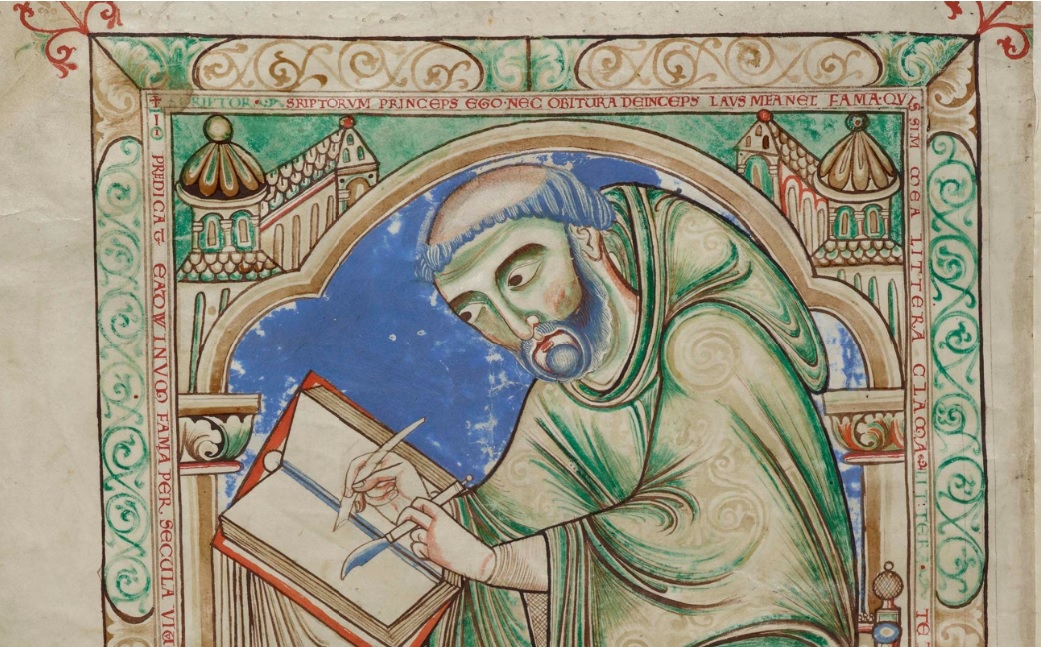
The broadly spaced Latin text on the outer edges of the left- and right-hand page is the Gallican version of the Psalter (marked “Gall.” on the bottom of the left page and on the top of the right page), with explanatory glosses in Latin between the lines and in bother margins. The second more narrow narrow column (marked “Rom.”) is the Romanum version of the Latin Psalter, with Old English interlinear glosses, while the column closest to the middle of the book (rightmost on the left page; leftmost on the right page) gives the Hebraicum version of the Latin Psalter, with Anglo-Norman interlinear glosses. Psalter-ception! Making sure that each page gave corresponding passages in the three Latin versions of the Psalter as well as making enough room for the glossing required Eadwine to carefully adjust the sizes of scripts, spacing and distribution of the text on the page. Managing all this, Eadwine certainly deserves the epithet of ‘s[c]riptorum princeps’ [master of scribes] with which he was described in the text surrounding his famous ‘author-portrait’ at the end of the Psalter that bears his name.
Portrait of Eadwine, part of the text surrounding this portrait reads: “SRIPTORUM PRINCEPS EGO NEC OBITURA DEINCEPS LAVS MEA NEC FAMA” [I am the chief of scribes.; neither my praise nor my fame will die one after the other]. Ironically, there is a scribal error in the word “sriptorum”, which should read “scriptorum”. Eadwine Psalter (E), fol. 283v.
The language, glossing technique, illuminations and mis-en-page are but some of the fascinating aspects of the Old English glossed Psalters (others include annotations by later users, scribes making mistakes, curious initials and so on); in future blog updates, I hope to devote posts to individual Old English Psalters to create a fifteen-part series, starting with the Vespasian Psalter (A). Stay tuned!
If you want to be alerted to subsequent blog posts, make sure to subscribe to this blog, using the box below. If you can’t wait for a next blog post to appear, check out the following related blog posts:
Stowe Psalter (F): London, British Library, Stowe 2
Vitellius Psalter (G): London, British Library, Cotton Vitellius E.xviii
Tiberius Psalter (H): London, British Library, Cotton Tiberius C.vi
Lambeth Psalter (I): London, Lambeth Palace, MS 427
Arundel Psalter (J): London, British Library, Arundel 60
Salisbury Psalter (K): Salisbury, Cathedral Library, MS 150
Bosworth Psalter (L): London, British Library, Additional 37517
Blickling Psalter (M): New York, Pierpont Morgan Library, M. 776
Fragments of Old English glossed Psalter (N): Cambridge, Pembroke College, 312, C, 1-2; Haarlem, Noord-Hollands Archief, 188 F 53; Sondershausen, Schlossmuseum, Lat. liturg. IX 1
Paris, Biblitohèque Nationale, Lat. 8846 (O)
Paris Psalter (P): Paris, Bibliothèque Nationale, Lat. 8824 (not a glossed Psalter; but a Psalter with facing Old English translation, see this blog post)
Relevant literature on the Old English glossed Psalters
Philip Pulsiano, ‘Psalters’, in The Liturgical Books of Anglo-Saxon England, ed. R. W. Pfaff (Kalamazoo, 1995), 61-86.
This blog post introduces a new online tool to explore the vocabulary of the Old English poem Beowulf. The tool is freely available and can offer unique new insights into the vocabulary of early medieval England’s best-known epic.
When a poet unlocks his word-hoard: The vocabulary of Beowulf
“word hord onleace” [unlocked the word hoard] in the Beowulf manuscript.
When Beowulf arrives in Denmark, he introduces himself and his men to a coast guard. The poet describes this action with the words “word hord onleac” [he unlocked his word hoard], creating the stunning image of an individual’s vocabulary as a treasure chest that can be unlocked. Over the years, many scholars have tried to access the Beowulf-poet’s own ‘word-hoard’ (consisting of over 3000 words) in order to open it up for analysis. Arthur Brodeur, in his classic study The Art of Beowulf (Berkeley, 1959), for instance praised the poet’s diction as “more vigorous, stately, and beautiful than that of any other Old English poem” (p. 38). In particular, scholars have praised the poet’s use of compound words, noting that a substantial number of these (over 600) are not found in any other Old English text (they are so-called hapax legomona).These hapaxes include morþor-bed ‘murder-bed’, sadol-beorht ‘made bright by a saddle’, fore-snotor ‘very intelligent’ and, my personal favourite, hleor-bolster ‘pillow; lit. cheek-bed’. A conventional approach to the vocabulary of Beowulf is to focus on words that belong to one given semantic field, e.g., ‘monster’, ‘sea’, ‘hall’ or ‘warrior’, and discuss how the poet’s treatment of the words denoting that concept differs from other texts in the Old English corpus. Such traditional analyses are highly insightful but they all rely on intensive, manual labour; essentially, one needs to leaf through a paper glossary of the text and mark words by hand. However, there is now a digital solution!
Introducing the Beowulf Thesaurus!
Do you want to know how many and which words the Beowulf poet used for such concepts as the colour black, affection, anger and a bench? The brand-new digital Beowulf Thesaurus can easily help you answer these questions: 3 words denoting black/blackness (blæc, sweart and wann), 5 words with the sense ‘love, affection, care’ (frēod, lufu, mōdlufu, myne and heahlufu), 3 words for ‘anger, wrath, fury’ (ierre, torn and wielm) and another 5 words that mean ‘bench, seat’ (benc, bencþel, sess, setl, ealubenc and medubenc)! These may seem like basic questions and answers, but they can be the starting point for interesting analyses of the poem: which emotion is best represented in the poem’s diction? How about animals, colours and actions? You can find it out for yourselves because the Beowulf Thesaurus is freely available online.
So, how does the Beowulf Thesaurus actually work?
You can go to its landing page http://evoke.ullet.net/content/beowulf/ , skip some of the technical description and scroll down to ‘ACCESS’ and click on ‘Explore in Evoke (alongside a Thesaurus of Old English)’. Evoke is a web application developed by Sander Stolk that allows you to browse (and analyse and annotate) thesaurus contents (see his non-technical explanation here; if you want more technical information see this Open Access article). You can use the search box in the top-right corner or browse the thesaurus by clicking on the ‘semantic tree’ with yellow blobs. To find words denoting the concept of ‘affection’, you type ‘affection’ in the search box and click on ‘Love, affection, care’ or you can click your way through the semantic tree via ‘Feelings’ > ‘Heart, spirit, mood, disposition’ > ‘Disposition towards others’ to “Love, affection, care”. Once you’ve done that, you will be given an overview of all Old English words denoting that particular concept along with usage information (e.g., whether that word is mostly used in poetry) – all of this data is taken from Glasgow’s Thesaurus of Old English. If you are using tie Beowulf Thesaurus in Evoke, you can also see which words occur in Beowulf, see the screenshot below:
A screenshot from the Beowulf Thesaurus, showing all words that can denote the concept ‘Love, affection, care’ in Old English – the ones that occur in the poem Beowulf have the tag ‘Beowulf’ on the right.
This overview tells you what words were available to denote the concept ‘Love, affection, care’; it tells you which words are considered ‘rare’ (e.g., mæglufu, lufræden and mægensibb), which words are restricted to poetry or glosses and, crucially, which words are found in Beowulf! And you can do the same for any concept imaginable, ranging from weapons to water, from horses to humility, and from actions to armpits (though the two Old English words for ‘armpit’, ōcusta and ōxn, are only found in glosses and not in Beowulf). Go out and explore the Beowulf Thesaurus yourself! http://evoke.ullet.net/content/beowulf/
Do more than just explore: Evoke as a research tool
Exploring the vocabulary of Beowulf by looking up words for concepts is only one way of using the application Evoke to learn more about Old English vocabulary. Within the same application, we have also made available digital thesauri of the Old English poem Andreasand the Old English Martyrology and using Evoke’s statistical tools one can also compare the words in these different texts and bring to the surface new and unnoticed patterns of vocabulary use. I wrote an article about this kind of research which is freely available – you can read it by clicking on the image below (but be warned: there will be graphs, tables and numbers!):
Click on the image to get access to Thijs Porck, “Onomasiological Profiles of Old English Texts: Analysing the Vocabulary of Beowulf, Andreas and the Old English Martyrology through Linguistic Linked Data“, in Exploring Early Medieval English Eloquence: A Digital Humanities Approach with A Thesaurus of Old English and Evoke, ed. Thijs Porck and Sander Stolk, special issue of Amsterdamer Beiträge zur älteren Germanistik 81: 3-4 (2021), 359–383.
This kind of statistical analysis may not be for everyone, but I do hope you will give browsing the digital Beowulf Thesaurus a try! We also hope to make available a series of online lessons to help you explore the vocabulary of Old English (as well as individual Old English texts) via the web application Evoke – so watch this space and, for now, enjoy unlocking the word-hoard and exploring the epic!
As of today, my YouTube channel has reached over 100,000 views. The material posted thus far (currently only 7 videos) mostly aim at making Old English grammar digestible. This blog post provides some behind-the-scenes information on the rationale and process behind the videos and also announces a new video, posted last week.
Why Old English grammar bytes?
While some students acquire the basics of Old English grammar after one round of explanation, others need to be reminded of the basics over and over again. This varying pace of acquisition cannot always be catered to in a traditional classroom setting. If I were to repeat the basic grammatical information too often, valuable in-class time is lost and the students who got it the first time may lose interest, creating a potentially hostile atmosphere for students who need the extra explanation.
So, what I really wanted to do was find a way for students to learn Old English grammar at their own pace and avoid having to repeat the same basic information over and over again. An added advantage of that would be that I would have more time in class to deal with specifics of literature or the weekly translations and so on. The idea for Old English Grammar Bytes was born: grammar videos that can be watched whenever, at one’s own pace, as often as one might want.
How were they made?
The videos were created using a green screen and fairly simple animations. I was very lucky to have the support of Leiden University’s Expertise Centre for Online Learning, which has a devoted support team for ‘knowledge clips’ (esp. Thomas J. Vorisek, who has done wonders with the camerawork and editing). For each clip, I made a storyboard with, on the left, an impression of what I wanted the image on the screen to look like and, on the right, the text I wanted to say. As you can see below, Peter Baker’s magic sheet of Old English was used as a point of departure for each of the videos, since his Introduction to Old English (3rd ed., 2010) was used for our first-year Old English course (attended by c. 100 students each year).
From storyboard (above) to YouTube clip (below)
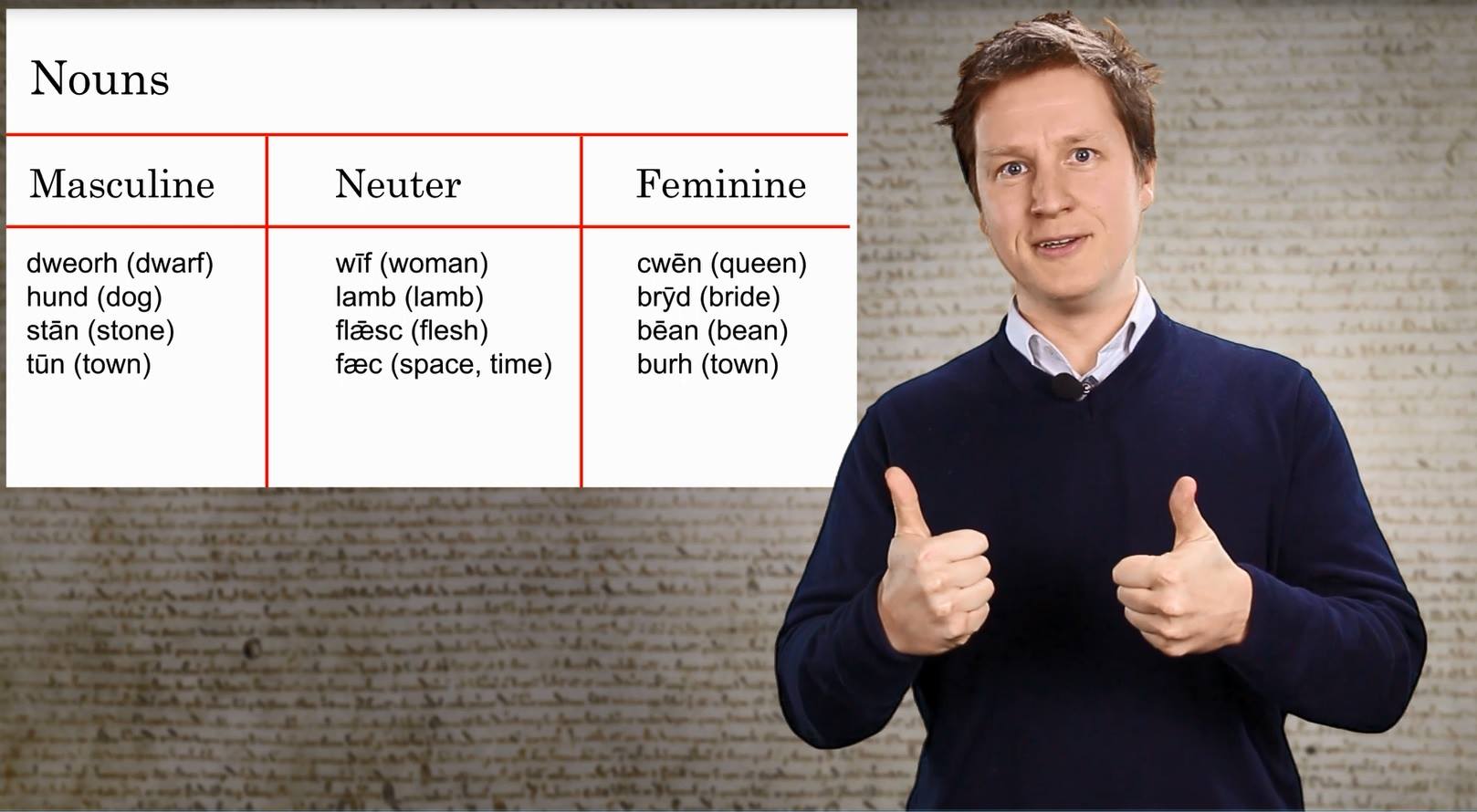
I quickly found that one of the advantages of using videos to explain grammar is that it allows for a better and more dynamic visualization of information than a traditional class room setting. For instance, we could zoom in on particular parts of the ‘Magic Sheet’ and indicate specific forms within paradigms. In addition, the ‘dry’ grammatical information could be presented in a light and attractive way by using visual material, including my own drawings (this video features my drawings of a dwarf throwing rocks at a dog to explain grammtical functions) and Old English memes (e.g., “swiga ond nim min mynet” perfectly illustrates the imperative mood and is a play on the popular ‘shut up and take my money’ meme – this meme was in vogue at the time of making the video – it is now a classic). Moreover, special effects, such as a booming voice shouting “Repeat after me: Whether adjectives are strong or weak is independent from the nouns they modify!”, help to hammer the message home – enjoy that here – the effect did not prove useful to everyone, given one of the YouTube comments “Please remove the deep voice at 2:49, I was showing this video to my young grandson and he ran out of the room in tears” – apologies! This combination of words, pictures, animation and narration allows students to learn better than from words alone.
From storyboard (above) to YouTube clip (below)
So, in making the videos, I carefully thought about the visuals and special effects, but, being a non-native speaker of English, I also had to carefully consider my words: long strings of text with many complex words are likely to trip me up, so I had to adapt my language somewhat. Also, you will notice that I do not appear too often in the videos, except mostly for the introductions, transitions and conclusions; there is a good reason for this: it is much easier to string together various pieces of audio, than it is to smoothly transition from one video of a person speaking to another in order to get rid of garbled speech.
Finally, a new video!
The Old English Grammar Bytes were written and filmed in the Spring of 2016 and were posted on YouTube in 2017. I had and have plans to make many more videos, but simply have not found the time yet. However, I did get a chance to particpate in making an ‘Online Experience’ for prospective students of the BA-programme English Language and Literature at Leiden University a couple of months ago (you can read about this initiative here, in Dutch). This meant that I was able to make three additional videos (one on Old English; one on the differences between Old and Middle English; and one on early medieval English place names) and I was allowed to share one of these on my own YouTube channel. I will embed this video, which is a basic and brief introduction to Old English as not being Shakespeare’s English, below:
New video
As you can see, we had some fun with new animations and special effects. Also: there was an autocue and that helped tremendously!
Hopefully, I will be able to make the other two Online Experience videos available as well, at some point, and/or find some time to make more grammar videos. I may even decide to make some vlogs out of my most popular blogs, but this too will take time. So until then, watch this space!
Every now and then, I will devote a post on this blog to an academic publication (usually ones that are available in Open Access), so as to give you an idea of what I am working on. This post turns the spotlight on an edited volume, edited by myself, that appeared as a special issue of the peer-reviewed journal Amsterdammer Beiträge zur älteren Germanistik . The entire volume has now become available in Open Access and this blog post will guide you through its contents.
Cover of The Familiar and the Foreign in Old Germanic Studies
As the subtitle of this special issue suggest, this volume commemorates the thirtieth anniversary of the Dutch-Flemish Society of Old Germanicists, a society for scholars of the language, history and culture of Old Germanic peoples in the Middle Ages. The collection brings together contributions by both veteran and early career members of the society and centres on the theme of the encounter between the familiar and the foreign, as I explain in the volume’s introduction (available here). This theme is intentionally vague and the contributions represent the broad scope of Old Germanic studies, ranging from philology to historical linguistics, through to history, text editions and manuscript studies, and spanning the geographical area from Iceland to the Mediterranean. The topics covered include cultural contact, literary representations of the ‘Other’, loan words, contact-induced sound changes, distinctive linguonyms and obscure riddles. A brief summary of all the articles follows below; you can click on every header to open the Open Access articles in a new tab.
The first article of the volume focuses on the influence of the story of the Anglo-Saxon singer Caedmon, found in Bede’s Historia Ecclesiastica, on two texts about religious poets on the continent: the Bernlef episodes in the Lives of Liudger and the Latin prefaces to the Old Saxon poem the Heliand. In this article, Veenbaas makes a revolutionary claim: he suggests that Bernlef might well be the poet of the Heliand.
In this article, we explore the displaying of body parts (notably the arm of Grendel and the head of the Danish advisor Æschere) in the Old English poem Beowulf. We argue that the display of Æschere’s head on top of the cliff towering over Grendel’s mere resembles the Anglo-Saxon heafod stoccan, ‘head stakes’, which acted as boundary markers (see Heads on sticks: Decapitation and impalement in early medieval England). Next, we argue for reinterpreting other potential boundary markers in the poem, including Grendel’s arm and the dragon’s corpse. Along the way, we also try to solve two textual cruces (= difficult passages) in Beowulf’s speech prior to his fight with Grendel. If that was not enough of a teaser, we also discuss the presence of an impaled decapitated head on Noah’s ark!
Raven pecking at an impaled head on Noah’s ark. London, British Library, Cotton Claudius B.iv, fol. 15r
Christine Rauer’s article discusses how literary productions in Mercia may have rivalled those literary efforts associated with King Alfred the Great of Wessex. In fact, Alfred’s famed ‘educational reform’ may well have been inspired by what was going on in the neighbouring kingdom of Mercia!
The next article moves beyond early medieval England and focuses, instead, on one of the early settlers of Iceland: Auðr djúpauðga ‘Aud the Deep-minded’. It draws on the fascinating Old icelandic Sturlubók and reconstructs Auðr’s life story. Fans of History Channel/Netflix’s Vikings may have spotted Auðr/Aud accompanying Floki to Iceland in series 5!
Floki and Auðr (Aud) in History Channel/Netflix’s Vikings s05e16
This German-language article deals with various fascinating Old Dutch glosses found in the Lex Salica, compiled around the year 500 AD by Clovis, king of the Franks. Quak also discusses glosses that are made up of elements from different languages; my favourite one he discusses, for obvious reasons, is the word hof-porcus, which features the Old Dutch hof ‘court’ and Latin porcus ‘pig’!
It is a well-known fact that the closest language to Old English is Old Frisian – the two languages share many features and they likely derive from a common linguistic ancestor (Anglo-Frisian). But not all similarities can be ascribed to a common ancestor, as we find out in this article that discusses the similar but independent developments of Old English būtan ‘but’ and Old Frisian būta ‘but’.
Continuing the line of questioning the origins of similar linguistic developments is this article by Kariem Philippa – he looks at the monophtongization of a set of diphthongs, found in a number of Germanic and Arabic dialects, and wonders whether these changes may have been caused by language contact between speakers of Arabic and Germanic. The answer: very unlikely, but the article does highlight some interesting instances of contact – including how the Arab Aḥmad ibn Faḍlān met some Nordic merchants (ibn Faḍlān is the inspiration for Antonio Banderas’ character in the 1999-film The Thirteenth Warrior).
Ibn Fadlan (Antonio Banderas) and one of his Viking friends (from The Thirteenth Warrior [1999])
Where does the term Dutch come from? And how does it differ from the Dutch word Duits, meaning ‘German’? These and other questions are answered by this lengthy German-language article; highly recommended for those people who are confused over why the Dutch national anthem has the phrase “ben ik van Duitsen bloed” and think it mean “I am of German blood”.
In this last German-languaqge contribution, the authors edit and solve four 16th-century riddles. As they demonstrate, solving these riddles requires a knowledge of multiple languages, musical annotation and cryptography!
Four 16th-century riddles in Brussel, KBR, ii 144, fol 55v
I hope that some of these articles were of interest to you and that you have taken the opportunity to use the fact that they are now Open Access! If youare interested in more Open Access publications, you can check out my Research and Publications tab for more and/or you can follow this blog and wait for a future update!
The stomach of a hare, the excrements of a goat and the urine of a child – these are but a few of the awkward ingredients prescribed by the medical manuscript fragment known as the Leiden Leechbook. This ninth-century fragment, now in the Leiden University Library, is a unique witness to medical practice in the early Middle Ages and the multilingual nature of the documents from this period. This blog post outlines some of its remedies, its languages and its connection to Anglo-Saxon England.
The Leiden Leechbook. Leiden University Library, VLF 96A, ff. 1v-2r
How to cure a headache?
The first folio of the fragment contains a list of Latin remedies. As with other medical texts from the medieval period, this compilation starts with cures dealing with the head and then works its way down (in this case to the hair and eyes, then the text breaks off). To the modern reader, early medieval medicine presents a curious combination of herbal remedies and what might be called ‘magic’. The Leiden Leechbook’s remedies for headaches can serve as an illustration of this bewildering mix. The first three full remedies read as follows:
First three full remedies from the Leiden Leechbook. Leiden University Library, VLF 96a, fol. 1r
Item herbæ quæ in flumine super nascuntur subtilitær trita folia frontique illita mire purgationi capitis proficiunt.
Item lapilli in uentriculus pullorum hirundinum inuendi quamuis deuternos inueteratosque dolores remediant, habidi maximi albi, qui ne terram tangant erit cauendum.
Similiter noctuæ caput recens coctum et comestum deuternos labores sedare dicitur.
[Again: herbs which grow upon a river, (their) leaves chopped small and applied to the brow have a marvellous effect for clearing the head.
Again: stones found in the stomach of young swallows heal the pains, however old and persistent, chiefly white ones – care should be taken that they do not touch the earth.
Likewise: the head of an owl recently cooked, and eaten, alleviates so it is said persistent pains (in the head)] (ed. and trans. Falileyev & Owen, 2005)
While the first remedy is a sensible prescription to apply a herb to one’s forehead to alleviate a headache, the second one clearly features more ‘occult’ instructions. The third one is a clear example of so-called ‘sympathetic magic’ (“use like to treat like”): are you suffering from a head ache? Eat a head! (for similar examples of ‘sympathetic magic’ from the Middle Ages, see How to cook your dragon and a medieval cure for old age).
Other remedies for aching heads mentioned in the Leiden Leechbook include:
The columbine plant
Eating a coot
Placing a small stone found on the side of a citygate on your head
The root of plantain, picked before sunrise, bound around the head
Smearing on the crushed seed of the elder tree
Eating the brains of a cooked crow
The nests of swallows, soaked in mud, applied to the forehead
A drink of standing water out of which an ass or cow has drunk
Once more, we find the striking combination of purely botanical ingredients (plantain, columbine, seed of the elder tree) and more occult substances (the nest of swallows, a stone found on the side of a citygate). The instruction to eat the brains of a cooked crow to soothe aching brains is another case of sympathetic magic, as may be the advice to eat a coot (coots have a frontal shield on their foreheads).
Ingredients mentioned in the Leiden Leechbook’s remedies against headaches: A crow’s brains, a coot, a swallow’s nest, a columbine plant, the plantain and the elder tree.
One last cure for headache seems rather unhygienic:
Leiden Leechbook. Leiden University Library, VLF 96a, fol. 1v
Caprinus fimus aceto resolutus et front illitus mire succurrit.
[The excrement of goats, dissolved in vinegar and applied to the forehead, is of amazing benefit.] (ed. and trans. Falileyev & Owen, 2005)
One wonders how many long-sufferers of headaches walked around with acetic goat droppings on their foreheads in the early Middle Ages…
The Leiden Leechbook and the multilingual Middle Ages
The bifolium that is now known as the Leiden Leechbook was once used as a pastedown in another manuscript (i.e. it was pasted onto the board of another manuscript so as to hide its binding mechanisms). That manuscript, Leiden University Library, VLF 96, came from the famous abbey in Fleury, France, and, therefore, the Leiden Leechbook is generally assigned to the same abbey (see Bremmer & Dekker 2006; Falileyev & Owen, 2005) . Intriguingly, the Leiden Leechbook was certainly not written by a French monk: four hands are responisble for its texts and they all used an insular script (the kind used in the British Isles).
The languages in the Leiden Leechbook, too, suggest a multiregional background for the manuscript. Aside from Latin, there is one Old Irish gloss in the manuscript and some of its further remedies are written in a Brittonic language (possibly Breton or Cornish). The Old Irish gloss was added by the first scribe who copied the remedy for a headache that prescribed the use of crushed seeds of an elder tree. The Latin word sambuci ‘elder tree’ was glossed with the Old Irish word tromm ‘elder tree’:
Old Irish tromm glossing Latin sambuci. Leiden University Library, VLF 96a, fol. 1v.
The second folio of the Leiden Leechbook contains a different set of remedies, written in a mixture of Latin and a Brittonic language. A case in point is the following remedy for “guædgou” [parasitic complexion]:
A Latin-Brttonic remedy for a parasitic complexion. Leiden University Library, VLF 96a, fol. 2r
[Take elder / fox-glove; take thorn; take alder; take oak; take staghorn; take holly; take apple-tree with beer. Poultice all the face with honey.] (ed. and trans. Falileyev & Owen, 2005)
In this remedy, all words, except Latin per/pær ‘with’, cornucærui ‘staghorn’ and cæruissam ‘beer’, are in a Brittonic language, which may be either Cornish or Breton (see Falileyev & Owen, 2005).
The manuscript’s provenance, scripts and languages thus are indicative of the pluriform origin story of the Leiden Leechbook which must include references to Fleury, France, Ireland, as well as Cornwall or Britanny. But there is more to the Leiden Leechbook: there may be a connection to Anglo-Saxon England as well!
Is that an Old English gloss or should I put a child’s urine in my eyes?
According to the German scholar O. B. Schlutter (1910), the Leiden Leechbook also contains three words in Old English. The first word, he suggested, was accidentally copied into one of the Latin remedies for a headache. The Latin remedy suggesting you eat cooked crow’s brains to cure your own aching brain reads: “cornicis … exrebellum coctum” [cooked brains of a crow]. The word exrebellum does not exist in Latin and this should have read cerebellum ‘brains’. According to Schlutter, the scribe made a mistake when he copied a Latin exemplar that read ‘cerebellum’ with an Old English gloss ex – the scribe accidentally copied the gloss into the main text and forgot to write down “ce”, producing the nonce word exrebellum. Falileyev & Owen (2005, p. 28) reject this hypothesis by Schlutter, claiming “[i]t is difficult to see how an AS word meaning ‘axe’ should be used to gloss cerebellum“. It should be noted, however, that the Old English word ex was, in fact, used for ‘brains’ in various Old English medical texts and the Dictionary of Old English (s.v. ex 2, exe) confirms Schlutter’s suggestion.
Schlutter identified another Old English word as an interlinear gloss in the following remedy for hairloss:
Ad capillos fluentes, leporis uentriculum coctum in sartagine et mixto oleo inpone capidi et capillos fluentes continet et cogit concrescere.
[For loose hair: put the stomach of a hare, cooked in a frying pan and mixed with oil, to the head, and that holds together loose hair and causes it to grow strong.] (ed. and trans. Falileyes & Owen, 2005)
According to Schlutter, an Old English gloss hara ‘hare’ had been added above the Latin leporis ‘of a hare’ – only the “h” is clearly visible, he writes, the rest has faded away. The most recent editors of the manuscript (Falileyev & Owen, 2005) reject Schlutter’s reading and claim that what Schlutter had seen is nothing other than a damage mark or scrape. You be the judge:
An Old English gloss or a scrape? Leiden University Library, VLF 96a, fol. 1r.
The third Old English word spotted by Schlutter is again rejected by Falileyev & Owen as an ink offset. This time, the Old English gloss is supposedly found in the headache remedy prescribing the crushed seeds of the elder tree. Here, Schlutter saw the Old English word ellærn ‘elder tree’ as a gloss for Latin sambuci (which was also glossed with Old Irish tromm). Despite Falileyev & Owen’s rejection, Schlutter’s reading is supported by the Dictionary of Old English (s.v. ellen noun 2, ellern) and, indeed, it is possible to make out some of the letters:
Ink offset or Old English gloss ellærn ‘elder tree’? Leiden University Library, VLF 96a, fol. 1v.
Are there three Old English words in the Leiden Leechbook, as Schlutter suggested, or none, as Falileyev & Owen argue?
There is one more reason to assume an Anglo-Saxon influence on the Leiden Leechbook: some of its remedies turn out to have (near) analogues in Old English medical texts. One such remedy is a cure for blurry eyesight, which is also found in the Old English Leechbook III:
Remedies for poor eyesight in the Leiden Leechbook (Leiden University Library, VLF 96a, fol. 1v) and Leechbook III (London, British Library, Royal MS 12 D.xvii, fol. 112r).
Leiden Leechbook: Ad caliginem: lotium infantis si cum melle optima misces et iunges patientem.
[For clouded/blurred vision: if you mix the urine of a suckling child with honey of superior quality you will then heal the patient.] (ed. and trans. Falileyev & Owen, 2005)
[If a mist be before the eyes, take a child’s urine and a drop of honey, mix together the same amount of both, rub the inside of the eyes with it.]
The existence of Old English analogues for some of the Leiden Leechbook’s remedies is an argument in favour of connecting the manuscript to Anglo-Saxon England. This connection, in turn, would strengthen the case for the existence of the Old English words spotted by Schlutter.
Are the Old English glosses hara and ellærn really in the Leiden Leechbook? I have looked long and hard at the manuscript and I cannot be sure whether the marks are letters, as Schlutter suggested, or damages to the parchment, as Falileyev & Owen argue; perhaps I should have another look after I have rinsed my eyes with child’s urine and honey…
Old English glosses or damages to the manuscript? Leiden University Library, VLF 96a, ff. 1r-1v.
If you liked this post, why not follow the blog (see button in the right-hand menu) and/or continue reading the following blogs on medieval medicine:
This blog post features an Anglo-Saxon trivia quiz that will test (and/or increase) your knowledge about magical medicine in early medieval England.
A bad reputation for early medieval medicine
Whereas the bulk of early medieval English medicine consists of herbal and botanical remedies, some of the more fanciful ways to alleviate various ailments border on witchcraft. These remedies involve incantations, love potions, occult rituals and references to supernatural beings including dwarfs and elves. According to some early scholars, there was a fine line between magic and medicine and, as a result, much of early medieval English medicine should be regarded as little more than nonsense:
Surveying the mass of folly and credulity that makes up Anglo-Saxon leechdoms, it may be asked “Is there any rational element here? Is the material based on anything that we may describe as experience?” The answer must be “Very little”
(J. H. G. Grattan and C. J. Singer, Anglo-Saxon Magic and Medicine (Oxford, 1952), p. 92)
Indeed, it is not hard to find examples of seemingly irrational, magical medicine in Anglo-Saxon sources, as the following trivia quiz will illustrate.
Have you got the folly and credulity to be an Anglo-Saxon doctor?
The following 10-question-quiz introduces some characteristics and intriguing examples of ‘magical medicine’ from Anglo-Saxon England. Each multiple-choice question has at least one right answer and clicking this will reveal an explanation with further information. Good luck! N.B. Unfortunately the quiz does not work in all mobile browsers (such as the Twitter browser), if you see all the explanations expanded, better use another browser!
1. The best cure against a head ache is:
Lying on a dog’s head, burned to ashes.
Correct! A common principle in early medieval medicine is ‘sympathetic magic’: the cure often resembles the disease. In the case of a head ache, you use a dog’s head. No actual puppies were harmed during this remedy, however, since Old English hundes heafod ‘dog’s head’ was the name for the plant now known as the small snapdragon [Antirrhinum orontium]. Here is a drawing of the hundes heafod in the eleventh-century Old English Herbal:
“Hundes Heafod” (Small snapdragon) in London, British Library, Cotton Vitellius C.iii, fol. 45v.
Drinking a hen’s egg, mixed in warm ale.
Singing nine Pater Nosters.
Leeches.
2. In an Anglo-Saxon aphrodisiac, you would likely use:
Oysters.
A carrot and two plums.
Leeches
Deer testicles.
Correct! The principle of sympathetic magic may be at work here as well. This ‘love potion’ is found in the Old English translation of Medicina de quadrupedibus:
Wif gemanan to aweccanne, nim heortes sceallan, dryg, wyrc to duste, do hys dæl on wines drinc. Þæt awecceþ wif gemanan lust. (London, British Library, Cotton Vitellius C.iii, fol. 76v.) [To arouse a woman for sexual intercourse, take the testicles of a deer, dry them, grind them to dust, do a part of this in a drink of wine. That will arouse a woman with the lust for intercourse.] Read more about Anglo-Saxon aphrodisiacs here: Anglo-Saxon aphrodisiacs: How to arouse someone from the early Middle Ages?
3. A hiccough is most likely caused by:
Accidentally swalllowing an elf.
Correct! The Old English word for hiccough was ælfsogoða ‘elf-sucking’, suggesting a hiccough was caused by sucking in an elf. Elves, dwarves and worms were often assumed to be the cause of diseases in Anglo-Saxon magico-medicine.
An imbalance of the humours.
Drinking too quickly.
Leeches.
4. Which is the best cure against warts?
A mixture of dog’s urine and mouse blood.
Correct! Waste products were often used in Anglo-Saxon medicine.
“Wiþ weartum. Genim hundes micgean 7 muse blod, meng to somne, smire mid þa weartan, hig witaþ sona aweg.” (British Library, Royal 12 D XVII, fol. 116r) [Against warts. Take the urine of a dog and mouse blood, mix together, rub the warts with it, they will immediately go away.]
Applying some leeches.
Cutting them off with a heated knife.
5. In case of severed sinews, I apply:
The bark of a young and healthy tree.
Earthworms.
Another case of sympathetic magic: Earthworms resemble sinews and, as an added bonus, they regenerate after being cut in half. What better to use for severed sinews?
Gif sinwe syn forcorfene nim renwyrmas, gecnuwa wel, lege on oþ þæt hi hale synd.” (British Library, Royal 12 D XVII, fol. 118r) [If the sinews are cut, take earthworms (lit. rain-worms), pound them wel, lay them on until they are whole.
Leeches.
6. Throwing a dungbeetle over your shoulder and saying “Remedium facio ad ventris dolorem” three times will:
Give you the power to cure stomach aches for a full year.
Get rid off an annoying itch between your shoulder blades.
Get rid off the dungbeetle.
Technically correct, but try again!
Alleviate diarrhea in the entire village.
7. A child has a fever, you:
Put it on a rooftop in the sun.
Correct! This way of curing a child was considered rather sinful and is mentioned in various Anglo-Saxon penitentials, including this one:
“Gyf hwylc wif seteð hire bearn ofer rof oððe on ofen for hwilcere untrymðe hælo .vii. gear fæste” (Brussels, Bibliothéque royale, 8558-63, fol. 152v) [If any woman sets her child on a roof or in an oven for the cure of any illness, fast for seven years].
Put it in an oven.
Correct! This way of curing a child was considered rather sinful and is mentioned in various Anglo-Saxon penitentials, including this one:
“Gyf hwylc wif seteð hire bearn ofer rof oððe on ofen for hwilcere untrymðe hælo .vii. gear fæste” (Brussels, Bibliothéque royale, 8558-63, fol. 152v) [If any woman sets her child on a roof or in an oven for the cure of any illness, fast for seven years].
Apply leeches on its forehead.
8. Against heart ache:
Ribwort, boiled in milk, drink it for nine mornings.
Correct! Nine is a magic number that is often used in Anglo-Saxon magico-medicine.
Ribwort, boiled in milk, drink it for seven mornings.
Ribwort, boiled in milk, drink it for six mornings.
Ribwort, boiled in milk, drink it for three mornings.
9. Which one of these remedies is NOT an actual Anglo-Saxon remedy?
Against a stomach ache, sleep next to a fat child.
Nope, this one is real:
“Him hylpð eac þæt him fæt cild æt slape 7 þæt he þæt gedo neah his wambe simle”(British Library, Royal 12 D XVII, fol. 83r) [It also helps him that a fat child should sleep by him, and that he should put it always near his (stomach).]
Against madness, hit the patient with a whip made of dolphin skin.
Nope. This one is real:
“nim mereswines fel, wyrc to swipan, swing mid þone man sona bið sel. Amen.” (British Library, Royal 12 D XVII, fol. 120r) [take the skin of a dolphin, make into a whip, hit the man with it. He is immediately healthy. Amen.] Note that the ‘Amen’ was added by a later hand!
Against misty eyes, rub the eyes with child’s urine and honey.
Nope. This one is real:
“Gif mist sie fore eagum nim cildes hlond 7 huniges tear meng tosomne begea emfela smire mid þa eagan innan” (British Library, Royal 12 D XVII, fol. 112r) [If a mist is before the eyes take a child’s urine and a drop of honey, mix them both together equally, smear it into the eyes].
None; They are all real.
Correct! Click on all individual answers to see the actual early medieval English remedies.
10. Your patient has a sore throat, you prescribe:
Drink heated honey with some herbs.
Correct! Not all Anglo-Saxon medicine is magical or silly!
Gurggle with the spittle of a horse.
No! Don’t be silly.
Take the neck of a goose and wrap it around the patient’s neck.
No! Don’t be silly.
Nine leeches.
No! Don’t be silly.
Put the patient in an oven.
No! Don’t be silly.
Does early medieval English medicine deserve its bad reputation?
While the quiz above may suggest that Grattan and Singer were justified in rejecting Anglo-Saxon medicine as folly and credulity, more recent scholarship has suggested this harsh criticism is undeserved. Treatments with magical and irrational elements only make up about fifteen percent of all early medieval English remedies. The majority can be categorised as herbal medicine, an alternaive form of medicine still practised today. M. L. Cameron tested out some of the ingredients in Anglo-Saxon remedies and concluded:
Did ancient and medieval physicians use ingredients and methods which were likely to have had beneficial effects on the patients whose ailments they treated?… I think the answer is “Yes, and their prescriptions were about as good as anything prescribed before the mid-twentieth century”. (M. L. Cameron, Anglo-Saxon Medicine (Cambridge, 1993), p. 117)
In other words, Anglo-Saxon medicine may not have been as ineffectual as it might seem. In fact, a few years ago, an Anglo-Saxon remedy for eye stye shocked the world by being able to succeed where modern antibiotics had failed:
CNN news report on Anglo-Saxon potion (more on this remedy here)
Perhaps, then, Anglo-Saxon medicine deserves more than a silly trivia quiz, but that’s something for future blog posts!
Kings, queens, warriors and monks often take centre stage in writings about Anglo-Saxon England; by contrast, this post calls attention to the beings that generally shunned the limelight: worms, earwigs, scorpions, spiders and dungbeetles. As it turns out, these minibeasts played an important role in early medieval medicine.
Lice for the learned: Crawling among the glosses
While Anglo-Saxon England must have been crawling with all sorts of little critters, ‘minibeasts’ (a general term denoting insects, spiders, scorpions and such) only rarely receive mention in Old English texts. In fact, most Old English words for various bugs only survive because they were listed as glosses (translations) of Latin words. The so-called ‘Leiden Glossary’ (c. 800), for instance, features the Old English words “hnitu” (‘nit’ for Latin lendina); “ęruigga” (‘earwig’ for Latin auricula) and “snægl” (‘snail’ for Latin maruca):
Insects in the Leiden Glossary. Leiden University Library, Special Collections, VLQ 69, fol. 35v.
Other minibeasts whose names only survive as glosses include:
ticia ‘tick’
beaw ‘gad-fly’
sidwyrm ‘silk worm’
seolcwyrm ‘silk worm’
rensnægl ‘rain snail’
sæsnægl ‘sea snail’
buterfleoge ‘butterfly’
eorþ-maþa ‘earth worm’
Some of these buggy Old English glosses are wonderfully descriptive, such as flǣsc-maþu ‘maggot, lit. flesh-worm’ and niht-butorflēoge ‘moth, lit. night-butterfly’.
Invasive insects: Purging pests with Anglo-Saxon medicine
Some creepy crawlies and the common ivy in the Old English Herbarium. London British Library, Cotton Vitellius C.iii, fol. 50r
Other than glossaries, Anglo-Saxon medical texts are the best place to find creepy crawlies. Anglo-Saxon medical practicioners were well aware of the dangers posed by parasites for the well-being of their patients. As such, Anglo-Saxon medicine features various recipes to purge the body of bugs. Bald’s Leechbook (compiled in the ninth century) provides ample examples of such remedies against invading worms and earwigs:
Wiþ wyrmum on eagum genim beolonan sæd, scead on gleda, do twa bleda fulle wæteres to, sete on twa healfe 7 site þær ofer, bræd þonne þæt heafod hider 7 geond ofer þæt fyr 7 þa bleda eac, þonne sceadaþ þa wyrmas on þæt wæter.
Wiþ earwicgan genim þæt micle greate windelstreaw twyecge þæt on worþium wixð, ceow on þæt eare. He bið of sona.
[For worms in eyes, take seed of henbane, shed it onto glowing embers, add two saucers full of water, set them on two sides of the man, and let him sit there over them, jerk the head hither and thither over the fire and the saucers also, then worms shed themselves into the water.
Against earwigs, take the big great windlestraw with two edges, which grows on highways, chew it into the ear; he (the insect) will soon be off.] (ed. and trans. Cockayne 1864, 38-39; 44-45 – I have slightly modernized the translation)
As these two remedies demonstrate, Anglo-Saxon medical practice could involve a mixture of bodily maneuvers (some practical, other less so) and the application of herbs.
Aggresive arthropods: Curing scorpion and spider bites in early medieval England
A snake and a scorpion in the entry for common plantain in the Old English Herbarium. London, British Library, Cotton Vitellius C. iii, fol. 21v
The beautiful Old English Herbarium (an eleventh-century Old English translation of a fifth-century Latin text) is a testimony to the importance of herbs in Anglo-Saxon medicine. The Herbarium gives illustrations for each herb, followed by various remedies that can be made with them. The common plantain (or: waybread), for instance, was said to help against the bites of scorpions, as well as intestinal worms:
Wiþ scorpiones slite genim wegbrædan wyrtwalan, bind on þone man. Þonne ys to gelyfenne þæt hyt cume him to godre are.
Gif men innan wyrmas eglen genim wægbredan seaw, cnuca 7 wring 7 syle him supan 7 nim ða sylfan wyrte, gecnuca, lege on þone naflan 7 wrið þærto swyðe fæste. (London, British Library, Cotton Vitellius C. iii, fol. 22r)
[Against the bite of a scorpion, take the roots of the plantain, bind them onto the man. Then it is believed that it will come to good use for him.
If intestinal worms harm a man, take the juice of the waybread, pound and wring, give it to him to drink and take the same plant, pound it to dust, put it on the navel (or: anus) and fasten it tightly thereto.]
The Old English Herbarium has various recipes against the bites of scorpions, despite the fact that, for as far as I know, these critters were not native to Anglo-Saxon England.
Another biting bug to be featured in the Old English Herbarium is the spider, whose bites may be alleviated with the help of the herbs vervain, ivy and stonecrop. Yet another medical text, known as Leechbook III, features a more obscure remedy for a spider bite:
Cure against spider bite in Leechbook III. London, British Library, Royal 12 D XVII, fol. 118r
Uiþ gongewifran bite nim henne æg, gnid on ealu hreaw 7 sceapes tord niwe, swa he nyte, sele him drincan godne scenc fulne.
[Against the bite of a spider, take a hen’s egg, mix it raw in ale with a fresh sheep’s turd, so that he does not know, give him a good cup full to drink.]
This cure seems hardly effective! Although it would, I suppose, prevent people from ever complaining about spider bites again. This cure also demonstrate another aspect of Anglo-Saxon medicine: some of its remedies make absolutely no sense or even come across as magical. (also worthy of note: the Old English word gongewifran literally means ‘a weaver as it goes, a walking weaver’!)
Another scorpion from the Old English Herbarium. London, British Library, Cotton Vitellius C.iii, fol. 78r
Medicinal minibeast magic: Creepy crawlies as part of the cure
The ‘magical’ side of Anglo-Saxon medicine truly comes to the fore in those remedies that feature insects not as causes of diseases, but as parts of the cure. Some of these cures rely on what might be termed ‘sympathetic magic’, a type of magic based on imitation or correspondence – i.e. the cure often resembles the ailment. Leechbook III seems to be appealing to this kind of magic when it proposes to use earthworms and ants in the case of severed or shrunken sinews:
Cures against severed and shrunken sinews in Leechbook III. London, British Library, Royal 12 D XVII, fol. 118r
Gif sinwe syn forcorfene nim renwyrmas, gecnuwa wel, lege on oþ þæt hi hale synd. Gif sinwe sien gescruncene nime æmettan mid hiora bedgeride, wyl on wætre & beþe mid & rece þa sinwe geornlice.
[If the sinews are cut, take earthworms (lit. rain-worms), pound them wel, lay them on until they are whole. If the sinews are shrunk, take ants and their nest, boil in water and bath therwith the sinews and expose them earnestly to the smoke]
The rationale behind these cures is simple: since earthworms can regenerate after having been cut, they must surely be able to help severed sinews; the best thing to use against small sinews is small insects like ants.
Leechbook III also features another peculiar cure, which involves a dung beetle. The occult procedure outlined below promises to give the practitioner the ability to cure stomach aches for a whole year:
Þær þu geseo tordwifel on eorþan up weorpan, ymbfo hine mid twam handum mid his geweorpe. Wafa mid þinum handum swiþe and cweð þriwa: Remedium facio ad ventris dolorem. Weorp þonne ofer bæc þone wifel on wege. Beheald þæt þu ne locige æfter. Þonne monnes wambe wærce oððe rysle, ymbfoh mid þinum handum þa wambe. Him biþ sona sel. XII monaþ þu meaht swa don after þam wifel. (London, British Library, Royal 12 D XVII, fol. 115r)
[Where you see a dungbeetle throw up on the earth, grab it with two hands along with its dung-ball. Wave greatly with your hands and say three times: Remedium facio ad ventris dolorem (I make a a cure for the pain in the stomach). Throw then the beetle over your shoulder onto the way. See to it that you do not look back. In case of a person’s stomach or abdomen pain, grab with your hands the stomach. It will soon be whole for them. You are able to do this for twelve months after the beetle.]
I wonder how many Anglo-Saxon dungbeetles fell prey to aspiring doctors in search of ways to alleviate rumbling tummies.
The Anglo-Saxon remedies described above would certainly be classified as ‘alternative’ by modern standards and it is to be hoped that today’s medical professionals have found more effective ways to remedy diseases caused by worms, earwigs, spiders, scorpions and other parasites.
If you liked this blog post, you may also enjoy:
Creepy crawlies in the Old English Herbarium. London, British Library, Cotton Vitellius C.iii, fol. 59r
Works referred to:
T.O. Cockayne (1864). Leechdoms, wortcunning, and starcraft of early England. Vol. 2 (London)







 “Hundes Heafod” (Small snapdragon) in London, British Library, Cotton Vitellius C.iii, fol. 45v.
 Wif gemanan to aweccanne, nim heortes sceallan, dryg, wyrc to duste, do hys dæl on wines drinc. Þæt awecceþ wif gemanan lust. (London, British Library, Cotton Vitellius C.iii, fol. 76v.) [To arouse a woman for sexual intercourse, take the testicles of a deer, dry them, grind them to dust, do a part of this in a drink of wine. That will arouse a woman with the lust for intercourse.] Read more about Anglo-Saxon aphrodisiacs here:
  “Wiþ weartum. Genim hundes micgean 7 muse blod, meng to somne, smire mid þa weartan, hig witaþ sona aweg.” (British Library, Royal 12 D XVII, fol. 116r) [Against warts. Take the urine of a dog and mouse blood, mix together, rub the warts with it, they will immediately go away.]
  Gif sinwe syn forcorfene nim renwyrmas, gecnuwa wel, lege on oþ þæt hi hale synd.” (British Library, Royal 12 D XVII, fol. 118r) [If the sinews are cut, take earthworms (lit. rain-worms), pound them wel, lay them on until they are whole.
 “Gyf hwylc wif seteð hire bearn ofer rof oððe on ofen for hwilcere untrymðe hælo .vii. gear fæste” (Brussels, Bibliothéque royale, 8558-63, fol. 152v) [If any woman sets her child on a roof or in an oven for the cure of any illness, fast for seven years].
 “Him hylpð eac þæt him fæt cild æt slape 7 þæt he þæt gedo neah his wambe simle”(British Library, Royal 12 D XVII, fol. 83r) [
 “nim mereswines fel, wyrc to swipan, swing mid þone man sona bið sel. Amen.” (British Library, Royal 12 D XVII, fol. 120r) [take the skin of a dolphin, make into a whip, hit the man with it. He is immediately healthy. Amen.] Note that the ‘Amen’ was added by a later hand!
  “Gif mist sie fore eagum nim cildes hlond 7 huniges tear meng tosomne begea emfela smire mid þa eagan innan” (British Library, Royal 12 D XVII, fol. 112r) [If a mist is before the eyes take a child’s urine and a drop of honey, mix them both together equally, smear it into the eyes].


