Tag: Old English

  • Grendel’s Mother: A Student Doodle Edition

    For a bonus question on one of my Old English literature exams, my students used their artistic talents to draw their own rendition of Grendel’s mother from the Old English poem Beowulf. Together, these doodles give a neat overview of how Beowulf criticism has approached this feminine ‘monster’ and what my students have remembered of the poem.

    i) Grendel’s mother: An enigmatic being

    Of the three main foes of Beowulf in the poem, Grendel’s mother is perhaps the most enigmatic. Scholars have long since debated what to make of this “brimwylf” [sea-she-wolf] Beowulf, ll. 1508, 1601), living in an underwater-hall. She is presented as monstrously violent, but her actions are motivated by a completely understandable (and human?) desire to avenge the death of her son. Is she a monster or a human?These drawings by my students clearly demonstrate this complex ambiguity, ranging as they do from catlike, beastly mothers to fair-haired dinosaurs, through to a green-scaled woman in a dress:

    Blog.GrendelsMumCompilation
    A compilation of Grendel’s mothers by my students

    ii) Grendel’s mother enters the scene: A woman on a mission

    Grendel’s mother makes her appearance halfway through the Old English poem. The poet has just recounted how Beowulf has defeated the monster Grendel by ripping off its arm. This arm is hung underneath the roof of the great hall Heorot as a sign of Beowulf’s victory and there is much rejoicing. King Hrothgar gives a lavish feast and, that night, the Danes fall asleep, confident that the monster Grendel no longer poses a threat. Enter Grendel’s mother, hell-bent on revenge:

    Blog.GrendelsMumWomanARealLady

    She trashes the Danish slumber party in Heorot, grabs hold of Æschere, King Hrothgar’s “best friend”, and then returns to her underwater hall.

    According to some critics (and students), there is a particular ‘poetic justice’ about the fact that Grendel’s mother takes Hrothgar’s ‘right-hand man’ in retribution for Grendel’s ripped-off arm:

    Blog.GrendelsMumHandForAHand
    “You took my son’s right hand! Now I will take yours!!!”

    iii) A mother in her mere

    The next morning, Hrothgar wakes up to the news that his friend Æschere has been killed and, spurred into action by Beowulf, he leads a troop to Grendel’s mere. Grendel’s mother, we are told, had ruled this place for fifty years.

    Blog.GrendelsMumMySwamp

    This eery pond is inhabited by strange monstrous creatures and none but Beowulf himself dares enter it. He swims down to Grendel’s mother’s underwater lair and soon finds out that his sword Hrunting is useless. Luckily, Beowulf finds a giant sword and manages to kill his female foe. Beowulf next finds the body of Grendel and decapitates it, turning the mere red with blood. The Danes see the blood and think Beowulf has lost, but the “faithful Geats remain in the neighbourhood waiting for Beowulf to emerge”:

    Blog.GrendelsMumFightUnderWater
    Note the wobbly ‘useless sword’ wielded by Beowulf!

    iv) Grendel’s mother: An exotic monster?

    As noted above, Grendel’s mother is often interpreted as a monster. How else could she live in an underwater lair and pose a threat to the strong hero Beowulf? Surely, she must have had sharp teeth, claws, webbed hands, flipper feet, “light eyes to see under water” and “biceps because she’s strong”:

    Blog.GrendelsMumExoticMonster

    Another student imagines a monster of another kind, one with a beard [the reference to the ‘Wonders of the East’ is to another text in the Beowulf manuscript, see The Marvels of the East: An early medieval Pokédex]:

    Blog.GrendelsMumBeardedLady
    “Grendel’s mother is like a hybrid of a sea-creature with a fish-like tail and a hairy woman beast with a beard (since beards on a woman were a horrible thing back then (Wonders of the East))”

    Yet another student thought Grendel’s mother may have hailed from Eastern Europe and was distressed because it could no longer feed its son a bowl of borscht:

    Blog.GrendelsMumBorscht

    v) Grendel’s mother as a human woman

    Some critics (and students) downplay the idea of Grendel’s mother as a monster. Their main argument revolves around the interpretation of the phrase “ides, aglæcwif” Beowulf, l. 1259a), used for Grendel’s mother. This phrase has been rendered rather negatively in some Beowulf translations, ranging from “wretch, or monster of a woman” (Klæber), to “monstrous hell bride” (Heaney), “monster-woman” (Chickering) and even “ugly troll lady” (Trask). These rather monstrous descriptions of Grendel’s mother are problematic: the word “ides” means ‘lady’ and is used in the poem to refer to queens, including Wealhtheow (wife of Hrothgar, king of the Danes); the first part of “aglæcwif” is indeed used of the monster Grendel and the dragon (both called “aglæca”), but it is also used of Beowulf and another human hero, Sigemund. Since there is no indication for calling Beowulf ‘ugly troll’, ‘monstrous’ or ‘monster’, it seems strange to give the word a negative meaning when it refers to Grendel’s mother. Hence, the word “aglæc” may be best rendered as ‘opponent, adversary’. The following student certainly remembered that bit:

    Blog.GrendelsMumWomanAWoman2
    “ides aglæcwif = lady warrior-woman. Grendel’s mother is called aglæcwif which can be translated as warrior-woman. Aglæc was also used for Beowulf. I don’t think she’s a monster because she’s described as ‘ides’ which means ‘lady’.”

    The next student, too, sees Grendel’s mother as “not a monster, just a sad woman”:

    Blog.GrendelsMumWomanheadOnPole3

    Æschere’s bloody head on a pole is a nice touch. In an article I recently co-authored, we argue that Æschere’s head was indeed used as a boundary marker (see: Thijs Porck & Sander Stolk, ‘Marking Boundaries in Beowulf: Æschere’s Head, Grendel’s Arm and the Dragon’s Corpse’).

    The following student blamed Grendel’s mother’s misfortune on her ugly baby:

    Blog.GrendelsMumUglybaby
    “I think Grendel’s mother wasn’t ugly, she just made the wrong choices and had an ugly baby. This is when she finds out Baby Grendel is really weird and ugly”

    vi) The Jolie-i-fication of Grendel’s mother

    Blog.GrendelsMumAngelina1
    Angelina Jolie as Grendel’s mother

    Beowulf has been brought to the big screen many times and these cinematic adaptations have certainly influenced how we visualise the monsters of this poem (I wrote about this here: Spoiling the Mystery: Grendel in Beowulf Movies). One of the most memorable depictions of Grendel’s mother was the 3D animation of Angelina Jolie in the 2007 film Beowulf. The Jolie-i-fication of Grendel’s mother is captured beautifully by this student’s drawing:

    Blog.GrendelsMumEffectofMovies

    vii) The Pietà of Grendelangelo

    The last student drawing is something special. It is not an exam doodle, but a ‘commissioned piece of art’. I asked Jolene Witkam, a student who wrote an excellent BA thesis about Grendel’s mother’s human nature ánd a skilled artist, to draw Grendel’s mother and Grendel in the poses of Mary and Christ of Michelangelo’s famous Pietà statue. The endresult, you will agree, is absolutely stunning:

    Blog.Pietà 1
    The Pietà of Grendelangelo. © Art work by Jolene Witkam.

    If you liked this blog post, you may also enjoy other student doodle editions:

    Blog.GrendelsMumLastBottomBanner

  • A Burgundian king in an Old English poem: The Germanic past in Widsith

    Many legends referred to in medieval Germanic literature, ranging from the Old High German Hildebrandslied to Icelandic sagas, are set in the age of the Germanic Migration Period (4th to 6th centuries). The same goes for several Old English heroic poems, including Beowulf (set in early 6th-century Scandinavia), Waldere (about a legendary 5th-century Visigothic king) and The Finnsburg Fragment (set in Migration Age Frisia). The Old English poem Widsith too refers to this crucial period in the early medieval history of Europe. This blog post focuses on one reference in Widsith in particular: to the Burgundian King Gundahari (d. 437), who also appears in the much later Volsunga Saga (as Gunnar) and the Nibelungenlied (as Gunther).

    Widsith, the widely travelled

    WidsithBlog
    Opening lines of Widsith in the Exeter Book (source)

    Ic wæs mid Hunum      ond mid Hreðgotum,
    mid Sweom ond mid Geatum      ond mid Suþdenum.
    Mid Wenlum ic wæs ond mid Wærnum      ond mid wicingum.  (Widsith, ll. 57-59)

    [I was with the Huns and with Goths,
    with Swedes and with Geats and with the South-Danes.
    With the Vandals I was and with Varni and with the Vikings.]

    Widsith is the name given to a 143-line poem in Old English that survives in the 10th-century Exeter Book (but was probably composed centuries earlier). In this curious poem, the speaker identifies himself as Widsith [‘broad journey’]; an apt name, since he claims to have travelled among no fewer than fifty different tribes, ranging from Fins, to Huns, through to Saracens, Egyptians, Indians and Frisians. He also claims to have interacted with various historical figures, including Julius Caesar (d. 44 BC), Ermanaric, king of the Goths (d. 376) and Alboin, king of the Lombards (d. 572). Clearly, we are dealing here with a fictional travelogue, unless we assume Widsith truly spanned the known globe and lived to at least 650 years of age.

    The Anglo-Saxon poet of Widsith shows a familiarity with stories surrounding pseudo-legendary historical figures from the Germanic Migration Period, who are also mentioned in other Old English poems. These include the Danes Hrothgar and Hrothwulf (mentioned in Beowulf), as well as the Frisian Finn and Half-Dane Hnæf (mentioned in Beowulf and The Finsburg Fragment; see: The Freoðuwebbe and the Freswael: A Comic Strip Reconstruction of the Finnsburg Fragment and Episode). In this intriguing catalogue, Widsith also mentions a magnanimous Burgundian king:

    ond mid Burgendum,      þær ic beag geþah;
    me þær Guðhere forgeaf      glædlicne maþþum
    songes to leane.      Næs þæt sæne cyning! (Widsith, ll. 65-67)

    and among the Burgundians, there I received a ring;
    there Guðhere gave me a shiny treasure,
    as a reward for a song. That was not a thrifty king!

    This Guðhere is a historical king of the Burgundians who plays an intriguing role in various Germanic literary traditions.

    Gundahari: A Burgundian king, defeated by Huns

    Even though the names may seem wholly different, etymologists will tell you that the name “Guðhere” in Widsith is the Old English reflex of the Burgundian name Gundahari. Old English gūþ ‘war’ and gunda both derive from Proto-Germanic *gunþī-/*gunþjō– ‘fight’ (just like Present-Day English mouth and German Mund both derive from Proto-Germanic *munþa- ‘mouth’); Old English here ‘war’ and hari come from Proto-Germanic *harja- (the Burgundians spoke an East Germanic language which, like Gothic, did not undergo i-mutation [a change in vowels followed by an or in the next syllable]). (For Proto-Germanic etymologies, see Kroonen 2013)

    Gundahari was a historical fifth-century king of an East Germanic tribe known as the  Burgdundians. He ruled a kingdom at Worms (Germany) which was overrun by Huns in the year 437. Gundahari was killed and, defeated by the Huns, the remaining  Burgundians started to migrate and ended up in the area of Savoy (France).

    Some of these Burgundians settled on the estate of the Roman diplomat and poet Sidonius Apollinaris (c. 430-489). In a letter to his friend Catullinus, Sidonius gives a fabulous description of these Germanic barbarians:

    Why — even supposing I had the skill — do you bid me compose a song … , placed as I am among long-haired hordes, having to endure German speech, praising oft with wry face the song of the gluttonous Burgundian who spreads rancid butter on his hair? Do you want me to tell you what wrecks all poetry ? Driven away by barbarian thrumming the Muse has spurned the six-footed exercise ever since she beheld these patrons seven feet high. I am fain to call your eyes and ears happy, happy too your nose, for you don’t have a reek of garlic and foul onions discharged upon you at early morn from ten breakfasts, and you are not invaded even before dawn … by a crowd of giants so many and so big that not even the kitchen of Alcinous could support them.  (trans. Anderson 1936)

    Sidonius’s gives the Burgundians a harsh review: they eat him out of house and home, they smell of garlic and onions, spread butter in their hair and sing horrible songs. It is most unfortunate that Sidonius did not record any of these Burgundian songs; who knows? They may have been singing of their king Gundahari and the crashing defeat by the Huns.

    It is certain that the name Gundahari was well remembered among the Burgundians. One of Gundahari’s successors, King Gundobad (c. 452 – 516 AD)  issued a law code known as the Lex Burgundionum [The Law of the Burgundians], which includes Gundahari in a list of memorable kings, along with Gibica, Godomar and Gislahari:

    Gundaharius in Lex Burngionum
    Gebega (Gibica), Godomare (Godomar), Gischaharius (Gislahari) and Gundaharius (Gundahari) in a tenth-century manuscript of the Lex Burgundionum

    That songs were indeed sung about Gundahari is further suggested by his appearance in other Germanic literary traditions.

    Sneaky Huns and sleepy snakes in the Völsunga Saga

    The thirteenth-century, Icelandic Völsunga Saga synthesizes various older (oral) stories about the history of Sigurd the dragon slayer and the destruction of the Burgundians. In the Völsunga Saga, Gundahari appears as Gunnar, son of Gjuki (that is: Gibica!), King of the Burgundians.  After a series of tragic events, Gunnar acquires the great treasure of Sigurd. This treasure rouses the interest of King Atli (that is: Atilla the Hun!). Through trickery, Atli lures Gunnar to his court and demands the treasure be handed over. Gunnar refuses and says that he has deposited the gold into the river Rhine. A battle between the Burgundians and Huns ensues and Gunnar is bound and thrown into a snake pit. Gudrun, Gunnar’s sister and Atli’s wife, helpfully hands Gunnar a harp and, in a desperate attempt to save his own life, the bound Gunnar begins to play the instrument with his toes. Almost all of the snakes fall asleep, but one stays awake and bites Gunnar to death.

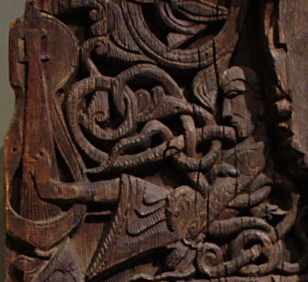
    Gunnar’s marvellous death scene was rather popular in medieval art and perhaps the most famous depiction of Gunnar in the snake pit is on the doorway of a 12th/13th-century stave church in Hylestad, Norway:

    Gunnar SnakePit
    Gunnar, playing his harp with his toes, in a snake pit. Hylestad stave church (source).

    Variations of the story of Gundahari/Gunnar appear, among others, in the Old Norse Edda and the Middle High German Nibelungenlied (in this version, Gundahari is named Gunther and is beheaded by his sister – no sleepy snakes involved). The Burgundian king that was struck down by Huns in 437, it seems, had truly become a legend.

    HagenThrowingTreasure In Rhine
    According to the Nibelungenlied, Gunther had ordered Hagen to throw the treasure in the Rhine. This statue in Worms commemorates this legend. (source)

    The reference to Gundahari in Widsith attests to the fact that this fifth-century Burgundian king was also known in early medieval England.  In this Old English poem, Gundahari is not linked to Atilla the Hun, there are no snakes, nor helpful (or vindictive) sisters; but the poem does associate the Burgundian king, explicitly, with treasure and song: this was not a thrifty king and he rewarded his poets well! These rewards, judging by Gundahari’s place in various literary traditions, certainly paid off!

    If you enjoyed this blog, you may also like the following blog posts:

    Works referred to:

    • Anderson, W.B., trans. (1936). Sidonius: Poems and Letters (Cambridge, MA)
    • Kroonen, G. (2013). Etymological Dictionary of Proto-Germanic (Leiden & Boston)

    N.B. Gundahari also gets a reference in the Old English Waldere, but that is something for another blog post!

    © Thijs Porck and Dutch Anglo-Saxonist Blog, 2018. Unauthorised use and/or duplication of this material without express and written permission from this site’s author and/or owner is strictly prohibited. Excerpts and links may be used, provided that full and clear credit is given to Thijs Porck and Dutch Anglo-Saxonist Blog with appropriate and specific direction to the original content.


  • Reading between the lines in early medieval England: Old English interlinear glosses

    A great portion of the extant Old English corpus survives between the lines of Latin manuscripts, as interlinear glosses. Generally, these glosses provide a simple word-for-word Old English translation of the Latin text in order to aid the reader, but various alternative glossing methods existed.  This blog post takes a look at what could be read between the lines in early medieval English manuscripts. 

    Save me, Lord: A simple word-for-word gloss in The Vespasian Psalter

    Glosses.WordForWord

    This beautiful page from the eighth-century Vespasian Psalter shows the opening lines of Psalm 68. A careful look at the words SALVUM ME reveals a great number of animals hiding out among these letters (animals often feature in such illustrated capitals; for another example see my blog on A medieval manuscript ransomed from Vikings: The Stockholm Codex Aureus ). More interesting, linguistically speaking, are the little words written above the Latin: Old English glosses, that provide a word for word translation of these lines:

    Halne mec doa god forðon ineodun weter oð sawle mine; gefestnad ic eam in lam grundes 7 nis spoed.

    Salvvm me fac deus quoniam introierunt aqvę usque ad animam meam; infixus sum in limum profundi et non est substantia.

    Save me, God: because the waters have come in unto my soul; I am fastened in the ground’s mud and there is no substance.

    Here, the Old English glosses clearly follow the word order of the Latin and, thus, “animam meam” is glossed with “sawle mine” [soul mine], whereas “mine sawle” [my soul] would be a more natural word order in Old English. This type of gloss is the most typical kind of gloss found in early medieval English manuscripts.

    When one word is not enough: Multiple glosses in The Lindisfarne Gospels

    Glosses.MultipleGloss

    Created around the year 700, the Lindisfarne Gospels is possibly the most famous Anglo-Saxon manuscript. While it is known for its beautiful illumination, the Lindisfarne Gospels also contains a word-for-word gloss, added some 250 years after the original manuscript had been produced. The maker of this tenth-century gloss, a monk named Aldred, was not always satisfied with offering just one Old English translation for each Latin word. His work features several ‘multiple glosses’; that is, several Old English alternatives are offered for one Latin word. The example above shows Aldred’s four glosses for Latin desponsata ‘married’: biwoedded, beboden, befeastnad and betaht. As such, Aldred’s gloss may function as something of a thesaurus of Old English.

    b, c, e, d, a: Paving letters in British Library, Cotton Tiberius A.iii

    PavingLettersGlosses

    Some glossators also included some syntactical guidance, since Latin word order was markedly different from Old English word order. A good example of such syntactical guidance are the so-called ‘paving letters’ in the Old English gloss to this eleventh-century copy of the Benedictine Rule. Here, the word-for-word Old English translations above the Latin are preceded by a letter – these letters show the Old English word order. Rather than “deað dæghwamlice ætforan eagan gewenedne habban” [death daily before eyes with expectation to have], this should be read as “habban deað dæghwamlice gewenedne ætforan eagan” [to have death daily, with expectation, before your eyes] which, incidentally, is one of the forty-five “tools of good works” that Benedictine monks had to abide by.

    . .. …. …: Dot glosses in the Lambeth Psalter

    DotGlosses

    The scribe responsible for the glosses to the tenth-/eleventh-century Lambeth Psalter had a different system for indicating word order and syntactical relationships. A system of dots and commas underneath the Latin words provide the reader with extra information. The commas under “qui” and “tribuit”, for instance, show that the relative pronoun “qui” is the subject of the verb “tribuit”: ‘who gives’. The dots underneath the Latin words show the Old English word order: rather than “ic singe drihtne þam þe goda sealde me 7 ic singe naman drihtnes þæs heahstan”, we should read “ic singe drihtne þam þe sealde goda me 7 ic singe naman þæs heahstan drihtnes” [I sing for the Lord who gave goods to me and I sing the name of the highest Lord], if we put the dotted words in numerical order.

    Now you see me, now you don’t: Scratched glosses in British Library, Royal 5 E XI

    Glosses.ScratchedGloss

    This eleventh-century manuscript of Aldhelm’s prose De virginitate shows yet another type of gloss: the so-called “scratched gloss”. These glosses were made without ink and, thus, were scratched into the parchment. As a result, these glosses are only visible from a particular angle (or, thanks to digital image editing, if you play around with contrast and brightness). In early medieval England, a user of this manuscript may have tilted the manuscript over in order to reveal the gloss. If he had done so for this manuscript, he would have seen that the Old English translation for Latin scribendi is “writende” [writing].

    If you liked this blog post about manuscripts, you may also enjoy the following posts:


  • Anglo-Saxonist, Plagiarist and Polyglot: James Platt Jr (1861-1910)

    James Platt Jr (1861-1910) is a rather obscure figure in the history of Anglo-Saxon Studies. Undeservedly so. This guest blog by my student-assistant Amos van Baalen will discuss Platt’s tumultuous life, including his promising youth, subsequent plagiarism and his ultimate return to the ranks of respected scholars.

    High hopes and harsh criticism: James Platt Jr arrives on the scene

    Blog.Platt1
    Letter by James Platt Jr to Pieter Jacob Cosijn (6-12-1882) © Leiden University Library, Special Collections

    “There are so few English Anglo-Saxon scholars that I shall not find it too hard to make a name among them,” James Platt Jr wrote in an introductory letter to Pieter Jacob Cosijn, a Dutch Professor of Germanic Philology and Anglo-Saxon. Despite his young age (he was only 21 at the time), Platt presents himself as a confident scholar; he had already read a number of papers at the prestigious Philological Society and one of his papers was due to be published in the Transactions of the Philological Society. This paper was a damning critique of Thomas Northcote Toller’s revision of Joseph Bosworth’s An Anglo-Saxon Dictionary (1838):

    “[T]he continuation of the work by Toller appears to be almost as bad as the commencement of it by Bosworth—and that is saying a great deal. … A thorough criticism it would be impossible to give—a re-writing of the whole book would be easier” (Platt 1882-1884, 237-238).

    One particularly snide piece of criticism in his paper is a list containing 128 Old English words that could not be found in the first 32 pages of the dictionary, which serves to underline Platt’s general belief that the dictionary was wholly inadequate:

    Blog.Platt2
    List of missing words (Platt 1882-1884, 241-242)

    Platt’s hostile review was certainly noticed among the Philological Society (Bankert 2003, 306, notes that Platt’s paper was criticized, mostly for its form, not its contents). Harsh though the criticism was, Toller does seem to have taken some of Platt’s remarks to heart: the dictionary’s 1898 edition and (primarily) its 1921 supplement (which can be accessed online here) actually do contain around two-thirds of the words in the list shown above (although the entries are sometimes spelled differently).

    Platt’s rise to philological prominence and his high hopes for his own career in Anglo-Saxon Studies would prove to be short-lived, however.

    A Philologist’s Fall from Favour: Platt and Plagiarism

    During the early 1880s, Platt received accusations of plagiarism. Three prominent scholars of Old English and Old Germanic languages were involved in these accusations: Pieter Jacob Cosijn, Henry Sweet and Eduard Sievers (see Bremmer 1991, xxi-xxiv). The correspondence between Platt and Cosijn (which can be found in the Leiden University Library) bears witness to how Platt operated. After introducing himself to Cosijn (see above), Platt asked him for specific information on historical linguistic matters. In one letter, he had asked Cosijn to send him Dutch words with the feminine agentive suffix -igge/-egge, such as Mod. D. dievegge ‘female thief’. Platt subsequently used the information provided by Cosijn in an article about Old English words with a similar suffix -icge (“Angelsächsisches,” Anglia 6 (1883): 171-78). Regrettably, Platt ‘forgot’ to attribute this information to Cosijn in the article itself. In Platt’s own words, this was because “[he] introduced the remarks about the igge words in Dutch at the last moment” and therefore “did not see [his] way clear to acknowledge it in [Cosijn’s] name without making a heavy alteration”; Platt had apparently been asked to “alter as little as possible as [his] was the last proof out” (letter to Cosijn, 29 January 1883).

    It soon turned out that Cosijn was not the only victim of Platt’s malpractice. Noted philologist Henry Sweet (see: Henry Sweet: The Man Who Taught the World Old English) warned Cosijn for Platt in a letter dated 3 February 1883:


    Blog.Platt3
    Letter by Henry Sweet to Pieter Jacob Cosijn (03-02-1883) © Leiden University Library, Special Collections

    Dear Sir, I feel it is my duty to give you some words of warning about a countryman of mine, Mr. J. Platt. He is in the habit of introducing himself to scholars as a friend of mine, extracting information from them, and then publishing it as his own without a word of acknowledgment.

    Apparently, Platt had also used information from Henry Sweet and Eduard Sievers (a famous German historical linguist) without permission. Platt’s case was brought before the Philological Society and, as a consequence, Platt received (in Sweet’s words – letter to Cosijn, 19 March 1883) “a severe vote of censure” from the Council.

    Ashamed and shunned by the Philological Society, Platt turned away from philological scholarship and he never seems to have informed his family about the plagiarism case. In James Platt the Younger: A Study in the Personality of a Great Scholar ([1910]), a biography of Platt written by his younger brother William, there is no mention of the plagiarism case. William simply makes reference to “a distinct lull in his philological activities” following this period in his life (10). According to William, James was hoping to take part in revising Bosworth’s dictionary, which he had criticised so severely. However, “one evening [James] abruptly announced […] that he had given up all idea of it!”. William reports that James felt “[his] health would not stand such a long concentrated effort” (11). It is not unlikely to think that Platt’s “severe vote of censure” from the Philological Society was the actual reason that prevented him from doing any further work on the dictionary. Bremmer (1991) certainly seems to think so when he decisively states that “[the vote of censure] put an end to Platt’s Anglo-Saxonist career” (xxiv).

    Blog.Platt4
    Platt, William. James Platt the Younger: A Study in the Personality of a Great Scholar. London: Simpkin Marshall, Hamilton, Kent & Co., Ltd., [1910].
    From Philology to Fiction: James Platt the Writer

    The period in Platt’s life following this incident is marked by no real scholarly activity. However, he seems to have been quite occupied by various creative exercises. His brother William mentions that James “started a manuscript periodical” to which he and his brothers contributed articles and stories (W. Platt [1910], 11). More intriguingly, Platt published a book of six horror stories called “Tales of the Supernatural” in 1894. This book has been uploaded to archive.org and may be found here. His biography mentions that the book was reviewed very favourably, with one reviewer even going as far to speak of “the advent of a writer of no common order, and one who will have to be reckoned with before long by the imaginative writers of his age” (W. Platt [1910], 15). It would seem, then, that Platt was certainly not any stuffy old scholar!

    Blog.Platt5
    James Platt Jr, Tales of the Supernatural. Six Romantic Stories (London, 1894)

    A Triumphant Return: Platt and the Oxford English Dictionary

    It would not be long before his attention returned to more scholarly pursuits. In addition to publishing articles in various journals from the early 1890s onwards, his most significant contribution to scholarship in the later part of his life is arguably the assistance that he provided to the Oxford English Dictionary (OED). Platt’s biography (W. Platt [1910], 16-18) relates that he got in contact with Dr James Murray, the legendary founding editor of the OED, after he (in true Platt style) published a critique on the information provided in the entry for the word he. Murray was pleased with the article and Platt offered to help him with the dictionary. Starting in 1899, Platt supplied the OED with etymological information for loanwords from lesser-known languages, including those spoken in Africa, America and Asia. His decision to tackle lesser-known languages was apparently motivated by the great number of experts who were already dealing with well-known languages (W. Platt [1910], 18) (Platt’s biography is included on the OED’s website [tip: scroll down!]).

    Blog.Platt6
    James Platt Jr (1861-1910) and James Murray (1837-1915)

    As a Dutchman, I was pleasantly surprised to find out that Platt also contributed a number of articles to a Dutch weekly journal called Vragen en Mededeelingen [Questions and Notes] in January and early February of 1910. The journal published several of Platt’s articles (written in English) with such names as “Etymology of Toucan”, “Scottish ‘Z’ in Proper Names” and “The Pronunciation of ‘Gh’ in English”. Sadly, Platt would only be able to contribute for one month: he was just 49 years old when he died from “severe bronchial asthma” on 5 February 1910 (W. Platt [1910], 23). Although he only contributed to Vragen en Mededeelingen for such a short period of time, he seems to have made quite an impact. The journal published a full-page obituary as the front page of the 18 February issue, in which it is stated that Platt’s death is “an irredeemable loss” (trans. from Dutch; Bense 1910, 73). Moreover, the editor writes the following concerning Platt’s qualities as a scholar: “We greatly fear that many a question will remain unanswered, because we do not believe he had an equal in terms of his knowledge of generally lesser-known languages” (trans.; Bense 1910, 73). This sentiment was apparently reflected in more than forty other obituaries in various publications, which likewise constituted “fine tributes to his scholarship” (W. Platt [1910], 24).

    It is clear, then, that James Platt’s youthful plagiarism did not permanently blemish his name. He ended up being a well-respected scholar who provided highly valued academic contributions during his, admittedly short, but fruitful life. It is hard to imagine why he is not more famous, seeing as he was praised by so many at the end of his life. I hope this blog post will in some way remedy his current obscurity.

    This guest blog by my student-assistant Amos van Baalen is part of the project Pieter Jakob Cosijn’s Correspondence and Scholarly Collaboration at the End of the Nineteenth Century. On the 17th of November 2017, we are organising a conference on “Scholarly Correspondence on Medieval Germanic Language and Literature’ at Leiden University; see the call-for-papers (deadline 31st of August, 2017) for more information. 

    If you liked this blog post, you may also enjoy:

    Blog.Platt7
    Pieter Jacob Cosijn; James Platt Jr; Henry Sweet

    Works referred to:

    • Bense, J. F. “James Platt, jun.” Vragen en Mededeelingen. 1.1.7 (1910): 73.
    • Bankert, Dabney Anderson. “T. Northcote Toller and the Making of the Supplement to the Anglo-Saxon Dictionary.” In: Textual and Material Culture in Anglo-Saxon England: Thomas Northcote Toller and the Toller Memorial Lectures, ed. Donald Scragg. Cambridge: D. S. Brewer, 2003. 301-322.
    • Bremmer, Rolf H., Jr “Pieter Jakob Cosijn (1840-1899): A Dutch Anglo-Saxonist in the Late Nineteenth Century.” In: Notes on Beowulf. By Pieter Jacob Cosijn, eds. Rolf H. Bremmer Jr, Jan van den Berg and David F. Johnson. Leeds: Leeds Studies in English, 1991. xi-xxxvi.
    • Platt, James, Jr. “The Bosworth-Toller Anglo-Saxon Dictionary.” Transactions of the Philological Society, 1882-4: Part 2 (1883), 237-246.
    • Platt, William. James Platt the Younger: A Study in the Personality of a Great Scholar. London: Simpkin Marshall, Hamilton, Kent & Co., Ltd., [1910].


  • Old English memes

    Memes have become a popular form of communication and, when put into Old English, can be an effective teaching tool. I made the memes featured in this blog some five years ago, but they remain effective in a class room setting today.  

    #1 Keep calm and carry on

    Blog.OEMeme1

    Perhaps the most widespread meme in the history of the Internet is the ‘Keep calm and carry on’-kind. Based on a motivational poster issued by the British government for boosting the moral in preparation of the second world war, this poster has sparked various spoofs. The Old English motivational quote may have profited some Anglo-Saxons during the time of the Viking raids.

    #2 You Only Live Once (YOLO)

    Blog.OEMeme2

    Beowulf’s decision to fight the monster Grendel without weapons may well be described as the ‘YOLO-moment’ of Anglo-Saxon literature.

    #3 You’re doing it wrong

    Blog.OEMeme3

    The phrase ‘You’re doing it wrong’ typically accompanies an image of someone ‘failing’ at doing something correctly. What better phrase to accompany this scene from the Bayeux Tapestry than ‘Riding on horses; you are doing it wrong’?

    #4 When you see it, you will shit bricks

    Blog.OEMeme4

    The phrase ‘When you see it, you will shit bricks’ is associated with images that, upon expectation, feature a surprising element. This certainly came to mind, when I spotted the Sutton Hoo helmet in King Arthur’s bed room in the BBC series Merlin (for which, see: Anglo-Saxon props: Three TV series and films that use early medieval objects).

    #5 Shut up and take my money

    Blog.OEMeme5

    This phrase is used in combination with a picture of something that is so desirable that people just really want to have it. Surely, the Old English variant must have been uttered whenever an Anglo-Saxon looked upon the dazzling Lindisfarne Gospels!

    #6 I don’t want to live on this planet anymore

    Blog.OEMeme6

    Out of disappointment with the stupidity of others, one can express the desire to no longer live on this planet. This sentiment certainly comes to mind when faced with the idiotic notion that Shakespeare spoke Old English (for which, see: What if Shakespeare HAD written Old English?)

    #7 Ain’t nobody got time for that

    Blog.OEMeme7

    What better way to introduce the Old English magic sheet (an overview of Old English declension made by Peter Baker – link) than by pointing out that it will save your students some time? “Learning Old English Declensions? Ain’t nobody got time for that!”

    #8 Lie down / Try not to cry / Cry a lot

    Blog.OEMeme8

    This meme provides instructions on how to act in situations of great sadness. Surely, no meme is better to suited to refer to the Ashburnham House Fire of 23 october 1731, which damaged many Anglo-Saxon manuscripts that belonged to the Cotton collection. For more damaged manuscripts, see: http://britishlibrary.typepad.co.uk/digitisedmanuscripts/2013/02/crisp-as-a-poppadom.html

    #9 I should buy a boat

    Blog.OEMeme9bb

    A picture of a cat reading a newspaper has become associated with the phrase ‘I should buy a boat’. This phrase certainly seems to have gone through Alfred the Great’s mind when he saw the Vikings (according to legend, Alfred founded the English navy).

    #10 Boy, that escalated quickly

    Blog.OEMeme11

    This meme phrase is used when something quickly gets out of hand. Rather suitable for the main plot of the last part of Beowulf (and Tolkien’s The Hobbit; for the former, see: Beowulf vs the Dragon: A Student Doodle Edition).

    #11 It is something

    Blog.OEMeme12

    This meme comments on the slightly disappointing number of books on Old English Literature in the open stacks of the English reading room of Leiden University Library.  Ah well, it is something.

    #12 Scumbag Byrhtnoth

    Blog.OEMeme9

    This meme is a take on the ‘Scumbag Steve meme’. It comments on Byrhtnoth’s decision in the Old English poem The Battle of Maldon to allow the Vikings to cross the bridge the English had been defending, thus causing the English to lose the battle. It translates to: “Should defend the bridge; lets the Vikings use the bridge.” For The Battle of Maldon, see: The Battle of Maldon: A Student Doodle Edition.

    #13 Come at me, bro!

    Blog.OEMeme13

    ‘Come at me, bro!’ was obviously what Wiglaf and Beowulf said against the dragon; well…if they had been called Swaglaf and Browulf, that is.

    #14 Heavy breathing

    Blog.OEMeme14This meme requires some explanation. A couple of years ago, I attended the Manchester Centre for Anglo-Saxon Studies Easter Conference and one of the speakers, Duncan Sayer of the University of Central Lancashire, spoke about the infamous ‘cow burial’: an Anglo-Saxon woman, found buried alongside a cow (news item). Sayer suggested that the cow, which had been skinned before being laid in the grave, was meant as a ‘feast for the dead’. A good opportunity to make a spoof of the ‘heavy breathing cat-meme’, which is used in combination with extravagant food.

    #15 Anglo-Saxon hipster, before it was cool

    Blog.OEMeme100

    Hipsters tend to like things before it was cool. The Anglo-Saxon hipster, of course, would have pronounced the word differently: cole (k-Oh-l), rather than cool (c-Oo-l).

    #16: Excuse me, what the…

    OEMeme.HwatÞætHæmed

    I imagine the Old English version of this meme may prove very handy for those encountering Old English for the first time.

    #17: Surprised Pika-theow

    memewealhtheow surprised

    This meme accurately represents Queen Wealhtheow’s response to King Hrothgar’s plan to adopt Beowulf as a son (and thus threatening the succession by her own sons).

    #18: This is my voice…

    thisismyvoicememe

    An Anglo-Saxonist’s response to this popular video format.

    #19: The History of English, the Meme

    histoy of english as meme

    A historical linguistic variant of this meme.

    Some of these memes were once posted on http://oememes.wordpress.com. To date, that website has catered to seven thousand unique viewers. All memes there have now been moved to this blog post; some new ones have been added.

  • Spoiling the Mystery: Grendel in Beowulf Movies

    “The oldest and strongest emotion of mankind is fear, and the oldest and strongest kind of fear is fear of the unknown.” (H.P. Lovecraft, Supernatural Horror in Literature). The secret to any, successful scary monster story is to keep your monsters clouded in mystery; a secret that was known to the Beowulf poet, but sadly lost on modern movie makers.

    Grendel goes to Heorot

    Grendel is one of the three monsters that feature in the Old English poem Beowulf. We are introduced to Grendel as an “ellengæst” [bold spirit] (l. 86a) who has spent the last twelve years harassing the hall of the Danish king Hrothgar, devouring anyone who spent the night there. A Geatish hero, Beowulf, arrives to save the day. After a long battle, Beowulf rips off Grendel’s arm and the monster, mortally wounded, returns to his home in the swamp and dies.

    A troll, a giant, a monstrous man or a bipedal dragon; what exactly is Grendel? The nature of Grendel is a matter of scholarly debate and the various solutions offered depend, mostly, on circumstantial evidence. The poem itself reveals very little about the monster; at one point, Beowulf himself confesses that Grendel is “sceaðona ic nat hwylc” [an enemy, I do not know what kind] (l. 274b). Throughout the poem, Grendel is described by generic terms, such as “grimma gæst” [grim spirit] (l. 102), “feond mancynnes” [enemy of mankind] (l. 164b) and “manscaða” [vile ravager] (l. 712a), and his physical description leaves much to be desired. At first, we only learn that “him of eagum stod ligge gelicost leoht unfæger” [from his eyes issued a distorted light, most like a flame] (l. 727b), that he drinks human blood and eats their bodies whole. It is only after Grendel is defeated that we learn a little more about him. The Danes report that he was wretchedly shaped like a man and very large:

    BeowulfBlog1
    We saw two monsters… © The British Library, Cotton Vitellius A.XV, fol. 162v-163r

    hie gesawon     swylce twegen
    micle mearcstapan     moras healdan,
    ellorgæstas.     ðæra oðer wæs,
    þæs þe hie gewislicost     gewitan meahton,
    idese onlicnæs;     oðer earmsceapen
    on weres wæstmum     wræclastas træd,
    næfne he wæs mara     þonne ænig man oðer;
    þone on geardagum     Grendel nemdon
    foldbuende.     No hie fæder cunnon (ll. 1347-1355)

    [they had seen two such big boundary-steppers holding the moors, bold spirits. One f them was, as they were most certainly able to discern, in the likeness of a lady; the other was wretchedly shaped in the forms of a man, he trod in the exile’s tracks, but he was bigger than any other man; people called him grendel in the days of yore. They did not know his father.

    Whatever kind of monster Grendel may be, what becomes clear from the poem is that Grendel is the ultimate ‘Other’. While the Danes enjoy life in a lighted hall, revelling in songs and enjoying each other’s company, Grendel dwells in a dark swamp, he does not speak and he lives the life of an exile, alone with his mother. Even Grendel’s parentage is obscured: whereas the Beowulf poet, rather annoyingly, mentions the father of every other Tom, Dick and Harry in the poem, we never find out who Grendel’s father is. We do learn that Grendel and his mother are descendants of Cain, just like “eotenas ond ylfe ond orcneas, swylce gigantas” [ogres, elves, orcs and also giants] (ll. 112-113a).

    In short, Grendel is a mystery monster, unknown and different. The Beowulf poet must have realised that the omission of descriptive details was an effective narrative method which would stimulate his audience to participate actively with his story. The vague description of his monster allowed his audience to imagine its own nightmare being.

    Grendel goes to Hollywood

    Beowulf has been brought to the big screen on six occasions (Not counting the Beowulf-inspired TV episodes of Animated Epics, Star Trek and Xena: Warrior Princess; and happily ignoring the rather licentious adaptations in the Sci-Fi-Channel television film Grendel (2007) and the ITV Series Beowulf: Return to the Shield Lands). Each movie has solved the Grendel mystery in its own, unique way.

    BeowulfBlog2
    Three movie ‘Grendels’

    In Grendel, Grendel, Grendel (1981), an animated musical, Grendel is depicted as a slightly depressed green crocodile or, possibly, a dragon without wings. The film Beowulf (1999) features Christopher Lambert as Beowulf who battles Grendel, a muddy ogre of sorts, in a ‘post-apocalyptic techno-feudal future’.  In The 13th Warrior (1999), the Viking hero Buliwyf takes on the Wendol, a group of bearskin wearing wildlings. Beowulf & Grendel (2005) depicts Grendel as an oversized, hairy human, who hits himself with rocks until his forehead bleeds. In the 3D animation Beowulf (2007), Grendel is “a hideously disfigured troll-like creature with superhuman strength”. Finally, in the movie Outlander (2008), Kainan (a man from another planet) crashes his spaceship in an eighth-century Norwegian lake and, accidentally brings along an alien, known as the Moorwen. The Moorwen takes on the role of Grendel and is best described as a fluorescent, reptile-like tiger with various tentacles at the end of its tail.

    BeowulfBlog4
    Three more movie Grendels

    Sympathy for the devil: Feeling sorry for Grendel

    Aside from making the monster’s appearance explicit, some movies also try to make their audience sympathize for the creature by adding motives for his vicious attacks on the Danes. In Grendel, Grendel, Grendel, the monster is a misunderstood intellectual that wants to be friends with the buffoonish Danes, who shun him for his monstrous appearance. Beowulf & Grendel opens with a scene where the young Grendel (a bearded baby!) witnesses the murder of his father by the Danish king. In Outlander, we learn that the Moorwen is only trying to avenge Kainan for having tried to colonize its home planet.

    BeowulfBlog5
    Poor, polite Grendel and nasty Danes in Grendel, Grendel, Grendel (1981)

    Who’s your daddy? Solving Grendel’s parentage

    The films Beowulf (1999) and Beowulf (2007) go one step further and even solve the problem of Grendel’s parentage: Grendel turns out to be the monstrous offspring of Hrothgar, the king of the Danes. His vicious attacks on Hrothgar’s hall thus become payback for a fatherless childhood. Far removed from the original poem, the only advantage of this approach appears to be the casting of a physically attractive actress for the role of Grendel’s mother. While the poem describes her as a “brimwylf” [sea-wolf] (l. 1506a) and an “aglaecwif” [opponent-woman] (l.1259a), the 1999 film featured Layla Roberts, a former playmate (who, in one scene, erotically licks Hrothgar’s nose!), and a 3D animation of Angelina Jolie (naked, covered in gold, with a tail!) was one of the ‘unique selling points’ of the 2007 film.

    BeowulfBlog6
    Grendel’s mother licking Hrothgar’s nose in Beowulf (1999)

    To conclude, none of these movies can be seen as a faithful adaptation of Beowulf and some have argued that film is an unsuited medium for the early medieval epic poem. As long as modern movie makers feel that they need to produce stunning visual effects, to create a sense of sympathy for the ‘bad guy’ and to include steamy bedroom scenes to please their modern audience, this certainly seems to be the case. Unlike the Old English poem, none of these movies can be called a huge success in terms of cultural impact and popularity. When it comes to effective storytelling, there is still a lot we can learn from the literature produced over a thousand years ago.

    If you liked this blog, you may also enjoy:

    BeowulfBlog7
    All movie Grendels combined


  • Heads on sticks: Decapitation and impalement in early medieval England

    In the second episode of series two of The Last Kingdom, a row of decapitated heads has been placed outside the main gate of Dunholm/Durham. As this blog post will illustrate, this practice, barbaric though it seems, is well attested for Anglo-Saxon England.

    ImpalementBlog1
    Impaled heads in The Last Kingdom © BBC

    Historical examples: Saint Oswald and the real Uhtred

    Perhaps the best-known example of decapitation and impalement was that of Saint Oswald of Northumbria (d. 642). After Oswald had been defeated by the pagan King Penda of Mercia, Penda had Oswald’s head and arms cut off. Penda then had these body parts put on stakes, until Oswald’s brother Oswy retrieved them, a year after the battle. Later, Oswald’s head was likely buried in the tomb of Saint Cuthbert (about whom, see: Splitting Anglo-Saxon Hairs: Cuthbert’s Comb) which ended up in Durham, where it still remains today. Intriguingly, aside from Durham Cathedral, four other institutions today claim to have the skull of Saint Oswald (Bailey 1995), including Hildesheim Cathedral  which houses a beautiful twelfth-century head reliquary depicting the head of Oswald (see image below).

    ImpalementBlog2
    Left: Illustrated initial showing the martyrdom of Saint Oswald © Darmstadt, Universitäts- und Landesbibliothek, HS 2766, 44r. Right: Head Reliquary of St. Oswald © Hildesheim Cathedral

    The display of decapitated heads did not die out with the arrival of Christianity. In the De Obsessione Dunelmi, a Latin historical work from around 1100, we are told of a siege of Durham by the Scots in the early eleventh century. Luckily for Durham, their bishop Ealdun’s daughter had been married to Uhtred (d. 1016), son of the earl of Northumbria and the inspiration for Bernard Cornwell’s Saxon Stories series upon which BBC’s The Last Kingdom is based. This Uhtred came to Durham’s aid and massacred the Scottish host and had the Scots decapitated. Uhtred then sent for the most attractive heads to be brought to Durham:

    The heads of the slain, made more presentable with their hair combed, as was the custom in those days, he had transported to Durham, and they were washed by four women and fixed on stakes around the circuit of the walls. The women who had previously washed them were each rewarded with a single cow. (cited in Thompson 2004: 193)

    Aside from the intriguing reward of a cow for washing a dead man’s head, this episode in the De Obsessione Dunelmi reveals that the display of decapitated heads remained common (customary even) until the eleventh century, at least.

    Heafod stoccan in Anglo-Saxon charters

    Anglo-Saxon charters often contained vernacular boundary clauses which described the areas under discussion. Within these boundary clauses, the term heafod stocc ‘head stake’ is frequently attested,  suggesting that it was common practice to mark the limits of estate properties with impaled heads. Various charters locate such head stakes in the vicinity of a road: e.g., “æfter foss to þam heafod stoccan” [after the way to the head stakes] (S 115); “of heafod stocca andlang stræt” [from the head stakes along the street] (S 309); and “7lang stret to þam heafod stoccan” [along the street to the head stakes] (S 695).  These examples suggest that these head stakes would have been visible for people travelling from and towards locations, possibly along main access roads. Given their use as boundary markers in surviving Anglo-Saxon charters, these head stakes must have been a permanent as well as salient feature in the landscape. The existence of head stakes is supported by archaeological evidence, which also locates execution sites at the boundaries of estates (see Reynolds 2009: 169). Just like the heads of criminals spiked on the walls of old London Bridge, the purpose of these head stakes must have been to not only mark the boundaries of an estate, but also to warn potential transgressors against the consequences of wrongdoings.

    ImpalementBlog3.jpg
    Heads on old London Bridge (source)

    An inspiration for Anglo-Saxon authors and artists

    The spectacle of decapitating an enemy’s head and putting it on display proved inspirational for various Anglo-Saxon authors and at least one artist. The Beowulf poet, for instance, has Beowulf and his men parade Grendel’s head on a stake towards Heorot: “feower scoldon / on þæm wælstenge weorcum geferian / to þæm goldsele Grendles heafod / oþ ðæt semninga to sele comon” [four had to carry Grendel’s head with hardships to the gold-hall on a battle-pole, until they came to the hall] (Beowulf, ll. 1637b-1639). Here, Grendel’s head functions as a trophy, a sign of Beowulf’s heroic triumph.

    ImpalementBlog4a
    Beowulf, ll. 1637-1639 © The British Library, Cotton Vitelius A.xv, ff. 168v-169r

    A rare visual depiction of a decapitated and impaled head is found in the Old English Hexateuch (British Library, Cotton Claudius B.iv) an eleventh-century, illustrated translation from the Latin Vulgate of the first six books of the Old Testament (see: The Illustrated Old English Hexateuch: An early medieval picture book). In his depiction of Genesis 8:7 (‘And he sent forth a raven, which went forth to and fro, until the waters were dried up from off the earth.’), the artist of the Hexateuch deviated from the biblical text and depicted a raven pecking at a head, impaled on Noah’s ark (see below). It has been suggested that the artist was drawing on his own creativity here, given the fact that there is no iconological tradition that depicts Noah’s raven in this way (Gatch 1975: 11). Perhaps, the Anglo-Saxon artist was so familiar with the practices of decapitation and impalement that he could think of no better way to depict God’s wrath!

    ImpalementBlog4
    Raven pecking at an impaled head on Noah’s ark. © The British Library, Cotton Claudius B.iv, fol. 15r

    If you liked this post, you may also enjoy other blog posts on The Last Kingdom or Anglo-Saxon decapitations:

    Works refered to:

    • Bailey, Richard N., “St Oswald’s Heads,” in Oswald: Northumbrian King to European Saint, ed. C. Stancliffe and E. Cambridge. 195-209. Stamford: Paul Watkins, 1995.
    • Gatch, Milton McC., “Noah’s Raven in Genesis A and the Illustrated Old English Hexateuch”, Gesta 14:2 (1975), pp. 3-15
    • Reynolds, Andrew, Anglo-Saxon Deviant Burial Customs. Oxford: Oxford University Press, 2009.
    • Thompson, Victoria. Dying and Death in Later Anglo-Saxon England. Woodbridge: Boydell, 2004.


    ImpalementBlog5
    Decapitation and impalement scene in the margin of an early-fourteenth-century manuscript of the Decretals of Gregory IX. © The British Library, Royal MS 10 E IV, 208r
  • Old English Words & Anglo-Saxon Worldviews

    Language can be a window to culture: by studying Old English words, we can get an insight into how the Anglo-Saxons saw the world around them. This blog post considers Old English words for fingers, pigs, old age and anger. All word clouds were made with www.tagul.com. Information about Old English words is taken from the Thesaurus of Old English.

    Old English words and Anglo-Saxon worldviews

    Blog.WaW1
    A Sutton Hoo helmet made of Old English words. Created with tagul.com

    In order to study the culture of the Anglo-Saxons, scholars first tend to turn to archaeology, history, literature and art. However, language can also be a valuable source for cultural analysis, as the famous linguist Edward Sapir has noted:

    Vocabulary is a very sensitive index of the culture of a people and changes of the meaning, loss of old words, the creation and borrowing of new ones are all dependent on the history of culture itself. Languages differ widely in the nature of their vocabularies. Distinctions which seem inevitable to us may be utterly ignored in languages which reflect an entirely different type of culture, while these in turn insist on distinctions which are all but unintelligible to us. (Sapir 1951)

    In other words, vocabulary reflects culture. Indeed, Old English words such as gafol-fisc ‘tribute fish’, cēapcniht ‘bought servant’, þri-milce-mōnaþ ‘May; lit. three-milk-month’, demonstrate that the Anglo-Saxons could pay tribute in fish, buy servants and milked their cows three times a day in May. Similarly, the etymology of Old English words for lord, lady, retainer and slave reveal traditional (perhaps pre-Anglo-Saxon) role patterns, in a household based on bread:

    hlāford ‘lord’ (< *hlāf-weard ‘guardian of the bread’)
    hlǣfdige ‘lady, woman’ (< *hlāf-dige ‘kneader of the bread’)
    hlāfǣta ‘dependant, retainer’ (< *hlāf-ǣta ‘eater of the bread’)
    hlāfbrytta ‘slave’ (< *hlāf-brytta ‘dispenser of the bread’)

    In this blog post, I will take a cursory glance at four ‘semantic fields’ (fingers, anger, old age and pigs) in order to find out what some Old English words may tell us about Anglo-Saxon culture.

    Philological finger food

    Blog.WaW2
    Old English finger-hand. Created with tagul.com

    The names we give to our fingers clearly reveal what we do with these fingers: on our ring-finger we wear our rings and with our index-finger we ‘indicate’ things (or: go through an index). Old English finger names are no different. Consider these words for the index-finger and ring-finger:

    bīcn(ig)end ‘forefinger; lit. indicator’
    scyte(l)finger ‘forefinger; lit. shot-finger’
    tǣcnend ‘forefinger; lit. signer’
    lēawfinger ‘forefinger; lit. betray-finger’
    hringfinger ‘ring-finger’
    goldfinger ‘ring-finger; lit. gold-finger’
    lǣcefinger ‘ring-finger; lit. physician-finger’

    These finger names yield few surprises: with their forefingers, the Anglo-Saxons pointed at things, shot arrows and made signs; they wore rings and gold on their ring-fingers.  Two finger names warrant some explanation. The first element in lēawfinger, first of all, is related to the Old English word lǣwan ‘to betray’ – the forefinger is “the pointer out, the betrayer” (Merrit 1954, p. 175-with thanks to deorreader in the comments below). Secondly, the name lǣcefinger ‘physician finger’ for ring-finger may be somewhat confusing; according to some, there was a vein from this finger that went all the way to the heart and, so, this finger could have medicinal properties.

    Apart from the obvious middelfinger, the Thesaurus of Old English lists two contradictory words for the middle finger: ǣwiscberend ‘offender’ and hālettend ‘greeter’ – talk about sending mixed signals! [The Dictionary of Old English, s.v. hālettend suggests that the sense ‘middle finger’ for hālettend is caused by a scribal error and that the word really means ‘forefinger’] The pinky was not only the last and smallest finger (se lȳtla finger; se lǣsta finger), it was also the Anglo-Saxon implement of choice when it came to cleaning out their ears: ēarclǣnsend ‘ear-cleaner’, ēarfinger ‘ear-finger’ and ēarscripel ‘ear-scraper’.

    ‘Talk to the hand’? If we look at the Old English words for fingers, it seems as if the hand is the one doing the talking, telling us what the Anglo-Saxons did with their fingers.

    Of Pork and Pigs in Old English

    Word Cloud pig no repeat
    A PIGGY MADE OF PORK WORDS IN OLD ENGLISH. CREATED WITH TAGUL.COM

    With over sixty words related to ‘pig’, swine are among the best-represented animals in the Anglo-Saxon vocabulary. Indeed, an Anglo-Saxon could distinguish between fōr, pecg, swīn (all ‘pig’), sū/sugu (‘sow’), bār, gealt (both’ boar’), hogg/hocg (‘hogg’), fearh and picga (both ‘young pig’); next, he could pick from a host of ‘special pigs’, including gilte (‘barren sow’), bearg ‘castrated boar’, mæstelberg ‘fattened hog’ and fēdelsswīn (swine fattened for killing). There were no fewer than seven words for ‘swine pasture’ (denbǣre, denberende, denn, mæsten, mæstland, swīnland and wealdbǣr) and various words for swineherd (e.g., swān and swīnhyrde), pigsty (hlōse, sulig, swīnhaga) and even a word for pig-fence (swīnhege). Then there was the non-domesticated variety, the wild boar (bār, eofor, eoforswīn, wildeswīn) that had to be hunted with a boar-spear (eofor-spere, eofor-sprēot) and made an appearance on helmets and battle-standards (see: Boars of battle: The wild boar in the early Middle Ages). The Anglo-Saxons even saw boars when they looked up at the sky (their name for the constellation Orion is eofor-þring ‘boar-crowd’) or down at the plants near their feet (eofor-fearn ‘Polypody fern; lit. boar-fern’; eofor-þrote ‘Carline thistle; lit. boar-throat’).

    Swine were appreciated, of course, for their meat, which is also well represented in the Old English lexicon: swīn, swīnflǣsc, swīnnes, flicce, spic, scencel/scencen. This meat would undoubtedly be stored in the pantry, which they called the spic-hūs: ‘the bacon-house’. Not all bacon would be in the bacon-house, however: some of it was offered to the gods. This much is at least suggested by the word offrung-spic ‘bacon offered to idols’ – there is no better tribute than sacrificial bacon!

    Old in Old English

    Blog.WaW4
    Beard made out of Old English words for ‘old’. Created with tagul.com

    I wrote my PhD thesis on old age in Anglo-Saxon England (more info here) and one of the things I did was look at the fifty-two Old English words that denote old age in order to show what Anglo-Saxons associated with growing old. The word hār, for instance, means both ‘grey’ and ‘old’ – a clear connotation that is also found in a word like hārwenge ‘old; lit. grey-cheeked’. The word frōd means both ‘old’ and wise’, showing that the Anglo-Saxons associated old age with wisdom. The word geomor-frōd ‘grief-wise; old, sad and wise’ shows that wisdom came at a cost and was related to grief – gēomor-frōd is a lexical precursor of the modern English idiom ‘sadder and wiser’!

    ‘Angry words’ in Old English

    Blog.WaW3
    Angry words in Old English. Created with tagul.com

    The Old English vocabulary of anger is fairly well studied (see Gevaert 2002; Izdebska 2015) and scholars have been able to pinpoint, on the basis of these words and their usages, a number of ‘metaphorical links’. One such link is between ANGER and HEAT. Today, we can have a heated argument, we can be boiling with rage, until steam comes out of our ears.  The Anglo-Saxons conceptualised ANGER in a similar way, as is revealed by such Old English words as hāt-heort-nes ‘anger; lit. hot-hearted-ness’ and hāt-hige ‘anger; lit. hot-mind’. At the same time, the Anglo-Saxons were aware that anger can be the result of despair or grief: the Old English word wēa-mōd-nes means ‘anger’ but can be analysed as ‘grief-minded-ness’ (cf. Dutch weemoed ‘grief’). Anger is also relatable to ‘swelling’. Just like we can be ‘puffed up with anger’, the Anglo-Saxons would speak of  gebolgen, ǣbylga, belgan and gebelg (cf. Dutch verbolgen ‘angry’), which are all related to ābelgan ‘to swell up’. On the basis of these and other words, scholars have been able to demonstrate that Anglo-Saxons connected anger to PRIDE, WRONG EMOTION, UNKINDNESS, DARKNESS, HEAVINESS and so on (see Izdebska 2015; Gevaert 2002).

    It is also interesting to note that the Anglo-Saxons had a specific word for the anger of a woman: wīf-gemædla ‘a woman’s fury’ – Apparently, Hell hath no fury like wīf-gemædla!

    If you liked this post, you may also enjoy:

    Works refered to:

    • Gevaert, C. (2002). ‘The Evolution of the Lexical and Conceptual Field of ANGER in Old and Middle English’, in A Changing World of Words: Studies in English Historical Lexicography, Lexicology and Semantics, ed. J. E. Díaz Vera (Amsterdam), 275–300.
    • Izdebska, D. W. (2015). Semantic field of ANGER in Old English. PhD thesis, University of Glasgow
    • Meritt, H. D. (1954). Fact and Lore About Old English Words (Stanford)
    • Sapir, E. (1951). ‘Language’, in Selected Writings of Edward Sapir in Language, Culture and Personality, ed. David G. Mandelbaum (Berkeley, 1951), 7–32.
  • Richard Morris: The Man Who Popularized Early English

    Richard Morris (1833-1894) was a remarkable scholar who laid some of the foundations for the academic study of Old and Middle English. This blog provides an overview of Morris’s publications with respect to Old English and Middle English texts. It also relates how Morris’s edition of some Old English homilies became the object of mockery in the correspondence of a nineteenth-century  student of Old English and his professor.

    Richard Morris (1833-1898): One of the founding fathers of Early English and Pali philology

    Blog.Morris1
    Having failed to find a photograph of Richard Morris, here are two of his close associates: Frederick Furnivall and Walter Skeat. Judging by this circumstantial evidence, we may assume that Richard Morris had a beard.

    Rev. Richard Morris, born in 1833 in Wales, was a self-taught schoolmaster and priest with a great interest in both Early English texts of the Middle Ages and the sacred language of Buddhism, Pali. An eclectic scholar? Not quite.

    Richard Morris was one of the greatest nineteenth-century scholars in the field of Comparative Philology (a branch of historical linguistics that compares languages in order to establish their historical relatedness). He was member of various scholarly societies that promoted the study of Old English and Middle English, including the Chaucer Society, the Early English Text Society and the Philological Society. For the last society, he served as President and vice-president for several years. Richard Morris is best remembered as an editor of medieval texts: his editions of texts in Old English and Middle English amount to a staggering number of thirty-one volumes! Below, I provide links to all his books, now freely available on the internet.

    First and foremost, Morris was a teacher and some of his most popular publications were of a didactic nature.  His interest in teaching already underlied his first publication: at the age of only 24, Morris published an overview of the etymological origins of English place names, hoping “to supply teachers with the chief root or key-words which are necessary for the explanation of local names in England” (The Etymology of Local Names, p. 13). He also produced an English grammar (the first to approach teaching English grammar from a historical perspective) and various student editions of medieval English texts.

    Morris’s career took a radical turn when he exchanged Early English for Pali, the sacred language of Buddhism. From the 1880s onwards, he produced four text editions for the Pali Text Society, including the The Puggala-paññatti. His interest in Pali was due to its historical relationship to Sanskrit. More and more philologists were finding their way to Pali, as Morris had himself noted in his in the fourth presidential address to the Philological Society:

    Of late years Sanskrit scholars have been turning their attention to Pali, Prakrit, and the modern dialects of India; and their value to general philology cannot be over-rated. Pali bears very much the same relation to later Sanskrit that Early English does to Old English.

    With his text editions, Richard Morris paved the way for the professional study of both Early English and Pali – a combination which, judging by his own words, may not be so strange after all.

    Edition, edition, edition: From a cookery poem to the Cursor Mundi

    Blog.Morris2
    Richard Morris’s edition of Legends of the Holy Rood (1871), with an illustration of St. Cyriac by art professor Henry Philip Delamotte on the basis of the Vernon Manuscript – did he base Cyriac’s facial features on Morris? Perhaps, there is no beard though!

    Thanks to the Internet Archive, most of Morris’s publications with regard to Early English  are now freely available. Below follows a chronological overview of his works (I have limited my selection to works touching on Early English; Morris also published an edition of the collected works of Edmund Spencer and editions of four texts in Pali):

    Pieter Jacob Cosijn (1840-1899) on Richard Morris: A good person, perhaps, but a bad musician

    In a letter to one of his students (dated 9 August, 1880), the Dutchman Pieter Jacob Cosijn (Professor of Germanic Philology and Anglo-Saxon at the University of Leiden) wrote a damning review of Morris’s edition of the Blickling homilies:

    Blog.Morris4
    Letter by P. J. Cosijn to G. J. P. J. Bolland (BOLLAND ARCHIVE, UB LEIDEN)

    In the meantime, I have worked through the B[lickling] Homilies and discovered that the rev. R. Morris might be a good person but he certainly is a “bad musician”. His edition is diplomatically faithful, but that is about all there is to say. His translation, however, is regrettably free and he does not know Anglo-Saxon.

    Cosijn then provided some specific examples, such as Morris’s translation of “risende wulf” as “rising wolf” [Cosijn, correctly, notes it must mean “devouring wolf”]. The second volume of Morris’s edition was the worst, according to Cosijn, who complained that he occasionally spent an hour trying to make sense of the errors:

    Blog.Morris5
    Letter by P.J. Cosijn to G.J.P.J. Bolland (Bolland Archive, UB Leiden)

    The second volume gets só bad near the middle, that I would occasionally spend an hour on just one page. I will see whether I can clean these Augean stables, but that remains to be seen. One single manuscript is always rather difficult.

    Cosijn’s comparison of the editing of the Blickling Homilies to the Herculean task of cleaning out the Augean stables is an interesting one. A more recent attempt at re-editing the manuscript by Richard Kelly (2003-2009) was not received well (see the reviews listed on this Wikipedia site) and Morris’s edition still remains the standard edition. Editing the text of this manuscript, it seems, is indeed a daunting task. A glance at the manuscript itself may explain why: it is filled with distractingly brilliant sketches in the margins:

    Blog.Morris6
    Distracting margins of the Blickling Homilies. © Princeton, Princeton University Library, W. H. Scheide Collection, MS 71, ff. 21r, 22r.

    Eventually, Cosijn seems to have changed his opinion about Morris. On 24 August 1880,Cosijn wrote another letter, in a much milder tone, to his student G.J.P.J. Bolland, who had gotten acquainted with Morris:  “I was very pleased to learn that you have met mister Morris. He is an intelligent man, who has edited and translated the Blickling Homilies very well”. Quite a turn-around!

    Cosijn also regretted the fact that Morris, like many other English scholars, did not fully devote himself to Old English, unlike the Germans and, perhaps, the Dutch:

    It is regrettable that he does not completely devote himself to Anglo-Saxon. The English appear to leave that to the Germans. But we Dutchmen shall show that we are there too, won’t we, young iron-eater?

    Indeed, Cosijn’s student (G. J. P. J. Bolland) was on his way to become a decent Anglo-Saxonist, until fate decided otherwise, as you can read here: “A conspicuous specimen of Anglosaxon poetry”: A student summary of Beowulf from 1880

    This is the fourth in a series of blogs related to my research project “My former Germanicist me”: G. J. P. J. Bolland (1854-1922) as an Amateur Old Germanicist , which explores how a Dutch student at the end of the nineteenth century tried to master Old English. Other blog posts include:


  • The Illustrated Psalms of Alfred the Great: The Old English Paris Psalter

    The Psalter was perhaps the best-known text among the Anglo-Saxons. As a result, many Psalters have survived from early medieval England. This blog post focuses on the Paris Psalter, which has been associated with Alfred the Great and features some beautiful illustrations.

    The prose Psalm translations of Alfred the Great in the Paris Psalter

    blog-parispsalter000-alfred-psalter
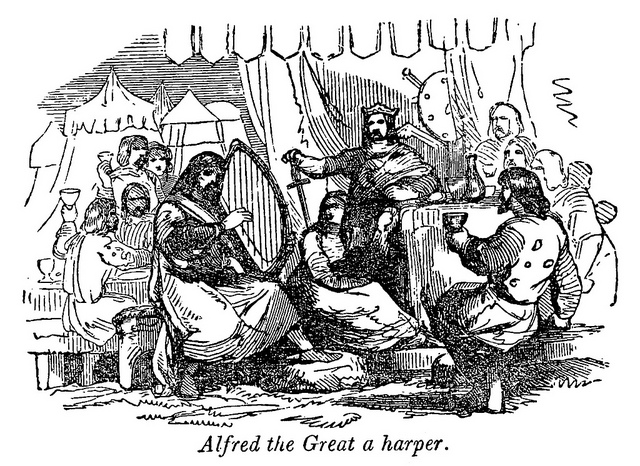
    Left: The Old English Paris Psalter. © Paris, BnF, Lat. 8824. Right: Alfred disguised as a harper in the Viking camp (source)

    Paris, Bibliothèque nationale de France, lat. 8824 (the ‘Paris Psalter’) is a unique manuscript dating to around 1050. The main texts of the manuscript are the 150 Latin Psalms with facing Old English translations: the first fifty Psalms are translated into Old English prose and another translator rendered the last hundred Psalms in Old English verse. Although the Paris Psalter does not mention the author of the Old English Psalm translations, the translator of the first fifty Psalms has been identified as none other than Alfred the Great (d. 899). The arguments for the attribution to Alfred concern the language of the prose translations (a ninth-century West Saxon dialect) as well as a twelfth-century chronicler recording that Alfred was working on a translation of the Book of Psalms but had not been able to finish it before he died. I have outlined these arguments in an earlier blog post on the Old English word earsling  (the ancestor word of the popular insult ‘arseling’), which occurs only in the Paris Psalter (see: Arseling: A Word Coined by Alfred the Great? ).

    Like the other translations associated with Alfred’s ‘educational revival’ (such as the Old English Boethius), the prose translations of the first fifty Psalms in the Paris Psalter are not entirely literal and often feature additional interpretations. A clear case in point is the rendition of Psalm 44:2 (My heart hath uttered a good word: I speak my works to the king: My tongue is the pen of a scrivener that writeth swiftly), which was expanded to:

    blog-parispsalter000-psalm-44
    Psalm 44 © Paris, BnF, lat. 8824, ff. 54r-54v

    As this passage illustrates, Alfred added allegorical interpretations of some of the phrases in the Psalm. These additions resulted in the Old English text being a lot longer than the Latin original. As we shall see, this difference in length caused some problems for the scribe of the Paris Psalter.

    Scribe of the Paris Psalter: Wulfwine ‘the Lumpy’

    The scribe of the Paris Psalter identifies himself in a colophon at the end of the manuscript:

    blog-parispsalter000-colophon
    Scribe’s colophon © Paris, BnF, lat. 8824, ff. 186r.

    Hoc psalterii carmen inclyti regis dauid. Sacer d[e]i Wulfwinus (i[d est] cognom[en]to Cada) manu sua conscripsit. Quicumq[ue] legerit scriptu[m]. Anime sue expetiat uotum.

    [This song of the psaltery by the famous King David the priest of God Wulfwine (who is nicknamed Cada) wrote with his own hand. Whoever reads what is written, seek out a prayer for his soul.]

    Wulfwine’s nickname ‘Cada’ means something like ‘stout, lumpy person’ (he is, by no means, the only Anglo-Saxon with a silly nickname, see: Anglo-Saxon bynames: Old English nicknames from the Domesday Book).

    Richard Emms (1999) has suggested that Wulfwine ‘the Lumpy’ may have come from Canterbury. He noted, for instance, that the Paris Psalter shares two rare features with another manuscript from Canterbury: its awkwardly long shape (the Paris Psalter is 52,6 cm long and only 18,6 cm wide) and a strange “open-topped a, looking rather like a u” at the end of some lines. Emms identified the same features in a late 10th-century manuscript of the Benedictine Rule from Canterbury (London, British Library, Harley 5431) and suggested this manuscript may have inspired Wulfwine:

    blog-parispsalter000-harley-5431
    Left: Paris Psalter © Paris, BnF, lat. 8824; Middle: Long-shaped Benedictine rule manuscript © The British Library, Harley 5431; Top right: “manus mea” in Paris Psalter; Bottom right: “tota anima” in Harley 5431

    The proposed localisation of Wulfwine in Canterbury is strengthened by the fact that some of the illustrations in the Paris Psalter resemble those of the Harley Psalter made in Canterbury (the Harley Psalter, in turn, was inspired by the ninth-century Utrecht Psalter, then in Canterbury). The illustrations of Psalm 4:6 (Offer up the sacrifice of justice) in both manuscripts are, indeed, similar:

    blog-parispsalter9-offerings-harleypsalter
    Left: Illustration of “Offer up the sacrifice of justice” (Ps. 4:6) © Paris, BnF, lat. 8824, fol. 3r; Right: The same scene in the Harley Psalter ©The British Library, Harley 603, fol. 2v.

    Emms (1999) was even able to locate a monk named Wulfwine in a late 11th-century necrology of the monastic community of St. Augustine’s, Canterbury:

    blog-parispsalter000-wulfwine-in-cotton-vitelius-cxii-fol-143v
    “Ob[it] Wulfwinus (scriptor) fr[ater] n[oste]r 7 Cecilia soror n[ost]ra” © The British Library, Cotton Vitelius C.xii, fol. 143v

    Could this Wulfwine ‘the scribe’ whose death was recorded in the late 11th-century Canterbury necrology really be the same person as scribe Wulfwine ‘the Lumpy’ who made the Paris Psalter and was inspired by at least two Canterbury manuscripts? As with the identification of Alfred the Great as the author of the prose translations, the evidence concerning the identity of the scribe Wulfwine is solely circumstantial, but the details do add up!

    Filling the gaps: Some illustrations from the Paris Psalter

    In producing the pages of the Paris Psalter, Wulfwine ‘the Lumpy’ had one particular problem: the Old English prose translation in the right hand column was often longer than the Latin original in the left-hand column. Consequently, the left-hand column often featured some gaps. Initially, Wulfwine tried to fill these gaps with illustrations; later, he tried to fix the problem by wrapping the Latin text in an awkward way; until he finally gave up on the idea of filling the left-hand column and simply let the gaps stand.

    blog-parispsalter33-filling-gaps
    Filling the gaps in the Paris Psalter with an illustration and by wrapping the Latin text © Paris, BnF, lat. 8824, ff. 3r, 12r

    That Wulfwine eventually abandoned the idea of filling the gaps with illustrations is to be regretted. While some of his illustrations match the well-known Harley Psalter, others are unique to the Paris Psalter and shed an interesting light on how an Anglo-Saxon interpreted these Psalm texts. Below, I provide my personal top five of the fabulous illustrations of the Paris Psalter.

    5) “Coochee coochee coo”

    blog-parispsalter7-and-you-raise-up-my-head
    Illustration of Psalm 3:4 © Paris, BnF, lat. 8824, fol. 2v

    Here, the artist has literally illustrated the Old English translation of Psalm 3:4: “þu ahefst upp min heafod” [you raise up my head]. I like how God gently seems to tickle the Psalmist under his beard.

    4) That moment when God thinks your beard needs trimming

    blog-parispsalter11-evilwillers-not-allowed-before-your-eyes
    Illustration of Psalm 5:5-6 © Paris, BnF, lat. 8824, fol. 3v

    This illustration shows a rather less cute interaction between God and a human being. The bearded figure, in this case, must be one of the “yfelwillenda” [those who want evil] or the “unrihtwisan” [the unjust], and God is intending to use his mega-scissors to remove this person from his sight.

    blog-parispsalter-beard-scissors

    3) Lion got your soul?

    blog-parispsalter14-a-lion-got-my-soul
    Illustration of Psalm 7:3 © Paris, BnF, lat. 8824, fol. 5r

    Another literal rendition: the lion trampling this young man is the enemy getting hold of a soul. Wulfwine here took inspiration from the Harley Psalter (or the Utrecht Psalter itself):

    blog-parispsalter14-a-lion-got-my-soul-harleypsalter
    Left: © Paris, BnF, lat. 8824, fol. 5r; Right: © The British Library, Harley 603, fol. 4r

    2) Struck by Cupid’s..err Satan’s arrows!

    blog-parispsalter16-he-shall-shoot-his-fiery-arrows
    Illustration of Psalm 7:14 © Paris, BnF, lat. 8824, fol. 6r

    A depiction of Ps. 7:14 (he hath made ready his arrows for them that burn) shows Satan shooting an arrow into the heart of the female part of a lovers’ couple.  Apparently, the couple had wild plans in their little love nest; note how the lovers are reaching between each other’s legs with their hands.

    blog-parispsalter-lovers

    1) What will happen to the evil-doers

    Psalm 5:7 (Thou hatest all the workers of iniquity: thou wilt destroy all that speak a lie. The bloody and the deceitful man the Lord will abhor) makes clear that God does not like those who commit evil acts and will seek to destroy them. The artist has depicted the first part of Psalm 5:7 as follows:

    blog-parispsalter12-you-hate-evildoers
    Illustration of Psalm 5:7 © Paris, BnF, lat. 8824, fol. 3v

    These evil-doers and liars are not, as I first thought, taking a trip in a boat; they are, in fact, in the mouth of Hell (see its little eye-ball on the left).

    blog-parispsalter-bootje

    The illustration of the second part of Psalm 5:7 (…The bloody and the deceitful man the Lord will abhor) is more spectacular:

    blog-parispsalter13-you-also-hate-evildoers
    Illustration of Psalm 5:7 © Paris, BnF, lat. 8824, ff. 3v-4r

    ‘If you pull my hair, I will stab your groin!’: Ouch!!!

    blog-parispsalter16-murderers-ouch

    If you liked the blog post, you may also enjoy:

    Works refered to: