This blog post introduces four new knowledge clips about an interesting topic: cultural contacts between ‘the East’ and ‘the West’ in the Early Middle Ages!
How much contact was there between early medieval England and the Middle East?
Fatima al Moufridji (one of my students at Leiden University, now doing her MA Viking and Early Medieval English Studies in Nottingham) was wondering about this very question, when she was introduced to a special coin from 8th-century England. The coin bears the name of the Anglo-Saxon king Offa of Mercia (757-796) but also has an inscription in Arabic; how did that happen and what other traces of cultural contact between England and Arabic speaking regions might be found? To find answers to these questions, Fatima and I applied for some funding from Leiden University’s Justice, Equity, Diversity and Inclusion (JEDI) fund. Our application was granted and we set out to make four short educational videos with the help of Leiden University’s Thomas Vorisek to spread awareness of the fact that early medieval England was not as isolated as one might think.
The links to the four videos are available at the bottom of this blog post, but just to peak your interest and give you a taste of the kind of texts, objects and individuals you might find in these videos, we each share our ‘top fives’ below!
Fatima al Moufridji’s top five
The Wonders of the East: “In our third video, we describe the Old English texts in the Beowulf manuscript that are not Beowulf – intriguingly, all these texts deal with the areas we now refer to as Northern Africa and the Middle East. My favourite one is ‘The Wonders of the East’, an Old English text that describes a wide variety of weird beings and monsters that live out in ‘the East’, ranging from headless monsters to exploding chickens! Being a Pokémon fan helps put this in the 1st spot, since it is basically an early medieval Pokedex.”
Theodore & Hadrian: “Our iconic duo! I think not crediting these two easterners for all they started in early Medieval England would be a crime: hailing from Northern Africa and the Middle East, Theodore and Hadrian established a famous school in England near the end of the seventh century, as we discuss in our fourth video. And what is interesting is that at Leiden University, we actually have an early medieval manuscript that can be linked to their educational efforts!”
Anglo-Saxon dreambook: “Did Anglo-Saxons really dream about exotic animals like camels and lions? And what did they think these dreams meant? It was interesting to see what kind of predictions people came up with when it comes to their dreams, one of the things that fascinated me the most about this aspect. And guess where they got their information from?”
Hygeburg (fl. 760-780): “A nun, responsible for writing down the travel stories of the Anglo-Saxon pilgrim Willibald who travelled through the Holy Land. Even though she did not write down her own experiences, she did give us a great piece of evidence for our second video, on people travelling long distances. I personally do suspect that she may have had a little crush on Willibald, whom she showers in praise!”
Bede’s Ecclesiastical history of the English people: “Our videos are full of tongue-twisters, with quotations in Old English, Latin and Arabic, but somehow the word I struggled most with was “ecclesiastical”, part of the title of one of our favourite and most important sources: Bede’s Ecclesiastical History of the English People – loved pronouncing that!”
Thijs Porck’s top five
Offa coin: “The Offa coin with its Arabic inscription is such an interesting object and really epitomizes the idea behind our videos: there was contact between these distant regions! It was really cool to listen to Fatima read out the inscription and see her pointing out some of the errors that the Anglo-Saxon die-cutter made in our first video.”
Leofwine silk: “I have a particular fascination for the Anglo-Saxon missionaries that brought Christianity to the Low Countries, people like Willibrord, Boniface and Leofwine (Lebuinus). So, I was pleasantly surprised that we could include some of these inspiring people in our videos: as it turns out, Boniface had a thing for exotic gifts and the bones of Leofwine were preserved in an piece of fabric that would have come in via the famous Silk Road. The Leofwine silk also allowed us to make one (of several) silly jokes.”
The Leiden Glossary: “Leiden University has the biggest collection of medieval manuscripts in the Netherlands and we also have a number of Old English manuscripts. Being able to showcase one of these with a link to the famous school of Theodore and Hadrian was a particular delight in making our fourth video!”
Willibald: “Willibald travelled all the way to the Holy Land and thanks to Hygeburg we know quite a lot about his experiences. One of the challenges of making our second video about this super-interesting text was the lack of illustrations, so I had a go at drawing scenes from his journeys myself!”
Cynocephali: “Dog-headed people! What a strange and awkward idea, but, apparently, pretty common in Anglo-Saxon imaginations of the East. We were surprised (and Fatima slightly annoyed) at how often these beings seemed to recur in the Beowulf manuscript!”
Want to find out more about all these interesting objects, texts and individuals? Watch our videos below or via this playlist on YouTube!
Video 1: Traces of trade between early medieval England and the Middle East: Coins, cloth and condiments
What are all these Arabic coins doing in early medieval England? What did Anglo-Saxons use exotic silks for and where did they get their spices? Join us as we explore some traces of trade between the East and the West in the early Middle Ages!
Video 2: Early medieval encounters: Travelling Arabs and Anglo-Saxons
Did you know that people travelled long distances in the Early Middle Ages? Learn more about a tenth-century Arabic description of Britain, the travels of St. Willibald through the Middle East and some pro-tips on using a calabash!
Video 3: Old English imaginations of the East: The other texts in the Beowulf manuscript
Beowulf is awesome! But the other Old English texts in the Beowulf manuscript are interesting as well – not in the least because they give us an idea of how Anglo-Saxons imagined areas including Northern Africa and the Middle East.
Video 4: Anglo-Saxon learning and intellectual import from the Middle East and Northern Africa
Learn more about the inspiring story of Theodore and Hadrian, two scholars from Northern Africa and the Middle East, who made their way to early medieval England! We also discuss the origins of some Anglo-Saxon medical texts (what’s up with all the snakes!?) and the engimatic prognostic texts!
One of the most important liturgical books in early medieval England was the Psalter. Some thirty Anglo-Saxon manuscripts containing the complete Psalter have survived, including no fewer than fifteen with (partial or complete) Old English interlinear glosses (that is: a word-for-word English translation between the Latin lines). While multiple manuscripts of the same well-known text may seem like a rather dull topic, the Old English glossed Psalters are fascinatingly different, as this blog post will demonstrate.
Different versions of the same Psalm verse (101:28)
To illustrate some of the diversity among the Old English glossed Psalters, here is the same Psalm verse (101:28 “Tu autem ipse es et anni tui non deficient”; You are truly the same and your years will not fail) in four different manuscripts with Old English glosses.
Psalm 101:28 in four different glossed Psalters. N.B. It is common practice to refer to these Old English glossed Psalters with their names, like ‘Vespasian Psalter’ or sigla (letter codes) A-P rather than the full manuscript shelf marks (a full list is provided at the bottom of this blog post.
One clear difference between these Old English glossed Psalters is the scripts that the scribes used. The eighth-century Vespasian Psalter, for instance, uses an uncial script for the Latin text and is accompanied by a later, ninth-century Old English gloss in a much smaller minuscule script. In the Winchcombe Psalter (1025-1050), the same scribe was responsible for both the Latin and the Old English text, using a round insular minuscule for the Old English and a Caroline minuscule for the Latin, as well as alternating coloured inks (red for Old English; black for Latin). A similar combination of Caroline and insular scripts, though without the alternating colours, was used by the scribe of the mid-tenth-century Royal Psalter. The early-eleventh-century scribe of the Lambeth Psalter added a third layer of glosses, the dots underneath.
There are more differences if we turn to what the letters actually spell out. They each give the same Latin text (“tu autem idem ipse es et anni tui non deficient”), although there are some differences in abbreviations (e.g., the Vespasian Psalter and Winchcombe Psalter spell out “autem” in full; but the Royal Psalter and the Lambeth Psalter give “aut” with an abreviation mark; the latter also provides the ampersand “&” while the others give “et”). The Old English translations show more profound differences:
Vespasian Psalter: ðu soðlice se ilca earð 7 ger ðin ne aspringað Winchcombe Psalter: þu soðlice se ylca iert 7 ger þine ne ateoriað Royal Psalter: se ilca selfa eart 7 gear þine na geteoriað Lambeth Psalter: þu soðlice se ilca sylf eart 7 gæres ðine ne ateoriað
These four Old English translations of the same Latin line clearly differ in spelling (ger, gear, gæres) and word choice (aspringað, ateoriað, geteoriað) – these differences are linguistically significant as we will explore further below.
Old English language through timeand place
One variation factor among the Old English glossed Psalters is that they were written at different times and places, which means we can see diachronic and dialectal differences between them. A clear example is found in the Old English glosses for Latin “anni” [years] in Ps. 101:28 above: the Vespasian and Winchcombe Psalters give the form “ger”, the Royal Psalter gives “gear”, while the Lambeth Psalter gives “gæres”. The difference between the Vespasian and Winchcombe Psalter on the one hand and the Royal Psalter on the other is one of dialect: the Royal Psalter’s “gear” shows ‘palatal diphthongization’ (a singular vowel sound changes into a combination of two vowels, when preceded by a /j/-sound), which is a feature of the West Saxon dialect of Old English, while the Vespasian and Winchcombe Psalters give the Mercian dialect form without diphthongization: “ger”.
The Lambeth Psalter’s form “gæres” is actually grammatically incorrect and this form reveals that this gloss is later than the other ones. The -es ending here indicates that the word is plural, but this plural form is ‘not according to Old English grammar rules’. Here is a complex explanation: in ‘proper Old English’, the word “gear/ger” is a strong neuter noun with a long stem, which does not get an ending to mark the plural (just like modern English sheep: one sheep, two sheep; NOT two sheep-s). By the end of the Old English period, when the Lambeth Psalter was made, the grammatical system of Old English was starting to change and eventually the -s plural (originally reserved for strong masculine nouns) came to be used for all nouns with few exceptions (e.g., Modern English sheep~sheep, ox~oxen), because of a process called ‘analogy’ (frequently used forms become the norm). Long story short, the Lambeth Psalter’s “gæres” is a late form anticipating Modern English year-s, while the “ger/gear” form represents earlier Old English (this also explains why the Lambeth Psalter gives the vowel “æ”, which is a later development from West Saxon “ea”).
Other linguistic differences stem from word choice, which may be influenced by dialect or time of composition, but could also be due to the glossator’s personal preference. In Ps. 101:28, for instance, the glossator of the Vespasian Psalter decided to translate Latin “deficient” with a form of apsringan ‘to fall, cease, fall away’, while the other Psalters have a form of ateorian/geteorian ‘to fail, come to an end’. Either synonym works fine as a translation of the Latin. There are also cases where glossators gave multiple synonyms for one Latin word, such as the following example from the Arundel Psalter, which may come in handy if all this linguistic stuff has made you a little drowsy:
A triple gloss for the Latin word “dormitationem” (Ps. 131:4) in the Arundel Psalter. The three glosses are separated with the abbreviation mark “ł”which stands for Latin “uel” [or].
Rather than giving just one translation for the Latin word “dormitationem”, the glossator provides three alternatives: “hnappunge”, “slæp” and “reste” – nap, sleep or rest. This glossator certainly was not asleep on the job!
To gloss or not to gloss: Glossing techniques
Another fundamental difference between the Old English glossed Psalters lies in their differing glossing techniques. For instance, there are Psalters in which every individual Latin word is glossed, as in the Vespasian Psalter, Winchcombe Psalter and Lambeth Psalter, while other Psalters tend not to gloss personal and place names or common words. In the gloss for Ps. 101:28 in the Royal Psalter, the words “tu” and “autem” are not glossed as the glossator apparently assumed the reader would have been familiar with these basic words.
Another issue that is dealt with in different ways in various Old English glossed Psalters is the Latin syntax. The typical word order of Latin differs from that of Old English – for example, in Latin, the possesive pronouns often follow the nouns they modify, whereas in Old English they would typically precede the nouns: Latin “anni tui” (lit. ‘years your’) would be “þine gear” in Old English, ‘your years’. In most Old English glossed Psalters, the Old English glosses follow the Latin word order and, therefore, result in unnatural Old English phrases, such as “gear þine” in the Royal Psalter. However, the scribe of the Lambeth Psalter found a solution to this problem: he added so-called ‘dot glosses’ underneath the Latin words that indicated the Old English word order (I explain this system here: Reading between the lines in early medieval England: Old English interlinear glosses).
Other Old English glossators simply rearranged the word order of the glosses, like the one responsible for this Old English gloss of Ps. 121:2 (‘Our feet were standing in your courtyards, Jerusalem’) in the Junius Psalter:
Psalm 121:2 in the Junius Psalter
Here the Old English glosses for the Latin phrases ‘pedes nostri’ and ‘atriis tuis’ have been ‘normalised’ to ‘ure fet’ and ‘þinum cafertunum’. You can also see that this glossator did not think it was useful to gloss the name Jerusalem.
Beatus-ful illuminations!
But it is not just linguistics that makes the Old English glossed Psalter fascinating things to look at: some of them are beautifully decorated! The opening lines of Psalms 1, 51 and 101, in particular, got additional artistic attention as they marked the beginning of three sections of fifty Psalms. Have a look at the opening of Psalm 1, which starts with ‘Beatus uir’ [‘Blessed man’], in three of the Old English glossed Psalters, below:
Beatus pages in three Old English Glossed Psalters.
These so-called ‘Beatus pages’ give the Psalters a stunning opening and the page often comes with the creative use of different coloured inks. Note how the Bosworth Psalter alternates between blue and red lines, while the Arundel Psalter has letters in red, blue and green. The decorated border of the Tiberius Psalter is so thick that there is little room for text in the middle; the Arundel Psalter, meanwhile, has a thinner border but a bigger capital B; a so-called ‘historiated initial’, depicting King David (who was assumed the be the author of many Psalms):
King David in the historiated initial of the Arundel Psalter
While King David plays the harp in the historiated initial of the Arundel Psalter, to the right of the initial we find the Latin words ‘Beatus uir’, accompanied by the Old English gloss ‘eadi wer’ [blessed man].
Mis-en-page to avoid mess-on-page
Arranging a manuscript page for lines of Latin text that left enough room for the accompanying layer of Old English glosses required careful planning. Here are two examples of planned-out ‘mis-en-page’ (the way text appears on the page), as well as one example of a page on which there was not enough space for the huge amount of glossing (in this case explanatory glosses that were added later) :
Varying text and gloss arrangements in three Old English glossed Psalters.
The third example clearly has a more messy appearance, since the planned space for glossing was smaller than it needed to be.
While correctly planning out a singular Latin text and one layer of Old English gloss was no mean feat, Eadwine, a twelfth-century monk from Canterbury, took on an even bigger challenge: the so-callled ‘Eadwine Psalter’ for which he was responsible is home to three different Latin versions of the Psalter, each accompanied with a different gloss, -and- a series of Psalter illustrations:
The Opening of Psalm 23 in the Eadwine Psalter
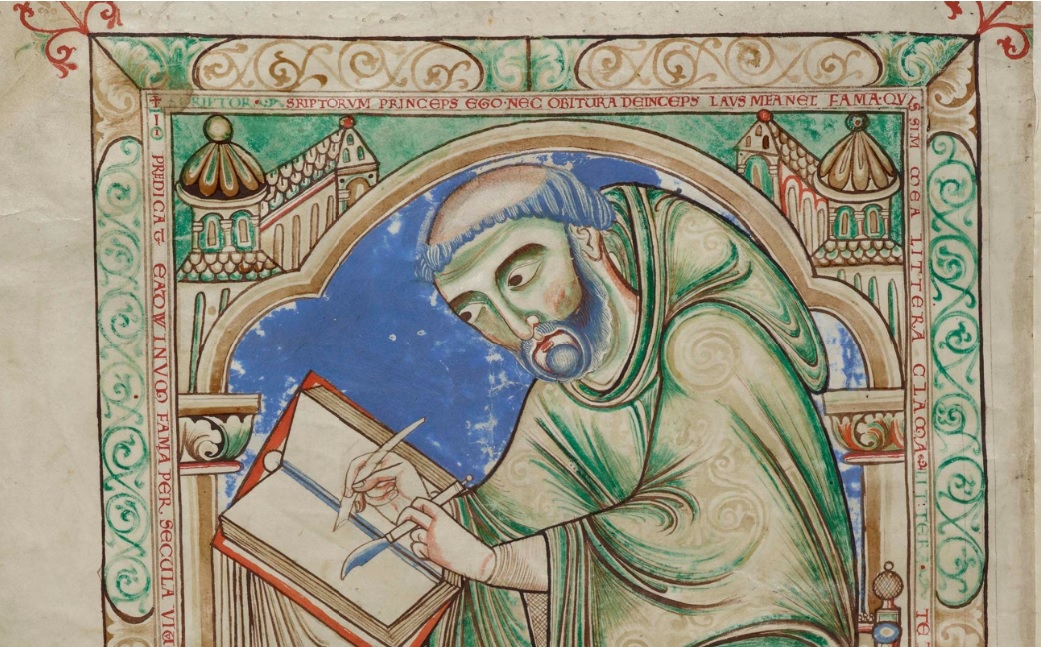
The broadly spaced Latin text on the outer edges of the left- and right-hand page is the Gallican version of the Psalter (marked “Gall.” on the bottom of the left page and on the top of the right page), with explanatory glosses in Latin between the lines and in bother margins. The second more narrow narrow column (marked “Rom.”) is the Romanum version of the Latin Psalter, with Old English interlinear glosses, while the column closest to the middle of the book (rightmost on the left page; leftmost on the right page) gives the Hebraicum version of the Latin Psalter, with Anglo-Norman interlinear glosses. Psalter-ception! Making sure that each page gave corresponding passages in the three Latin versions of the Psalter as well as making enough room for the glossing required Eadwine to carefully adjust the sizes of scripts, spacing and distribution of the text on the page. Managing all this, Eadwine certainly deserves the epithet of ‘s[c]riptorum princeps’ [master of scribes] with which he was described in the text surrounding his famous ‘author-portrait’ at the end of the Psalter that bears his name.
Portrait of Eadwine, part of the text surrounding this portrait reads: “SRIPTORUM PRINCEPS EGO NEC OBITURA DEINCEPS LAVS MEA NEC FAMA” [I am the chief of scribes.; neither my praise nor my fame will die one after the other]. Ironically, there is a scribal error in the word “sriptorum”, which should read “scriptorum”. Eadwine Psalter (E), fol. 283v.
The language, glossing technique, illuminations and mis-en-page are but some of the fascinating aspects of the Old English glossed Psalters (others include annotations by later users, scribes making mistakes, curious initials and so on); in future blog updates, I hope to devote posts to individual Old English Psalters to create a fifteen-part series, starting with the Vespasian Psalter (A). Stay tuned!
If you want to be alerted to subsequent blog posts, make sure to subscribe to this blog, using the box below. If you can’t wait for a next blog post to appear, check out the following related blog posts:
Stowe Psalter (F): London, British Library, Stowe 2
Vitellius Psalter (G): London, British Library, Cotton Vitellius E.xviii
Tiberius Psalter (H): London, British Library, Cotton Tiberius C.vi
Lambeth Psalter (I): London, Lambeth Palace, MS 427
Arundel Psalter (J): London, British Library, Arundel 60
Salisbury Psalter (K): Salisbury, Cathedral Library, MS 150
Bosworth Psalter (L): London, British Library, Additional 37517
Blickling Psalter (M): New York, Pierpont Morgan Library, M. 776
Fragments of Old English glossed Psalter (N): Cambridge, Pembroke College, 312, C, 1-2; Haarlem, Noord-Hollands Archief, 188 F 53; Sondershausen, Schlossmuseum, Lat. liturg. IX 1
Paris, Biblitohèque Nationale, Lat. 8846 (O)
Paris Psalter (P): Paris, Bibliothèque Nationale, Lat. 8824 (not a glossed Psalter; but a Psalter with facing Old English translation, see this blog post)
Relevant literature on the Old English glossed Psalters
Philip Pulsiano, ‘Psalters’, in The Liturgical Books of Anglo-Saxon England, ed. R. W. Pfaff (Kalamazoo, 1995), 61-86.
This blog post features an Anglo-Saxon trivia quiz that will test (and/or increase) your knowledge about magical medicine in early medieval England.
A bad reputation for early medieval medicine
Whereas the bulk of early medieval English medicine consists of herbal and botanical remedies, some of the more fanciful ways to alleviate various ailments border on witchcraft. These remedies involve incantations, love potions, occult rituals and references to supernatural beings including dwarfs and elves. According to some early scholars, there was a fine line between magic and medicine and, as a result, much of early medieval English medicine should be regarded as little more than nonsense:
Surveying the mass of folly and credulity that makes up Anglo-Saxon leechdoms, it may be asked “Is there any rational element here? Is the material based on anything that we may describe as experience?” The answer must be “Very little”
(J. H. G. Grattan and C. J. Singer, Anglo-Saxon Magic and Medicine (Oxford, 1952), p. 92)
Indeed, it is not hard to find examples of seemingly irrational, magical medicine in Anglo-Saxon sources, as the following trivia quiz will illustrate.
Have you got the folly and credulity to be an Anglo-Saxon doctor?
The following 10-question-quiz introduces some characteristics and intriguing examples of ‘magical medicine’ from Anglo-Saxon England. Each multiple-choice question has at least one right answer and clicking this will reveal an explanation with further information. Good luck! N.B. Unfortunately the quiz does not work in all mobile browsers (such as the Twitter browser), if you see all the explanations expanded, better use another browser!
1. The best cure against a head ache is:
Lying on a dog’s head, burned to ashes.
Correct! A common principle in early medieval medicine is ‘sympathetic magic’: the cure often resembles the disease. In the case of a head ache, you use a dog’s head. No actual puppies were harmed during this remedy, however, since Old English hundes heafod ‘dog’s head’ was the name for the plant now known as the small snapdragon [Antirrhinum orontium]. Here is a drawing of the hundes heafod in the eleventh-century Old English Herbal:
“Hundes Heafod” (Small snapdragon) in London, British Library, Cotton Vitellius C.iii, fol. 45v.
Drinking a hen’s egg, mixed in warm ale.
Singing nine Pater Nosters.
Leeches.
2. In an Anglo-Saxon aphrodisiac, you would likely use:
Oysters.
A carrot and two plums.
Leeches
Deer testicles.
Correct! The principle of sympathetic magic may be at work here as well. This ‘love potion’ is found in the Old English translation of Medicina de quadrupedibus:
Wif gemanan to aweccanne, nim heortes sceallan, dryg, wyrc to duste, do hys dæl on wines drinc. Þæt awecceþ wif gemanan lust. (London, British Library, Cotton Vitellius C.iii, fol. 76v.) [To arouse a woman for sexual intercourse, take the testicles of a deer, dry them, grind them to dust, do a part of this in a drink of wine. That will arouse a woman with the lust for intercourse.] Read more about Anglo-Saxon aphrodisiacs here: Anglo-Saxon aphrodisiacs: How to arouse someone from the early Middle Ages?
3. A hiccough is most likely caused by:
Accidentally swalllowing an elf.
Correct! The Old English word for hiccough was ælfsogoða ‘elf-sucking’, suggesting a hiccough was caused by sucking in an elf. Elves, dwarves and worms were often assumed to be the cause of diseases in Anglo-Saxon magico-medicine.
An imbalance of the humours.
Drinking too quickly.
Leeches.
4. Which is the best cure against warts?
A mixture of dog’s urine and mouse blood.
Correct! Waste products were often used in Anglo-Saxon medicine.
“Wiþ weartum. Genim hundes micgean 7 muse blod, meng to somne, smire mid þa weartan, hig witaþ sona aweg.” (British Library, Royal 12 D XVII, fol. 116r) [Against warts. Take the urine of a dog and mouse blood, mix together, rub the warts with it, they will immediately go away.]
Applying some leeches.
Cutting them off with a heated knife.
5. In case of severed sinews, I apply:
The bark of a young and healthy tree.
Earthworms.
Another case of sympathetic magic: Earthworms resemble sinews and, as an added bonus, they regenerate after being cut in half. What better to use for severed sinews?
Gif sinwe syn forcorfene nim renwyrmas, gecnuwa wel, lege on oþ þæt hi hale synd.” (British Library, Royal 12 D XVII, fol. 118r) [If the sinews are cut, take earthworms (lit. rain-worms), pound them wel, lay them on until they are whole.
Leeches.
6. Throwing a dungbeetle over your shoulder and saying “Remedium facio ad ventris dolorem” three times will:
Give you the power to cure stomach aches for a full year.
Get rid off an annoying itch between your shoulder blades.
Get rid off the dungbeetle.
Technically correct, but try again!
Alleviate diarrhea in the entire village.
7. A child has a fever, you:
Put it on a rooftop in the sun.
Correct! This way of curing a child was considered rather sinful and is mentioned in various Anglo-Saxon penitentials, including this one:
“Gyf hwylc wif seteð hire bearn ofer rof oððe on ofen for hwilcere untrymðe hælo .vii. gear fæste” (Brussels, Bibliothéque royale, 8558-63, fol. 152v) [If any woman sets her child on a roof or in an oven for the cure of any illness, fast for seven years].
Put it in an oven.
Correct! This way of curing a child was considered rather sinful and is mentioned in various Anglo-Saxon penitentials, including this one:
“Gyf hwylc wif seteð hire bearn ofer rof oððe on ofen for hwilcere untrymðe hælo .vii. gear fæste” (Brussels, Bibliothéque royale, 8558-63, fol. 152v) [If any woman sets her child on a roof or in an oven for the cure of any illness, fast for seven years].
Apply leeches on its forehead.
8. Against heart ache:
Ribwort, boiled in milk, drink it for nine mornings.
Correct! Nine is a magic number that is often used in Anglo-Saxon magico-medicine.
Ribwort, boiled in milk, drink it for seven mornings.
Ribwort, boiled in milk, drink it for six mornings.
Ribwort, boiled in milk, drink it for three mornings.
9. Which one of these remedies is NOT an actual Anglo-Saxon remedy?
Against a stomach ache, sleep next to a fat child.
Nope, this one is real:
“Him hylpð eac þæt him fæt cild æt slape 7 þæt he þæt gedo neah his wambe simle”(British Library, Royal 12 D XVII, fol. 83r) [It also helps him that a fat child should sleep by him, and that he should put it always near his (stomach).]
Against madness, hit the patient with a whip made of dolphin skin.
Nope. This one is real:
“nim mereswines fel, wyrc to swipan, swing mid þone man sona bið sel. Amen.” (British Library, Royal 12 D XVII, fol. 120r) [take the skin of a dolphin, make into a whip, hit the man with it. He is immediately healthy. Amen.] Note that the ‘Amen’ was added by a later hand!
Against misty eyes, rub the eyes with child’s urine and honey.
Nope. This one is real:
“Gif mist sie fore eagum nim cildes hlond 7 huniges tear meng tosomne begea emfela smire mid þa eagan innan” (British Library, Royal 12 D XVII, fol. 112r) [If a mist is before the eyes take a child’s urine and a drop of honey, mix them both together equally, smear it into the eyes].
None; They are all real.
Correct! Click on all individual answers to see the actual early medieval English remedies.
10. Your patient has a sore throat, you prescribe:
Drink heated honey with some herbs.
Correct! Not all Anglo-Saxon medicine is magical or silly!
Gurggle with the spittle of a horse.
No! Don’t be silly.
Take the neck of a goose and wrap it around the patient’s neck.
No! Don’t be silly.
Nine leeches.
No! Don’t be silly.
Put the patient in an oven.
No! Don’t be silly.
Does early medieval English medicine deserve its bad reputation?
While the quiz above may suggest that Grattan and Singer were justified in rejecting Anglo-Saxon medicine as folly and credulity, more recent scholarship has suggested this harsh criticism is undeserved. Treatments with magical and irrational elements only make up about fifteen percent of all early medieval English remedies. The majority can be categorised as herbal medicine, an alternaive form of medicine still practised today. M. L. Cameron tested out some of the ingredients in Anglo-Saxon remedies and concluded:
Did ancient and medieval physicians use ingredients and methods which were likely to have had beneficial effects on the patients whose ailments they treated?… I think the answer is “Yes, and their prescriptions were about as good as anything prescribed before the mid-twentieth century”. (M. L. Cameron, Anglo-Saxon Medicine (Cambridge, 1993), p. 117)
In other words, Anglo-Saxon medicine may not have been as ineffectual as it might seem. In fact, a few years ago, an Anglo-Saxon remedy for eye stye shocked the world by being able to succeed where modern antibiotics had failed:
CNN news report on Anglo-Saxon potion (more on this remedy here)
Perhaps, then, Anglo-Saxon medicine deserves more than a silly trivia quiz, but that’s something for future blog posts!
Kings, queens, warriors and monks often take centre stage in writings about Anglo-Saxon England; by contrast, this post calls attention to the beings that generally shunned the limelight: worms, earwigs, scorpions, spiders and dungbeetles. As it turns out, these minibeasts played an important role in early medieval medicine.
Lice for the learned: Crawling among the glosses
While Anglo-Saxon England must have been crawling with all sorts of little critters, ‘minibeasts’ (a general term denoting insects, spiders, scorpions and such) only rarely receive mention in Old English texts. In fact, most Old English words for various bugs only survive because they were listed as glosses (translations) of Latin words. The so-called ‘Leiden Glossary’ (c. 800), for instance, features the Old English words “hnitu” (‘nit’ for Latin lendina); “ęruigga” (‘earwig’ for Latin auricula) and “snægl” (‘snail’ for Latin maruca):
Insects in the Leiden Glossary. Leiden University Library, Special Collections, VLQ 69, fol. 35v.
Other minibeasts whose names only survive as glosses include:
ticia ‘tick’
beaw ‘gad-fly’
sidwyrm ‘silk worm’
seolcwyrm ‘silk worm’
rensnægl ‘rain snail’
sæsnægl ‘sea snail’
buterfleoge ‘butterfly’
eorþ-maþa ‘earth worm’
Some of these buggy Old English glosses are wonderfully descriptive, such as flǣsc-maþu ‘maggot, lit. flesh-worm’ and niht-butorflēoge ‘moth, lit. night-butterfly’.
Invasive insects: Purging pests with Anglo-Saxon medicine
Some creepy crawlies and the common ivy in the Old English Herbarium. London British Library, Cotton Vitellius C.iii, fol. 50r
Other than glossaries, Anglo-Saxon medical texts are the best place to find creepy crawlies. Anglo-Saxon medical practicioners were well aware of the dangers posed by parasites for the well-being of their patients. As such, Anglo-Saxon medicine features various recipes to purge the body of bugs. Bald’s Leechbook (compiled in the ninth century) provides ample examples of such remedies against invading worms and earwigs:
Wiþ wyrmum on eagum genim beolonan sæd, scead on gleda, do twa bleda fulle wæteres to, sete on twa healfe 7 site þær ofer, bræd þonne þæt heafod hider 7 geond ofer þæt fyr 7 þa bleda eac, þonne sceadaþ þa wyrmas on þæt wæter.
Wiþ earwicgan genim þæt micle greate windelstreaw twyecge þæt on worþium wixð, ceow on þæt eare. He bið of sona.
[For worms in eyes, take seed of henbane, shed it onto glowing embers, add two saucers full of water, set them on two sides of the man, and let him sit there over them, jerk the head hither and thither over the fire and the saucers also, then worms shed themselves into the water.
Against earwigs, take the big great windlestraw with two edges, which grows on highways, chew it into the ear; he (the insect) will soon be off.] (ed. and trans. Cockayne 1864, 38-39; 44-45 – I have slightly modernized the translation)
As these two remedies demonstrate, Anglo-Saxon medical practice could involve a mixture of bodily maneuvers (some practical, other less so) and the application of herbs.
Aggresive arthropods: Curing scorpion and spider bites in early medieval England
A snake and a scorpion in the entry for common plantain in the Old English Herbarium. London, British Library, Cotton Vitellius C. iii, fol. 21v
The beautiful Old English Herbarium (an eleventh-century Old English translation of a fifth-century Latin text) is a testimony to the importance of herbs in Anglo-Saxon medicine. The Herbarium gives illustrations for each herb, followed by various remedies that can be made with them. The common plantain (or: waybread), for instance, was said to help against the bites of scorpions, as well as intestinal worms:
Wiþ scorpiones slite genim wegbrædan wyrtwalan, bind on þone man. Þonne ys to gelyfenne þæt hyt cume him to godre are.
Gif men innan wyrmas eglen genim wægbredan seaw, cnuca 7 wring 7 syle him supan 7 nim ða sylfan wyrte, gecnuca, lege on þone naflan 7 wrið þærto swyðe fæste. (London, British Library, Cotton Vitellius C. iii, fol. 22r)
[Against the bite of a scorpion, take the roots of the plantain, bind them onto the man. Then it is believed that it will come to good use for him.
If intestinal worms harm a man, take the juice of the waybread, pound and wring, give it to him to drink and take the same plant, pound it to dust, put it on the navel (or: anus) and fasten it tightly thereto.]
The Old English Herbarium has various recipes against the bites of scorpions, despite the fact that, for as far as I know, these critters were not native to Anglo-Saxon England.
Another biting bug to be featured in the Old English Herbarium is the spider, whose bites may be alleviated with the help of the herbs vervain, ivy and stonecrop. Yet another medical text, known as Leechbook III, features a more obscure remedy for a spider bite:
Cure against spider bite in Leechbook III. London, British Library, Royal 12 D XVII, fol. 118r
Uiþ gongewifran bite nim henne æg, gnid on ealu hreaw 7 sceapes tord niwe, swa he nyte, sele him drincan godne scenc fulne.
[Against the bite of a spider, take a hen’s egg, mix it raw in ale with a fresh sheep’s turd, so that he does not know, give him a good cup full to drink.]
This cure seems hardly effective! Although it would, I suppose, prevent people from ever complaining about spider bites again. This cure also demonstrate another aspect of Anglo-Saxon medicine: some of its remedies make absolutely no sense or even come across as magical. (also worthy of note: the Old English word gongewifran literally means ‘a weaver as it goes, a walking weaver’!)
Another scorpion from the Old English Herbarium. London, British Library, Cotton Vitellius C.iii, fol. 78r
Medicinal minibeast magic: Creepy crawlies as part of the cure
The ‘magical’ side of Anglo-Saxon medicine truly comes to the fore in those remedies that feature insects not as causes of diseases, but as parts of the cure. Some of these cures rely on what might be termed ‘sympathetic magic’, a type of magic based on imitation or correspondence – i.e. the cure often resembles the ailment. Leechbook III seems to be appealing to this kind of magic when it proposes to use earthworms and ants in the case of severed or shrunken sinews:
Cures against severed and shrunken sinews in Leechbook III. London, British Library, Royal 12 D XVII, fol. 118r
Gif sinwe syn forcorfene nim renwyrmas, gecnuwa wel, lege on oþ þæt hi hale synd. Gif sinwe sien gescruncene nime æmettan mid hiora bedgeride, wyl on wætre & beþe mid & rece þa sinwe geornlice.
[If the sinews are cut, take earthworms (lit. rain-worms), pound them wel, lay them on until they are whole. If the sinews are shrunk, take ants and their nest, boil in water and bath therwith the sinews and expose them earnestly to the smoke]
The rationale behind these cures is simple: since earthworms can regenerate after having been cut, they must surely be able to help severed sinews; the best thing to use against small sinews is small insects like ants.
Leechbook III also features another peculiar cure, which involves a dung beetle. The occult procedure outlined below promises to give the practitioner the ability to cure stomach aches for a whole year:
Þær þu geseo tordwifel on eorþan up weorpan, ymbfo hine mid twam handum mid his geweorpe. Wafa mid þinum handum swiþe and cweð þriwa: Remedium facio ad ventris dolorem. Weorp þonne ofer bæc þone wifel on wege. Beheald þæt þu ne locige æfter. Þonne monnes wambe wærce oððe rysle, ymbfoh mid þinum handum þa wambe. Him biþ sona sel. XII monaþ þu meaht swa don after þam wifel. (London, British Library, Royal 12 D XVII, fol. 115r)
[Where you see a dungbeetle throw up on the earth, grab it with two hands along with its dung-ball. Wave greatly with your hands and say three times: Remedium facio ad ventris dolorem (I make a a cure for the pain in the stomach). Throw then the beetle over your shoulder onto the way. See to it that you do not look back. In case of a person’s stomach or abdomen pain, grab with your hands the stomach. It will soon be whole for them. You are able to do this for twelve months after the beetle.]
I wonder how many Anglo-Saxon dungbeetles fell prey to aspiring doctors in search of ways to alleviate rumbling tummies.
The Anglo-Saxon remedies described above would certainly be classified as ‘alternative’ by modern standards and it is to be hoped that today’s medical professionals have found more effective ways to remedy diseases caused by worms, earwigs, spiders, scorpions and other parasites.
If you liked this blog post, you may also enjoy:
Creepy crawlies in the Old English Herbarium. London, British Library, Cotton Vitellius C.iii, fol. 59r
Works referred to:
T.O. Cockayne (1864). Leechdoms, wortcunning, and starcraft of early England. Vol. 2 (London)
Among all of his responsibilities, Alfred the Great found the time to invent the candle clock. As this blog post will demonstrate, Alfred, by no means, was the only Anglo-Saxon king to have a thing for candles.
Alfred the Great: Inventor of time management and the candle clock
Eight Hour Day Banner, Melbourne, 1856
The slogan “Eight hours labour, eight hours recreation, eight hours rest” is supposed to have been coined by the social reformer Robert Owen (d. 1858); but the Anglo-Saxon King Alfred the Great (d. 899) seems to have divided his time in a similar way. According to the twelfth-century chronicler William of Malmesbury:
he [Alfred] so divided the twenty-four hours of the day and night as to employ eight of them in writing, in reading, and in prayer, eight in the refreshment of his body, and eight in dispatching the business of the realm. There was in his chapel a candle consisting of twenty-four divisions, and an attendant, whose peculiar province it was to admonish the king of his several duties by its consumption. (source)
Assuming that Alfred regarded writing, reading and praying as recreation – Alfred’s daily routine, as described by William, is quite similar to Robert Owen’s slogan.
William’s reference to “a candle consisting of twenty-four divisions” refers to a famous story related in Asser’s Life of Alfred (893), which recounts how Alfred invented a “candle clock” consisting of six candles (not one), which each burned for four hours:
By this plan, therefore, those six candles burned for twenty-four hours, a night and day, without fail… but sometimes when they would not continue burning a whole day and night, till the same hour that they were lighted the preceding evening, from the violence of the wind, which blew day and night without intermission through the doors and windows of the churches … the king therefore considered by what means he might shut out the wind, and so by a useful and cunning invention, he ordered a lantern to be beautifully constructed of wood and white ox-horn, which, when skilfully planed till it is thin, is no less transparent than a vessel of glass. … By this contrivance, then, six candles, lighted in succession, lasted four and twenty hours, neither more nor less, and, when these were extinguished, others were lighted. (source)
Æthelwulf of Wessex: Coins and candle holders for the pope
Anglo-Saxon coin inscribed with “EĐELVVLF REX” (source)
Alfred may have gotten his interest in lights and candles from his father Æthelwulf of Wessex (d. 858). Upon his death, Asser reports in his Life of Alfred, Æthelwulf ordered an annual sum of money to be sent to Rome of which a major part was to be spent on lighting lamps at Easter:
He commanded also a large sum of money, namely, three hundred mancuses, to be carried to Rome for the good of his soul, to be distributed in the following manner: namely, a hundred mancuses in honour of St. Peter, specially to buy oil for the lights of the church of that apostle on Easter eve, and also at the cock-crow: a hundred mancuses in honour of St. Paul, for the same purpose of buying oil for the church of St. Paul the apostle, to light the lamps on Easter eve and at the cock-crow; and a hundred mancuses for the universal apostolic pontiff. (source)
Æthelwulf’s charity did not stop there. The ninth-century Liber Pontificalis (the book of Popes) relates how, upon visiting Rome with his son Alfred, gifted the Church of St Peter with many precious objects, including a silver candle holder:
a crown of pure gold weighing four pounds, an ornamental sword with gold inlay, a gilded silver candle holder in the Saxon style, a purple dyed tunic embossed with golden keys, a golden goblet, and numerous valuable robes. (R. Abels, King Alfred the Great: War, Kingship and Culture in Anglo-Saxon England, p. 53)
Upon his trip to Rome, Alfred may have learned a valuable lesson from his father: candles are candy for the pope!
While Alfred and his father Æthelwulf had positive experiences with candles, one of their kinsmen fared differently. As legend would have it, Æthelred ‘the Unready’ (d. 1016), Alfred’s great-great-grand-son, was traumatized by candles in his youth. William of Malmesbury relates the following incident in his Gesta regum Anglorum:
I have read, that when he was ten years of age, hearing it noised abroad that his brother [Edward ‘the Martyr’ (d. 978)] was killed, he so irritated his furious mother by his weeping, that not having a whip at hand, she beat the little innocent with some candles she had snatched up: nor did she desist, till herself bedewed him, nearly lifeless, with her tears. On this account he dreaded candles during the rest of his life, to such a degree that he would never suffer the light of them to be brought into his presence. (source)
As Æthelred grew up, he gained a reputation as being one of the worst kings in English history. He certainly was never able to fill his great-great-grandfather Alfred’s shoes, and we now know why: without the help of candles (or a candle clock), how could he ever have managed his time!?!
Imagine having to copy a lengthy medieval manuscript by hand – day in day out, crouched over your writing desk, dabbling away with your quill, for weeks, nay, months on end. No wonder some medieval scribes were relieved when the job was done. This blog post features a number of evocative colophons from early medieval English manuscripts which shed some light on the state of mind of these weary scribes.
Qui istum librum legat precat pro anima Sistan me scripsit. Amen
Whoever may read this book, pray for the soul of Sigestan who wrote me. Amen
This Sigestan’s plea to ‘say a little prayer for him’, added at the end of a tenth-century manuscript of Paschasius Radbertus’s De corpore et sanguine Domini is a typical early medieval colophon. Colophons were added at the end of a text or manuscript and usually ask the reader to pray for the scribe’s soul or give thanks to God. In addition, the colophon may identify the scribe responsible for the manuscript and reveal something of the scribe’s circumstances. The examples provided below suggest that those circumstances may not always have been very pleasant.
‘Three fingers write, but the whole body labours’
Writing with a quill was a full-body workout, if we are to trust the testimony of the following three medieval English scribes. The first wrote the following at the end of an eighth-century copy of Gregory’s Pastoral Care:
Qui nescit scribere laborem esse non putat. Tribus digitis scribitur totum corpus laborat. Orate pro me qui istum librum legerit.
[He who does not know how to write does not think that it is a labour. Three fingers write, the whole body labours. Whoever has read this book, pray for me.]
The scribe responsible for a tenth-century copy of Aldhelm’s De Virginitate wrote eerily similar lines:
Tres digiti scribunt totum corpusque laborat. Scribere qui nescit nullum putat esse laborem.
[Three fingers write and the whole body labours. He who does not know how to write thinks it is no work.]
A third attestation of similar lines in a scribal colophon of a twelfth-century manuscript (another manuscript of Aldhelm’s De virginitate) reveals that we are dealing with a popular maxim among scribes:
Tres digiti scribunt totum corpusque laborat
Scribere qui nescit nullum putet esse laborem.
Dum digiti scribunt uix cetera membra quiescunt.
[Three fingers write and the whole body labours. He who does not know how to write thinks it is no work. While the fingers write, the other members hardly rest.]
Anyone with a desk-job today can relate to this medieval sentiment!
The last chapter as a long-awaited harbour: Scribes getting metaphorical
Though his whole body may have quivered from the labour of his three fingers, the eighth-century scribe Æthelberht still had enough inspiration to come up with a beautiful metaphor. In his colophon to a copy of a commentary on the Psalm he likens the copying of a manuscript to an arduous sea journey:
Finit liber psalmorum. In Christo Iesu domino nostro … lege in pace — Sicut portus oportunus nauigantibus ita uorsus [for uersus?] nouissimus scribentibus. Edilberict filius berictfridi scripsit hanc glosam quicumque hoc legat oret pro scriptore. Et ipse similiter omnibus populis et tribubus et linguis et universo genem humano aeternam salutem optat —— in Christo, Amen, Amen, Amen ——
The Psalter is finished. In Christ our lord, read in peace. Like a timely harbour to sailors is the last line to scribes. Æthelberht, son of Berhtfrith, wrote this gloss. Whoever may read it, may he pray for the scribe. And he himself similarly desires eternal health for all people, tribes and tongue and for the entire human race. In Christ, Amen, Amen, Amen.
Interestingly, Æthelberht was not the only Anglo-Saxon scribe to compare a scribe finishing his copy to a sailor reaching port. In a tenth- or eleventh-century Aldhelm manuscript (now Cambridge,Corpus Christ College, MS 326), a scribe added the following lines in Latin:
Nauta rudis pelagi ut seuis ereptus ab undis
In portum veniens pectora leta tenet
Sic scriptor fessus calamum sub colle laboris
Deponens habeat pectore laeta quidem (source)
[A sailor, rescued from savage waves of the rough sea, coming into the harbour, holds a happy heart; So may a scribe, tired under the mountain of labour, laying down the quill, have a happy heart, indeed.
‘God help my hands’
The last example is a colophon in Old English that follows an eleventh-century version of Ælfric’s Old English De temporibus anni. This scribe shows some signs of fatigue. He duly notes his job is done, but seems to have had no spirit or energy left to come up with a proper maxim or a nice metaphor:
In this day and age of cyber espionage, encryption of information is becoming increasingly more important. But even in the early Middle Ages, scribes developed techniques to encode their messages, as this blog post reveals.
At the very end of an eleventh-century manuscript copy of St Augustine’s Confessions, an Anglo-Saxon scribe wrote “Fknktp Lkbrp χρp prfcpnkB rfddp”. Rather than garbled gobbledegook, these words were written in a simple but popular code: the vowels have been replaced by their neighbouring consonants in the alphabet: a=b; e=f; i=k; o=p; x=u. The scribe’s words actually read: “Finito libero Christo [the Greek letters χρ is a well-known abbreviation for Christ] preconio reddo”, which is Latin for something along the lines of: “The book is finished, I give a laudation to Christ in return”. Apparently, this scribe was happy that his job was done and rendered thanks to Christ in an encoded message.
The same motivation seems to underlie another encrypted colophon at the end of an eleventh-century Gospel-book made in England: “DFPGRBTKBS AMΗN”:
The first two words of this colophon read “DEO GRATIAS” [thanks be to God]; the last word is “AMEN”, with a Greek capital Eta instead of the E (and a weird M and N, which I haven’t been able to identify).
One of the most ambitious encoded messages of this kind is found in Ælfwine’s Prayerbook, made in the 1020s in Winchester. The encoded message reads as follows:
The first line is easy to decipher: “Frater humillimus et monachus Ælsinus me scripsit, sit illi longa salus” [Ælsige, the most humble brother and monk, wrote me, may a long health be to him]. The code “B m .. n” means “Amen”, the “e” is replaced by two dots (for which, see below).
The next two lines take some more effort. The first part of the third lines reads: “Ælfwino monacho aeque decano compotum istum possideo” [I posses the computus for Ælfwine, the monk and dean]. The second line (vel us, vel us, vel us), makes clear that the words “Ælfwino monacho aeque decano” can also be read as “Ælfwinus monachus aeque decanus”, thus changing the dative forms into the nominative forms. Combined with the last part of the third line which starts with “vel”, this reads: “vel Ælfwinus monachus aeque decanus me possidet. Bfmn.” [or Ælfwine, the monk and dean, possesses me. Amen].
The rather intricate code is simply an inscription to indicate the maker of the manuscript (Ælfsige) and its owner (Ælfwine). Given the rather complicated encoding, one might wonder whether Ælfsige’s modesty (he calls himself humillimus ‘most humble’) is feigned modesty.
Hygeburg, a cryptographic Anglo-Saxon nun
Another case of feigned modesty is found in the prologue of the Anglo-Saxon nun Hygeburg (fl. 780). As part of the Anglo-Saxon mission, she ended up in Heidenheim, Germany. She was an abbess and wrote a work called the Hodoeporicon, a saint’s life of the Anglo-Saxon missionary saint Willebald. In her introudction, Hygeburg confesses that she considered her womanhood a hindrance for writing hagiography, noting in her preface:
And yet I especially, corruptible through the womanly frail foolishness of my sex, not supported by any prerogative of wisdom or exalted by the energy of great strength, but impelled spontaneously by the ardour of my will, as a little ignorant creature culling a few thoughts from the sagacity of the heart, from the many leafy, fruit-bearing trees laden with a variety of flowers, it pleases me to pluck, assemble and display some few, gathered – with whatever feeble art, at least from the lowest branches-for you to hold in memory. (trans. Dronke 1984)
Hygeburg’s declaration of ignorance is undermined by the flowery rhetoric of her Latin prose, which suggests a high level of education. The encoded message with which she closes her message has a similar, subversive effect:
In this message, Hygeburg has replaced all the vowels with abbreviations for ordinal numbers, e.g., “Secd” for “secundum” [second] meaning the vowel e. The code can cracked as follows:
With her encoded message, Hygeburg not only shows off her encryption skills, she also claims the text (and possibly the manuscript?) to be her own: “Ego una Saxonica nomine Hugeburc ordinando hec scribebam” [I, a Saxon nun named Hygeburg, have written this].
Dot codes in Anglo-Saxon manuscripts
My reproduction of dot-coded writing in Cambridge, Corpus Christi College, MS 326, p. 105 (Corpus Christi College does not allow the use of images of their manuscript, you can see a low-res image of this page here)
Another encryption method, similar to Hygeburg’s, is the replacement of vowels by dots. One dot equals the first vowel (a), two dots equal the second vowel (e), three dots mean the third vowel (i), and so on. A line in a tenth-century manuscript of Aldhelm’s De Virginitate, probably made in Canterbury, is reproduced above and reads: “V⋮V:V·L:F:L⋮C⁞MCR⋮ST:: ·M:N” (four dots in a line representing U; four dots in a square representing O). In other words: “Vive vale feli cum Cristo. Amen” – here, the word “feli” [with/for the cat] is usually emended to “felix” [happy], so that it translates to “Live, be well, happy with Christ. Amen.” (Live, be well, for the cat, with Christ would make little sense, especially given the rather haphazard relationships between cats and medieval manuscripts, for which see: Paws, Pee and Pests: Cats among Medieval Manuscripts).
My last example is found in a tenth- or eleventh-century manuscript of Bede’s Vita Sancti Cuthberti, made in southern England. Here, the scribe has once more replaced the vowels with dots: ·=a – :=e – ⋮=i – ::=o – :·:=u.
Which, rather charmingly, translates to “May he who wrote live and may he who may read be happy”. This encrypted message suggests that encoding messages was an enjoyable pastime for scribes and that decoding these messages was considered a fun mental exercise for readers.
K HPPF YPX H·V: :NJ::Y:D R2nd1stD3rdNG TH⋮S BL::G PPST!
If you have enjoyed this blog post, why not follow this blog (see button on the right-hand side) and/or read the following posts:
Alfred and the cakes, Cnut and the waves, and Eadmer the flying monk: Anglo-Saxon history is full of anecdotes. On this blog I will regularly highlight some amusing and/or remarkable episodes from early medieval England, along with a selfmade cartoon. This post discusses how Cnut the Great (d. 1035) was scared by the reanimated corpse of St. Edith of Wilton.
A recent article in the Guardian reported on the mutilation of dead bodies by medieval inhabitants of Yorkshire. The archaeologists suggested that the villagers had been so afraid of the dead rising from their graves that they made reassurances by smashing some of the skeletons to pieces. Similar practices have been reported for Anglo-Saxon England. The archaeologist David Wilson, for instance, has described how some Anglo-Saxon skeletons were found buried upside down (prone burials), covered under stones, or had their heads cut off. These practices, he notes, have been interpreted as being “intended to prevent the ghost from walking and returning to haunt the living” (Wilson 1992: 92). A fear for a zombie apocalypse, it seems, is nothing new!
The Three Living and the Three Dead
A famous medieval tale revolves around the chance meeting of three living young men with three animated corpses. The corpses remind the young men that they too will die (memento mori, remember to die) and that it is not too late to change their ways.
Versions of the tale of the Three Living and the Three Dead have come down to us from the 13th century onwards (see this blog), but the transformative power of a meeting with a dead person has a longer history; a history that includes Cnut the Great and the corpse of St Edith of Wilton.
Cnut the Great and the reanimated corpse of St Edith of Wilton
Cnut the Great (d. 1035) has a reputation as a god-fearing, Christian king. However, an anecdote in William of Malmesbury’s Gesta Pontificum Anglorum (1125) suggests Cnut started out as an unbelieving irreligious rebel, until he saw a zombie:
Cnut was a Dane, a man of action but one who had no affection for English saints because of the enmity between the two races. The cast of mind made him wilful, and when at Wilton one Whitsun he poured out his customary jeers at Eadgyth herself [St Edith of Wilton, an Anglo-Saxon saint]: he would never credit the sanctity of the daughter of King Edgar, a vicious man, an especial slave to lust, and more tyrant than king. He belched out taunts like this with the uncouthness characteristic of a barbarian, just to indulge his ill temper; but Archbishop Æthelnoth, who was present, spoke up against him. Cnut became even more excited, and ordered the opening of the grave to see what the dead girl could provide in the way of holiness.
The tomb was opened and, like a jack-in-the-box, St Edith of Wilton rose from her grave:
When the tomb was broken into, Eadgyth was seen to emerge as far as the waist, though her face was veiled, and to launch herself at the contumacious king. In his fright, he drew his head right back; his knees gave way, and he collapsed to the ground. The fall so shattered him that for some time his breathing was impeded, and he was judged dead. But gradually strength returned and he felt both shame an joy that despite his stern punishment he had lived to repent. (Trans. Preest 2002: 127)
In the second episode of series two of The Last Kingdom, a row of decapitated heads has been placed outside the main gate of Dunholm/Durham. As this blog post will illustrate, this practice, barbaric though it seems, is well attested for Anglo-Saxon England.
Historical examples: Saint Oswald and the real Uhtred
Perhaps the best-known example of decapitation and impalement was that of Saint Oswald of Northumbria (d. 642). After Oswald had been defeated by the pagan King Penda of Mercia, Penda had Oswald’s head and arms cut off. Penda then had these body parts put on stakes, until Oswald’s brother Oswy retrieved them, a year after the battle. Later, Oswald’s head was likely buried in the tomb of Saint Cuthbert (about whom, see: Splitting Anglo-Saxon Hairs: Cuthbert’s Comb) which ended up in Durham, where it still remains today. Intriguingly, aside from Durham Cathedral, four other institutions today claim to have the skull of Saint Oswald (Bailey 1995), including Hildesheim Cathedral which houses a beautiful twelfth-century head reliquary depicting the head of Oswald (see image below).
The display of decapitated heads did not die out with the arrival of Christianity. In the De Obsessione Dunelmi, a Latin historical work from around 1100, we are told of a siege of Durham by the Scots in the early eleventh century. Luckily for Durham, their bishop Ealdun’s daughter had been married to Uhtred (d. 1016), son of the earl of Northumbria and the inspiration for Bernard Cornwell’s Saxon Stories series upon which BBC’s The Last Kingdom is based. This Uhtred came to Durham’s aid and massacred the Scottish host and had the Scots decapitated. Uhtred then sent for the most attractive heads to be brought to Durham:
The heads of the slain, made more presentable with their hair combed, as was the custom in those days, he had transported to Durham, and they were washed by four women and fixed on stakes around the circuit of the walls. The women who had previously washed them were each rewarded with a single cow. (cited in Thompson 2004: 193)
Aside from the intriguing reward of a cow for washing a dead man’s head, this episode in the De Obsessione Dunelmi reveals that the display of decapitated heads remained common (customary even) until the eleventh century, at least.
Heafod stoccan in Anglo-Saxon charters
Anglo-Saxon charters often contained vernacular boundary clauses which described the areas under discussion. Within these boundary clauses, the term heafod stocc ‘head stake’ is frequently attested, suggesting that it was common practice to mark the limits of estate properties with impaled heads. Various charters locate such head stakes in the vicinity of a road: e.g., “æfter foss to þam heafod stoccan” [after the way to the head stakes] (S 115); “of heafod stocca andlang stræt” [from the head stakes along the street] (S 309); and “7lang stret to þam heafod stoccan” [along the street to the head stakes] (S 695). These examples suggest that these head stakes would have been visible for people travelling from and towards locations, possibly along main access roads. Given their use as boundary markers in surviving Anglo-Saxon charters, these head stakes must have been a permanent as well as salient feature in the landscape. The existence of head stakes is supported by archaeological evidence, which also locates execution sites at the boundaries of estates (see Reynolds 2009: 169). Just like the heads of criminals spiked on the walls of old London Bridge, the purpose of these head stakes must have been to not only mark the boundaries of an estate, but also to warn potential transgressors against the consequences of wrongdoings.
An inspiration for Anglo-Saxon authors and artists
The spectacle of decapitating an enemy’s head and putting it on display proved inspirational for various Anglo-Saxon authors and at least one artist. The Beowulf poet, for instance, has Beowulf and his men parade Grendel’s head on a stake towards Heorot: “feower scoldon / on þæm wælstenge weorcum geferian / to þæm goldsele Grendles heafod / oþ ðæt semninga to sele comon” [four had to carry Grendel’s head with hardships to the gold-hall on a battle-pole, until they came to the hall] (Beowulf, ll. 1637b-1639). Here, Grendel’s head functions as a trophy, a sign of Beowulf’s heroic triumph.
A rare visual depiction of a decapitated and impaled head is found in the Old English Hexateuch (British Library, Cotton Claudius B.iv) an eleventh-century, illustrated translation from the Latin Vulgate of the first six books of the Old Testament (see: The Illustrated Old English Hexateuch: An early medieval picture book). In his depiction of Genesis 8:7 (‘And he sent forth a raven, which went forth to and fro, until the waters were dried up from off the earth.’), the artist of the Hexateuch deviated from the biblical text and depicted a raven pecking at a head, impaled on Noah’s ark (see below). It has been suggested that the artist was drawing on his own creativity here, given the fact that there is no iconological tradition that depicts Noah’s raven in this way (Gatch 1975: 11). Perhaps, the Anglo-Saxon artist was so familiar with the practices of decapitation and impalement that he could think of no better way to depict God’s wrath!
Bailey, Richard N., “St Oswald’s Heads,” in Oswald: Northumbrian King to European Saint, ed. C. Stancliffe and E. Cambridge. 195-209. Stamford: Paul Watkins, 1995.
Gatch, Milton McC., “Noah’s Raven in Genesis A and the Illustrated Old English Hexateuch”, Gesta 14:2 (1975), pp. 3-15
The newly elected president of the United States has triggered over half a million women to march in a political protest against the new leader of their country. While this Women’s March was record-breaking, a report in an eleventh-century manuscriptof The Anglo-Saxon Chronicle suggests that it may not have been unprecedented.This is the story of Gytha and the Anglo-Saxon rebellion against William the Conqueror. #NotMyConqueror
A Women’s March to Flat Holm in 1068
The entry for the year 1067 in manuscript D of The Anglo-Saxon Chronicle describes a number of events that took place in the two years following the Norman Conquest in 1066. Most of the executive orders by the new king William are described in a rather negative manner, such as his imposing a heavy tax on the “earm folc” [poor people] and his siege of Exeter in 1068 (“he heom wel behet, 7 yfele gelæste” [he promised them well and he performed evil]). The annalist is more positive about a curious journey by Gytha, mother of the deceased King Harold Godwinson (d. 1066), who was joined by other women of good standing:
7 her ferde Gyða ut, Haroldes modor, 7 manegra godra manna wif mid hyre, into Bradan Reolice, 7 þær wunode sume hwile, 7 swa for þanon ofer sæ to Sancte Audomare.
[and in this year Gytha, Harold’s mother, went out and many wives of good men with her, to Flat Holme, and remained there for a while and thus from there over sea to St Omer (France)]
Gytha’s ‘Women’s March’ is part of the English rebellion against William the Conqueror and probably followed the Siege of Exeter in 1068, in which Gytha played an important role.
Gytha and her sons: Breaking their mother’s heart three times over.
Much of what we know about Gytha (fl. 1022-1068) derives from sources post-dating the Norman Conquest. According to the Domesday Book, she was one of the greatest women landowners in the year 1066 (Stafford 1989), She owed much of her wealth and status to her marriage to the powerful Earl Godwin of Wessex (d. 1053), whom she bore many sons and daughters. Most of her sons became powerful earls and one of them even became king in 1066 (Harold Godwinson). While their careers may have made Gytha proud, some of her sons’ actions may have broken her heart.
Sweyn Godwinson, earl of Herefordshire (d. 1058), for instance, shocked his mother by insisting that Godwin was not his real father. Instead, he claimed to be the son of Cnut the Great (d. 1035). Sweyn’s claim was recorded in the late eleventh-century Cartulary of Hemming (a collection of charters and lawsuits regarding lands in Worcester). Hemming also included Gytha’s reaction:
Quam nimie arrogantie vanitatem mater illius, conjunx videlicet prefati ducis Godwini, exhorrescens, multis ex occidentalium Saxonum parte adductis nobilibus feminis, se matrem illius, et Godwinum patrem ejus esse, magnis juramentis et illarum probavit testmoniis.
[His mother, the wife of the aforesaid Earl Godwin, horrified by his excessive arrogance and vanity, brought together many noble ladies from the West Saxons, and proved by great oaths and their testimony that she was his mother and Godwine was his father.]
Sweyn disagreed and Hemming reports that while Cnut and Sweyn may not have shared blood and genes, they did share certain shortcomings, such as pride and excessive lusts of the flesh. To illustrate the latter, Hemming narrates how Sweyn had once abducted the abbess of Leominster and had kept her as a wife for a year. He had returned the abbess after threats of excommunication by the bishop of Worcester but had then retaliated by stealing some estates from the diocese of Worcester. Clearly the black sheep of the family, Sweyn was exiled on various occasions and died in 1052 after returning from a penitential pilgrimage to the Holy Land – Sweyn certainly did not make his mommy proud!
Her two more famous sons, Tostig (d. 1066) and Harold, did little better. In the year of the Norman Conquest, Tostig had rebelled against the English throne and had sided with the Norwegian king Harald Hardrada (d. 1066). In the Battle at Stamford Bridge, brother fought brother and Tostig was killed. Following the battle and his brother’s death, Harold hears the news that the Norman fleet of William has landed and Harold wants to rush south. The chronicler Orderic Vitalis (d. c. 1142) writes how Gytha, having just lost Tostig, feared for Harold’s life and tried to dissuade her son. Harold not only refused to listen to his elderly mother, he gave her a kick to boot: “[Harold] even forgot himself so far as to kick his mother when she hung about him in her too great anxiety to detain him with her” (trans. Forester, Vol. I, p. 482). Ouch!
Gytha’s fear became a reality and Harold did die at the Battle of Hastings. Orderic Vitalis reports how the grieving mother had asked William the Conqueror for the body of her son:
The sorrowing mother now offered to Duke William, for the body of Harold, its weight in gold; but the great conqueror refused such a barter, thinking it was not right that a mother should pay the last honours to one by whose insatiable ambition vast numbers lay unburied (trans. Forester, Vol. I, p. 488)
Another twelfth-century chronicler, William of Malmesbury (d. c. 1143) supplies an ‘alternative fact’: “He sent the body of Harold to his mother, who begged it, unransomed; though she proffered large sums by her messengers” (trans. Giles, pp. 280-281).
Whatever may have happened to Harold’s body, Gytha had every reason to detest William and she, a well-connected and wealthy noblewoman, became the focal point of resistance against the new Norman overlord.
Gytha and the Siege of Exeter in 1068
It is generally assumed that Gytha was involved in the resistance offered by the city of Exeter in 1068. Orderic Vitalis records how Exeter was the first city to fight for its freedom. The townsfolk barricaded the city walls and claimed “We will neither swear allegiance to the king, nor admit him within our walls; but will pay him tribute, according to ancient custom” (trans. Forester, Vol. II, p. 15). #NotMyConqueror. William gathered 500 horsemen and marched on Exeter. He besieged the town for eighteen days and committed various acts of cruelty, including the blinding of one the hostages. William of Malmesbury related William’s ferocity to an intriguing action by one of the Exeter townsfolk:
Indeed he had attacked it with more ferocity, asserting that those irreverent men would be deserted by God’s favour, because one of them, standing upon the wall, had bared his posteriors, and had broken wind, in contempt of the Normans. (trans. Giles, p. 282)
That’s right, it seems as if someone farted in the king’s general direction! After eighteen days, Exeter capitulated, but Gytha had escaped and began making her way to Flat Holm.
“I fart in your general direction!” Monty Python quote may be based on Siege of Exeter in 1068.
A Women’s March or a Women’s Flight?
The Siege of Exeter was a definite blow to Gytha and her rebellion. However, her march might still be regarded as an act of defiance against William, if only because a group of travelling noblewomen was sure to draw the people’s attention. It certainly made an impression on the annalist of annal 1067 in MS D of The Anglo-Saxon Chronicle. Whereas he had denounced William’s actions following the Norman Conquest (see above), the annalist writes approvingly of Gytha’s going out, noting how the women who joined her are the “wives of good men”. Orderic Vitalis, generally more appreciative of William the Conqueror, is more negative about Gytha’s retreat to France. After going over how various English uprisings were justly put to rest, Orderic describes how Gytha “secretly collected vast wealth, and from her fear of King William crossed over to France, never to return” (trans. Forester, Vol. II, pp. 23-24).
So, was it a women’s march or a women’s flight? Much depends, it would seem, on the political stance of the person bringing the news – a notion that still very much applies to this day and age.




 “Hundes Heafod” (Small snapdragon) in London, British Library, Cotton Vitellius C.iii, fol. 45v.
 Wif gemanan to aweccanne, nim heortes sceallan, dryg, wyrc to duste, do hys dæl on wines drinc. Þæt awecceþ wif gemanan lust. (London, British Library, Cotton Vitellius C.iii, fol. 76v.) [To arouse a woman for sexual intercourse, take the testicles of a deer, dry them, grind them to dust, do a part of this in a drink of wine. That will arouse a woman with the lust for intercourse.] Read more about Anglo-Saxon aphrodisiacs here:
  “Wiþ weartum. Genim hundes micgean 7 muse blod, meng to somne, smire mid þa weartan, hig witaþ sona aweg.” (British Library, Royal 12 D XVII, fol. 116r) [Against warts. Take the urine of a dog and mouse blood, mix together, rub the warts with it, they will immediately go away.]
  Gif sinwe syn forcorfene nim renwyrmas, gecnuwa wel, lege on oþ þæt hi hale synd.” (British Library, Royal 12 D XVII, fol. 118r) [If the sinews are cut, take earthworms (lit. rain-worms), pound them wel, lay them on until they are whole.
 “Gyf hwylc wif seteð hire bearn ofer rof oððe on ofen for hwilcere untrymðe hælo .vii. gear fæste” (Brussels, Bibliothéque royale, 8558-63, fol. 152v) [If any woman sets her child on a roof or in an oven for the cure of any illness, fast for seven years].
 “Him hylpð eac þæt him fæt cild æt slape 7 þæt he þæt gedo neah his wambe simle”(British Library, Royal 12 D XVII, fol. 83r) [
 “nim mereswines fel, wyrc to swipan, swing mid þone man sona bið sel. Amen.” (British Library, Royal 12 D XVII, fol. 120r) [take the skin of a dolphin, make into a whip, hit the man with it. He is immediately healthy. Amen.] Note that the ‘Amen’ was added by a later hand!
  “Gif mist sie fore eagum nim cildes hlond 7 huniges tear meng tosomne begea emfela smire mid þa eagan innan” (British Library, Royal 12 D XVII, fol. 112r) [If a mist is before the eyes take a child’s urine and a drop of honey, mix them both together equally, smear it into the eyes].


