This blog post introduces four new knowledge clips about an interesting topic: cultural contacts between ‘the East’ and ‘the West’ in the Early Middle Ages!
How much contact was there between early medieval England and the Middle East?
Fatima al Moufridji (one of my students at Leiden University, now doing her MA Viking and Early Medieval English Studies in Nottingham) was wondering about this very question, when she was introduced to a special coin from 8th-century England. The coin bears the name of the Anglo-Saxon king Offa of Mercia (757-796) but also has an inscription in Arabic; how did that happen and what other traces of cultural contact between England and Arabic speaking regions might be found? To find answers to these questions, Fatima and I applied for some funding from Leiden University’s Justice, Equity, Diversity and Inclusion (JEDI) fund. Our application was granted and we set out to make four short educational videos with the help of Leiden University’s Thomas Vorisek to spread awareness of the fact that early medieval England was not as isolated as one might think.
The links to the four videos are available at the bottom of this blog post, but just to peak your interest and give you a taste of the kind of texts, objects and individuals you might find in these videos, we each share our ‘top fives’ below!
Fatima al Moufridji’s top five
The Wonders of the East: “In our third video, we describe the Old English texts in the Beowulf manuscript that are not Beowulf – intriguingly, all these texts deal with the areas we now refer to as Northern Africa and the Middle East. My favourite one is ‘The Wonders of the East’, an Old English text that describes a wide variety of weird beings and monsters that live out in ‘the East’, ranging from headless monsters to exploding chickens! Being a Pokémon fan helps put this in the 1st spot, since it is basically an early medieval Pokedex.”
Theodore & Hadrian: “Our iconic duo! I think not crediting these two easterners for all they started in early Medieval England would be a crime: hailing from Northern Africa and the Middle East, Theodore and Hadrian established a famous school in England near the end of the seventh century, as we discuss in our fourth video. And what is interesting is that at Leiden University, we actually have an early medieval manuscript that can be linked to their educational efforts!”
Anglo-Saxon dreambook: “Did Anglo-Saxons really dream about exotic animals like camels and lions? And what did they think these dreams meant? It was interesting to see what kind of predictions people came up with when it comes to their dreams, one of the things that fascinated me the most about this aspect. And guess where they got their information from?”
Hygeburg (fl. 760-780): “A nun, responsible for writing down the travel stories of the Anglo-Saxon pilgrim Willibald who travelled through the Holy Land. Even though she did not write down her own experiences, she did give us a great piece of evidence for our second video, on people travelling long distances. I personally do suspect that she may have had a little crush on Willibald, whom she showers in praise!”
Bede’s Ecclesiastical history of the English people: “Our videos are full of tongue-twisters, with quotations in Old English, Latin and Arabic, but somehow the word I struggled most with was “ecclesiastical”, part of the title of one of our favourite and most important sources: Bede’s Ecclesiastical History of the English People – loved pronouncing that!”
Thijs Porck’s top five
Offa coin: “The Offa coin with its Arabic inscription is such an interesting object and really epitomizes the idea behind our videos: there was contact between these distant regions! It was really cool to listen to Fatima read out the inscription and see her pointing out some of the errors that the Anglo-Saxon die-cutter made in our first video.”
Leofwine silk: “I have a particular fascination for the Anglo-Saxon missionaries that brought Christianity to the Low Countries, people like Willibrord, Boniface and Leofwine (Lebuinus). So, I was pleasantly surprised that we could include some of these inspiring people in our videos: as it turns out, Boniface had a thing for exotic gifts and the bones of Leofwine were preserved in an piece of fabric that would have come in via the famous Silk Road. The Leofwine silk also allowed us to make one (of several) silly jokes.”
The Leiden Glossary: “Leiden University has the biggest collection of medieval manuscripts in the Netherlands and we also have a number of Old English manuscripts. Being able to showcase one of these with a link to the famous school of Theodore and Hadrian was a particular delight in making our fourth video!”
Willibald: “Willibald travelled all the way to the Holy Land and thanks to Hygeburg we know quite a lot about his experiences. One of the challenges of making our second video about this super-interesting text was the lack of illustrations, so I had a go at drawing scenes from his journeys myself!”
Cynocephali: “Dog-headed people! What a strange and awkward idea, but, apparently, pretty common in Anglo-Saxon imaginations of the East. We were surprised (and Fatima slightly annoyed) at how often these beings seemed to recur in the Beowulf manuscript!”
Want to find out more about all these interesting objects, texts and individuals? Watch our videos below or via this playlist on YouTube!
Video 1: Traces of trade between early medieval England and the Middle East: Coins, cloth and condiments
What are all these Arabic coins doing in early medieval England? What did Anglo-Saxons use exotic silks for and where did they get their spices? Join us as we explore some traces of trade between the East and the West in the early Middle Ages!
Video 2: Early medieval encounters: Travelling Arabs and Anglo-Saxons
Did you know that people travelled long distances in the Early Middle Ages? Learn more about a tenth-century Arabic description of Britain, the travels of St. Willibald through the Middle East and some pro-tips on using a calabash!
Video 3: Old English imaginations of the East: The other texts in the Beowulf manuscript
Beowulf is awesome! But the other Old English texts in the Beowulf manuscript are interesting as well – not in the least because they give us an idea of how Anglo-Saxons imagined areas including Northern Africa and the Middle East.
Video 4: Anglo-Saxon learning and intellectual import from the Middle East and Northern Africa
Learn more about the inspiring story of Theodore and Hadrian, two scholars from Northern Africa and the Middle East, who made their way to early medieval England! We also discuss the origins of some Anglo-Saxon medical texts (what’s up with all the snakes!?) and the engimatic prognostic texts!
One of the most important liturgical books in early medieval England was the Psalter. Some thirty Anglo-Saxon manuscripts containing the complete Psalter have survived, including no fewer than fifteen with (partial or complete) Old English interlinear glosses (that is: a word-for-word English translation between the Latin lines). While multiple manuscripts of the same well-known text may seem like a rather dull topic, the Old English glossed Psalters are fascinatingly different, as this blog post will demonstrate.
Different versions of the same Psalm verse (101:28)
To illustrate some of the diversity among the Old English glossed Psalters, here is the same Psalm verse (101:28 “Tu autem ipse es et anni tui non deficient”; You are truly the same and your years will not fail) in four different manuscripts with Old English glosses.
Psalm 101:28 in four different glossed Psalters. N.B. It is common practice to refer to these Old English glossed Psalters with their names, like ‘Vespasian Psalter’ or sigla (letter codes) A-P rather than the full manuscript shelf marks (a full list is provided at the bottom of this blog post.
One clear difference between these Old English glossed Psalters is the scripts that the scribes used. The eighth-century Vespasian Psalter, for instance, uses an uncial script for the Latin text and is accompanied by a later, ninth-century Old English gloss in a much smaller minuscule script. In the Winchcombe Psalter (1025-1050), the same scribe was responsible for both the Latin and the Old English text, using a round insular minuscule for the Old English and a Caroline minuscule for the Latin, as well as alternating coloured inks (red for Old English; black for Latin). A similar combination of Caroline and insular scripts, though without the alternating colours, was used by the scribe of the mid-tenth-century Royal Psalter. The early-eleventh-century scribe of the Lambeth Psalter added a third layer of glosses, the dots underneath.
There are more differences if we turn to what the letters actually spell out. They each give the same Latin text (“tu autem idem ipse es et anni tui non deficient”), although there are some differences in abbreviations (e.g., the Vespasian Psalter and Winchcombe Psalter spell out “autem” in full; but the Royal Psalter and the Lambeth Psalter give “aut” with an abreviation mark; the latter also provides the ampersand “&” while the others give “et”). The Old English translations show more profound differences:
Vespasian Psalter: ðu soðlice se ilca earð 7 ger ðin ne aspringað Winchcombe Psalter: þu soðlice se ylca iert 7 ger þine ne ateoriað Royal Psalter: se ilca selfa eart 7 gear þine na geteoriað Lambeth Psalter: þu soðlice se ilca sylf eart 7 gæres ðine ne ateoriað
These four Old English translations of the same Latin line clearly differ in spelling (ger, gear, gæres) and word choice (aspringað, ateoriað, geteoriað) – these differences are linguistically significant as we will explore further below.
Old English language through timeand place
One variation factor among the Old English glossed Psalters is that they were written at different times and places, which means we can see diachronic and dialectal differences between them. A clear example is found in the Old English glosses for Latin “anni” [years] in Ps. 101:28 above: the Vespasian and Winchcombe Psalters give the form “ger”, the Royal Psalter gives “gear”, while the Lambeth Psalter gives “gæres”. The difference between the Vespasian and Winchcombe Psalter on the one hand and the Royal Psalter on the other is one of dialect: the Royal Psalter’s “gear” shows ‘palatal diphthongization’ (a singular vowel sound changes into a combination of two vowels, when preceded by a /j/-sound), which is a feature of the West Saxon dialect of Old English, while the Vespasian and Winchcombe Psalters give the Mercian dialect form without diphthongization: “ger”.
The Lambeth Psalter’s form “gæres” is actually grammatically incorrect and this form reveals that this gloss is later than the other ones. The -es ending here indicates that the word is plural, but this plural form is ‘not according to Old English grammar rules’. Here is a complex explanation: in ‘proper Old English’, the word “gear/ger” is a strong neuter noun with a long stem, which does not get an ending to mark the plural (just like modern English sheep: one sheep, two sheep; NOT two sheep-s). By the end of the Old English period, when the Lambeth Psalter was made, the grammatical system of Old English was starting to change and eventually the -s plural (originally reserved for strong masculine nouns) came to be used for all nouns with few exceptions (e.g., Modern English sheep~sheep, ox~oxen), because of a process called ‘analogy’ (frequently used forms become the norm). Long story short, the Lambeth Psalter’s “gæres” is a late form anticipating Modern English year-s, while the “ger/gear” form represents earlier Old English (this also explains why the Lambeth Psalter gives the vowel “æ”, which is a later development from West Saxon “ea”).
Other linguistic differences stem from word choice, which may be influenced by dialect or time of composition, but could also be due to the glossator’s personal preference. In Ps. 101:28, for instance, the glossator of the Vespasian Psalter decided to translate Latin “deficient” with a form of apsringan ‘to fall, cease, fall away’, while the other Psalters have a form of ateorian/geteorian ‘to fail, come to an end’. Either synonym works fine as a translation of the Latin. There are also cases where glossators gave multiple synonyms for one Latin word, such as the following example from the Arundel Psalter, which may come in handy if all this linguistic stuff has made you a little drowsy:
A triple gloss for the Latin word “dormitationem” (Ps. 131:4) in the Arundel Psalter. The three glosses are separated with the abbreviation mark “ł”which stands for Latin “uel” [or].
Rather than giving just one translation for the Latin word “dormitationem”, the glossator provides three alternatives: “hnappunge”, “slæp” and “reste” – nap, sleep or rest. This glossator certainly was not asleep on the job!
To gloss or not to gloss: Glossing techniques
Another fundamental difference between the Old English glossed Psalters lies in their differing glossing techniques. For instance, there are Psalters in which every individual Latin word is glossed, as in the Vespasian Psalter, Winchcombe Psalter and Lambeth Psalter, while other Psalters tend not to gloss personal and place names or common words. In the gloss for Ps. 101:28 in the Royal Psalter, the words “tu” and “autem” are not glossed as the glossator apparently assumed the reader would have been familiar with these basic words.
Another issue that is dealt with in different ways in various Old English glossed Psalters is the Latin syntax. The typical word order of Latin differs from that of Old English – for example, in Latin, the possesive pronouns often follow the nouns they modify, whereas in Old English they would typically precede the nouns: Latin “anni tui” (lit. ‘years your’) would be “þine gear” in Old English, ‘your years’. In most Old English glossed Psalters, the Old English glosses follow the Latin word order and, therefore, result in unnatural Old English phrases, such as “gear þine” in the Royal Psalter. However, the scribe of the Lambeth Psalter found a solution to this problem: he added so-called ‘dot glosses’ underneath the Latin words that indicated the Old English word order (I explain this system here: Reading between the lines in early medieval England: Old English interlinear glosses).
Other Old English glossators simply rearranged the word order of the glosses, like the one responsible for this Old English gloss of Ps. 121:2 (‘Our feet were standing in your courtyards, Jerusalem’) in the Junius Psalter:
Psalm 121:2 in the Junius Psalter
Here the Old English glosses for the Latin phrases ‘pedes nostri’ and ‘atriis tuis’ have been ‘normalised’ to ‘ure fet’ and ‘þinum cafertunum’. You can also see that this glossator did not think it was useful to gloss the name Jerusalem.
Beatus-ful illuminations!
But it is not just linguistics that makes the Old English glossed Psalter fascinating things to look at: some of them are beautifully decorated! The opening lines of Psalms 1, 51 and 101, in particular, got additional artistic attention as they marked the beginning of three sections of fifty Psalms. Have a look at the opening of Psalm 1, which starts with ‘Beatus uir’ [‘Blessed man’], in three of the Old English glossed Psalters, below:
Beatus pages in three Old English Glossed Psalters.
These so-called ‘Beatus pages’ give the Psalters a stunning opening and the page often comes with the creative use of different coloured inks. Note how the Bosworth Psalter alternates between blue and red lines, while the Arundel Psalter has letters in red, blue and green. The decorated border of the Tiberius Psalter is so thick that there is little room for text in the middle; the Arundel Psalter, meanwhile, has a thinner border but a bigger capital B; a so-called ‘historiated initial’, depicting King David (who was assumed the be the author of many Psalms):
King David in the historiated initial of the Arundel Psalter
While King David plays the harp in the historiated initial of the Arundel Psalter, to the right of the initial we find the Latin words ‘Beatus uir’, accompanied by the Old English gloss ‘eadi wer’ [blessed man].
Mis-en-page to avoid mess-on-page
Arranging a manuscript page for lines of Latin text that left enough room for the accompanying layer of Old English glosses required careful planning. Here are two examples of planned-out ‘mis-en-page’ (the way text appears on the page), as well as one example of a page on which there was not enough space for the huge amount of glossing (in this case explanatory glosses that were added later) :
Varying text and gloss arrangements in three Old English glossed Psalters.
The third example clearly has a more messy appearance, since the planned space for glossing was smaller than it needed to be.
While correctly planning out a singular Latin text and one layer of Old English gloss was no mean feat, Eadwine, a twelfth-century monk from Canterbury, took on an even bigger challenge: the so-callled ‘Eadwine Psalter’ for which he was responsible is home to three different Latin versions of the Psalter, each accompanied with a different gloss, -and- a series of Psalter illustrations:
The Opening of Psalm 23 in the Eadwine Psalter
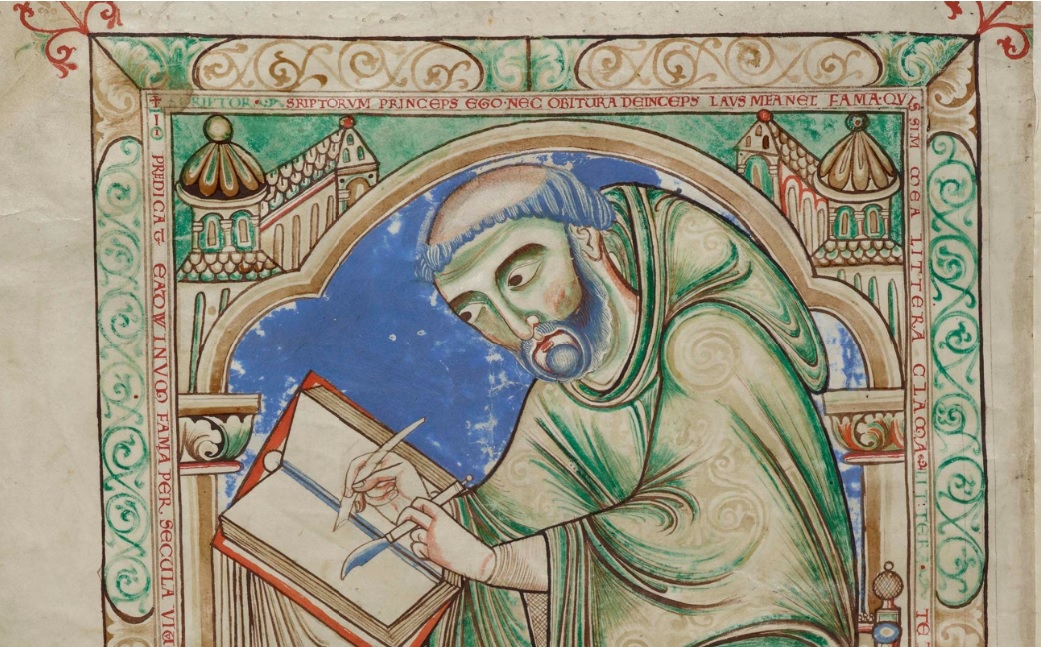
The broadly spaced Latin text on the outer edges of the left- and right-hand page is the Gallican version of the Psalter (marked “Gall.” on the bottom of the left page and on the top of the right page), with explanatory glosses in Latin between the lines and in bother margins. The second more narrow narrow column (marked “Rom.”) is the Romanum version of the Latin Psalter, with Old English interlinear glosses, while the column closest to the middle of the book (rightmost on the left page; leftmost on the right page) gives the Hebraicum version of the Latin Psalter, with Anglo-Norman interlinear glosses. Psalter-ception! Making sure that each page gave corresponding passages in the three Latin versions of the Psalter as well as making enough room for the glossing required Eadwine to carefully adjust the sizes of scripts, spacing and distribution of the text on the page. Managing all this, Eadwine certainly deserves the epithet of ‘s[c]riptorum princeps’ [master of scribes] with which he was described in the text surrounding his famous ‘author-portrait’ at the end of the Psalter that bears his name.
Portrait of Eadwine, part of the text surrounding this portrait reads: “SRIPTORUM PRINCEPS EGO NEC OBITURA DEINCEPS LAVS MEA NEC FAMA” [I am the chief of scribes.; neither my praise nor my fame will die one after the other]. Ironically, there is a scribal error in the word “sriptorum”, which should read “scriptorum”. Eadwine Psalter (E), fol. 283v.
The language, glossing technique, illuminations and mis-en-page are but some of the fascinating aspects of the Old English glossed Psalters (others include annotations by later users, scribes making mistakes, curious initials and so on); in future blog updates, I hope to devote posts to individual Old English Psalters to create a fifteen-part series, starting with the Vespasian Psalter (A). Stay tuned!
If you want to be alerted to subsequent blog posts, make sure to subscribe to this blog, using the box below. If you can’t wait for a next blog post to appear, check out the following related blog posts:
Stowe Psalter (F): London, British Library, Stowe 2
Vitellius Psalter (G): London, British Library, Cotton Vitellius E.xviii
Tiberius Psalter (H): London, British Library, Cotton Tiberius C.vi
Lambeth Psalter (I): London, Lambeth Palace, MS 427
Arundel Psalter (J): London, British Library, Arundel 60
Salisbury Psalter (K): Salisbury, Cathedral Library, MS 150
Bosworth Psalter (L): London, British Library, Additional 37517
Blickling Psalter (M): New York, Pierpont Morgan Library, M. 776
Fragments of Old English glossed Psalter (N): Cambridge, Pembroke College, 312, C, 1-2; Haarlem, Noord-Hollands Archief, 188 F 53; Sondershausen, Schlossmuseum, Lat. liturg. IX 1
Paris, Biblitohèque Nationale, Lat. 8846 (O)
Paris Psalter (P): Paris, Bibliothèque Nationale, Lat. 8824 (not a glossed Psalter; but a Psalter with facing Old English translation, see this blog post)
Relevant literature on the Old English glossed Psalters
Philip Pulsiano, ‘Psalters’, in The Liturgical Books of Anglo-Saxon England, ed. R. W. Pfaff (Kalamazoo, 1995), 61-86.
What do the English place names Everton, Oxford, Winchester and Whitby have in common? They have all been around for more than a thousand years and their origins and original meanings can shed a unique light on the fascinating early history of England!
Traces of Celts and Romans
Map with some Celtic and Roman place names. The Celtic helmet is based on the Waterloo Helmet *map altered slightly on 9/7/2020 due to misplacement of Carlisle*
If we were to go back some 2500 years in time, Britain was inhabited by people who spoke Celtic languages (present-day Welsh and Cornish are among the linguistic descendants of these languages). These Celtic speakers have left their traces in the toponyms (place names, river names) of present-day England. The place name Dover, for instance, derives from a Celtic word for ‘waters’ and the first part of Carlisle stems from a Celtic word for ‘fort’ (cf. Welsh caer and Cornish ker). In addition, about two-thirds of English rivers today have English names, these include the rivers Avon, Trent, Tyne and the Thames – most of these river names excitingly mean ‘river’.
In the first century AD, Britain was conquered by the Romans and their influence too can be found in English place names. Place names with an element like –chester, for instance, ultimately derive from Roman army camps, denoted by the Latin word castra (though via Old English ceaster). In other words, Winchester, Lancaster, Leicester and Chester all show traces of Roman occupation of what is now England. The Latin word vicus for ‘settlement’ is found at the end of the places Norwich and Sandwich (though via Old English wic). The Latin word for ‘harbour’, portus, can be seen in Portsmouth – mouth of the harbour. Intriguingly, the ninth-century compilers of TheAnglo-Saxon Chronicle appear to have assumed that the name derived from a man called Port, who landed there in 501 with his sons Bieda and Mægla:
In this year, Port came to Britain along with his two sons Bieda and Mægla in two ships to the place that is called Portsmouth and they killed a young British man, a very noble man.
The Anglo-Saxon Chronicle, s.a. 501
Anglo-Saxons and their place names
After the Romans left Britain in 410 AD, the remaining Celts eventually had to give way to Germanic invaders from the European Continent: the Angles, Saxons and Jutes, who come over from Northern Germany and Southern Denmark. These Anglo-Saxons, as they are generally referred to, bring Old English to England and its is to them that we owe place names that contain such elements as
ham (meaning ‘home’, as in Fulham, Westham and Birmingham)
tun (meaning ‘town’, as Skipton)
ford (meaning ‘crossing in a river’, as in Oxford)
burna (meaning ‘stream’ as in Bournemouth and Blackburn)
burh (meaning ‘fortification’, as in Canterbury; Bury St Edmunds and, simply, Bury)
Sometimes, these Anglo-Saxon settlers named places and regions after themselves. We can find the Angles in East Anglia and, ultimately, in England. The Saxons gave their name to Sussex, Essex, Wessex and Middlesex; that is the Saxons in the South, in the East, in the West and in the middle. Apparently, there we no Saxons in the North – a common pun is that the Northern Saxons only lasted for one generation since they had Nosex. The Jutes do not seem to have lend their names to a place, but other ‘Anglo-Saxon’ people did. The Old English place name element -ingas means something like “the descendants, followers or people of” and, so, Reading used to be the place where the people of Ræda lived; in Hastings lived the descendants of a man called Hæsta.
In come the Vikings!
Viking place names in England. The heat map on the right shows a rough representation of the concentration of Viking place names, on the basis of data by Key to English Place Names
Another group to make a major contribution to English place names were the Vikings, who not only raided and plundered, but also settled in England and founded villages and towns which they gave Scandinavian names. Place names ending in -by, for instance, like Whitby and Derby derive from the Old Norse word by ‘settlement’. Another typical Scandinavian place name in England ends in thorpe ‘village’, as in Scunthorpe and the seven places in England simply called Thorpe. The word toft, as in Lowestoft, refers to ‘site of a house’ and is another sign that you are dealing with a Viking place name.
Viking place names are concentrated in the North East of England, as you can tell by the heat map I made above (the map on the right shows a rough representation of the concentration of Viking place names, on the basis of data by Key to English Place Names ). There are good reasons for this geographical distribution: the area in which we typically find Viking place names was known as the Danelaw area, which had been assigned to Scandinavian settlers as part of a peace treaty with King Alfred the Great, following a decisive battle in the year 878. It is for this reason that place names ending in – by or -thorpe tend to be in the North East of England. As we shall see below, Viking place names are not the only ones to show a certain geographical concentration.
Place names and migratory patterns?
Rough heat maps showing concentrations of Celtic place names and Old English place names (-ingas/-ham and -tun)
Using the data of Key to English Place Names along with the Halogen geospatial search facility it is relatively easy to get an idea of where certain place names occur. The maps above are (very) rough representations that I made on the basis of looking for place names of a Celtic origin and two sets of Old English place names. The results are interesting. Place names of Celtic origin tend to be in the South and in the West; that is near Wales and Cornwall – this has been interpreted as representing the gradual displacement of Celtic speaking people towards these areas due to the gradual influx of the Anglo-Saxons.
The two sets of Old English place names also show an interesting distribution: the place names ending in -ingas and -ham tend to be found in the South East, whereas Old English place names ending in -tun tend to be found further West and North. Scholars have argued that this is because the first set of place names were typically used by the earliest Anglo-Saxon settlers, who arrived in Kent and spread their influence West and North from there. The place names based on Old English tun ‘town’ could reflect later settlement patterns, though this is a matter of scholarly debate (see Clark 1992).
Flora and fauna of early medieval England
Of course, place names did not only depend on who inhabited the place at some time, often places were named after the surroundings in which the early settlers found themselves. As such, place names allow us to identify some of the flora and fauna that was around in Anglo-Saxon England.
One of the Old English place name elements that the Angles, Saxons and Jutes brough to England was the word leah, meaning field or clearing in a forest. Today, this element survives at the end of place names like: Ashley, Stanley, Crawley, Shipley and Sugley. These then must all have been fields or clearings in a forest. The first element in these place names gives us another defining feature of that field. Ashley was probably surrounded by ash-trees (from Old English æsc); there were stones at Stanley (from Old English stan), crows near Crawley (from Old English craw), sheep near Shipley (from Old English sceap) and in Sugley you can see the Old English word for sow, sugu.
We can recognize the Old English words for animals in various other place names as well. In Everton, you can see the Old English eofor ‘boar’; Brock-holes is named after the holes made by a broc, the Old English word for “Badger’; you can see the Old English word bucca ‘goat’ in Buckingham and Swinburn must have been a stream with some pigs (Old English swin) nearby.
In conclusion: place names are fascinating, they reflect the rich cultural and linguistic history of what we now call England. England’s history, as well as the place names on its map, was formed and shaped by various migrations and interactions with different peoples and cultures. These people looked around them and named what they saw: trees, clearings, river-crossings and animals. And if we study their language and history, we can see those things too.
If you liked this post, consider subscribing to this blog for regular updates and/or read the following posts about early medieval English history:
Among all of his responsibilities, Alfred the Great found the time to invent the candle clock. As this blog post will demonstrate, Alfred, by no means, was the only Anglo-Saxon king to have a thing for candles.
Alfred the Great: Inventor of time management and the candle clock
Eight Hour Day Banner, Melbourne, 1856
The slogan “Eight hours labour, eight hours recreation, eight hours rest” is supposed to have been coined by the social reformer Robert Owen (d. 1858); but the Anglo-Saxon King Alfred the Great (d. 899) seems to have divided his time in a similar way. According to the twelfth-century chronicler William of Malmesbury:
he [Alfred] so divided the twenty-four hours of the day and night as to employ eight of them in writing, in reading, and in prayer, eight in the refreshment of his body, and eight in dispatching the business of the realm. There was in his chapel a candle consisting of twenty-four divisions, and an attendant, whose peculiar province it was to admonish the king of his several duties by its consumption. (source)
Assuming that Alfred regarded writing, reading and praying as recreation – Alfred’s daily routine, as described by William, is quite similar to Robert Owen’s slogan.
William’s reference to “a candle consisting of twenty-four divisions” refers to a famous story related in Asser’s Life of Alfred (893), which recounts how Alfred invented a “candle clock” consisting of six candles (not one), which each burned for four hours:
By this plan, therefore, those six candles burned for twenty-four hours, a night and day, without fail… but sometimes when they would not continue burning a whole day and night, till the same hour that they were lighted the preceding evening, from the violence of the wind, which blew day and night without intermission through the doors and windows of the churches … the king therefore considered by what means he might shut out the wind, and so by a useful and cunning invention, he ordered a lantern to be beautifully constructed of wood and white ox-horn, which, when skilfully planed till it is thin, is no less transparent than a vessel of glass. … By this contrivance, then, six candles, lighted in succession, lasted four and twenty hours, neither more nor less, and, when these were extinguished, others were lighted. (source)
Æthelwulf of Wessex: Coins and candle holders for the pope
Anglo-Saxon coin inscribed with “EĐELVVLF REX” (source)
Alfred may have gotten his interest in lights and candles from his father Æthelwulf of Wessex (d. 858). Upon his death, Asser reports in his Life of Alfred, Æthelwulf ordered an annual sum of money to be sent to Rome of which a major part was to be spent on lighting lamps at Easter:
He commanded also a large sum of money, namely, three hundred mancuses, to be carried to Rome for the good of his soul, to be distributed in the following manner: namely, a hundred mancuses in honour of St. Peter, specially to buy oil for the lights of the church of that apostle on Easter eve, and also at the cock-crow: a hundred mancuses in honour of St. Paul, for the same purpose of buying oil for the church of St. Paul the apostle, to light the lamps on Easter eve and at the cock-crow; and a hundred mancuses for the universal apostolic pontiff. (source)
Æthelwulf’s charity did not stop there. The ninth-century Liber Pontificalis (the book of Popes) relates how, upon visiting Rome with his son Alfred, gifted the Church of St Peter with many precious objects, including a silver candle holder:
a crown of pure gold weighing four pounds, an ornamental sword with gold inlay, a gilded silver candle holder in the Saxon style, a purple dyed tunic embossed with golden keys, a golden goblet, and numerous valuable robes. (R. Abels, King Alfred the Great: War, Kingship and Culture in Anglo-Saxon England, p. 53)
Upon his trip to Rome, Alfred may have learned a valuable lesson from his father: candles are candy for the pope!
While Alfred and his father Æthelwulf had positive experiences with candles, one of their kinsmen fared differently. As legend would have it, Æthelred ‘the Unready’ (d. 1016), Alfred’s great-great-grand-son, was traumatized by candles in his youth. William of Malmesbury relates the following incident in his Gesta regum Anglorum:
I have read, that when he was ten years of age, hearing it noised abroad that his brother [Edward ‘the Martyr’ (d. 978)] was killed, he so irritated his furious mother by his weeping, that not having a whip at hand, she beat the little innocent with some candles she had snatched up: nor did she desist, till herself bedewed him, nearly lifeless, with her tears. On this account he dreaded candles during the rest of his life, to such a degree that he would never suffer the light of them to be brought into his presence. (source)
As Æthelred grew up, he gained a reputation as being one of the worst kings in English history. He certainly was never able to fill his great-great-grandfather Alfred’s shoes, and we now know why: without the help of candles (or a candle clock), how could he ever have managed his time!?!
Aside from their stereotypical burning, pillaging and raping, Vikings also seem to have introduced a new hairstyle to early medieval England. This blog post discusses how some Anglo-Saxon priests were concerned over Anglo-Saxons mimicking the hair of the Viking invaders.
In the aftermath of the Viking raid on Lindisfarne in 793, the Anglo-Saxon monk and scholar Alcuin wrote an admonishing letter to King Æthelred of Northumbria (d. 796). Alcuin had noted how the king and his nobles had not been at their best behaviour, not-so-subtly implying that if the Northumbrians would only live modestly and humbly that such horrible events as the raid of Lindisfarne would never happen again. Interestingly, Alcuin reminded Æthelred of the fact that he and his nobles had copied the hairstyle and dress of the Scandinavians that were now causing so much havoc:
Consider the dress, the way of wearing the hair, the luxurious habits of the princes and people. Look at your trimming of beard and hair, in which you have wished to resemble the pagans. Are you not menaced by terror of them whose fashion you wished to follow? (trans. Whitelock, source)
Whereas Alcuin did not go into any detail as to what the Viking hairstyle may have looked like, these details are provided two centuries later by another Anglo-Saxon religious writer, Ælfric of Eynsham (d. c. 1010). In a letter addressed to a ‘brother Edward’, Ælfric complained of various malpractices he had heard of. These malpractices included the eating of blood and consuming of drink and food on the toilet (something Ælfric attributed to ‘uplandish women’). Ælfric also complained about Anglo-Saxon monks dressing up ‘in Danish fashion’:
Ic secge eac ðe, broðor Eadweard, … þæt ge doð unrihtlive þæt ge ða Engliscan þeawas forlætað þe eowre fæderas heoldon, and hæðenra manna þeawas lufiað … mid ðam ġeswuteliað þæt ge forseoð eower cynn and eowre yldran … þonne ge … tysliað eow on Denisc, ableredum hneccan and ablendum eagum. (ed. Clayton, source)
[I also tell you, brother Edward, that you act wrongly when you abandon the English customs which your fathers observed and love the customs of heathens, wit them you show that you despise you kin and your elders, when you adorn yourself in Danish fashion, with bared neck and blinded eyes.]
While no depictions of Vikings (or Anglo-Saxons) with bared necks and blinded eyes have survived, it has been suggested that the Normans on the Bayeux Tapestry are typically depicted without hair in their necks:
Normans rocking a bare-neck-haircut on the Bayeux Tapestry (source)
Now why would Anglo-Saxon men want to mimic the hairstyle of the Vikings? The answer: for the ladies. A thirteenth-century chronicle ascribed to John of Wallingford (d. 1258) describes how Danes living in England were able to seduce various Anglo-Saxon women, due to their fashionable hair and beards:
They were wont, after the fashion of their country, to comb their hair every day, to bathe every Saturday, to change their garments often, and set off their persons by many such frivolous devices. In this manner they laid siege to the virtue of the married women, and persuaded the daughters even of the nobles to be their concubines. (trans. Stevenson, source)
The best way to win an Anglo-Saxon woman’s heart? Viking haircuts and weekly baths!
In the second episode of series two of The Last Kingdom, a row of decapitated heads has been placed outside the main gate of Dunholm/Durham. As this blog post will illustrate, this practice, barbaric though it seems, is well attested for Anglo-Saxon England.
Historical examples: Saint Oswald and the real Uhtred
Perhaps the best-known example of decapitation and impalement was that of Saint Oswald of Northumbria (d. 642). After Oswald had been defeated by the pagan King Penda of Mercia, Penda had Oswald’s head and arms cut off. Penda then had these body parts put on stakes, until Oswald’s brother Oswy retrieved them, a year after the battle. Later, Oswald’s head was likely buried in the tomb of Saint Cuthbert (about whom, see: Splitting Anglo-Saxon Hairs: Cuthbert’s Comb) which ended up in Durham, where it still remains today. Intriguingly, aside from Durham Cathedral, four other institutions today claim to have the skull of Saint Oswald (Bailey 1995), including Hildesheim Cathedral which houses a beautiful twelfth-century head reliquary depicting the head of Oswald (see image below).
The display of decapitated heads did not die out with the arrival of Christianity. In the De Obsessione Dunelmi, a Latin historical work from around 1100, we are told of a siege of Durham by the Scots in the early eleventh century. Luckily for Durham, their bishop Ealdun’s daughter had been married to Uhtred (d. 1016), son of the earl of Northumbria and the inspiration for Bernard Cornwell’s Saxon Stories series upon which BBC’s The Last Kingdom is based. This Uhtred came to Durham’s aid and massacred the Scottish host and had the Scots decapitated. Uhtred then sent for the most attractive heads to be brought to Durham:
The heads of the slain, made more presentable with their hair combed, as was the custom in those days, he had transported to Durham, and they were washed by four women and fixed on stakes around the circuit of the walls. The women who had previously washed them were each rewarded with a single cow. (cited in Thompson 2004: 193)
Aside from the intriguing reward of a cow for washing a dead man’s head, this episode in the De Obsessione Dunelmi reveals that the display of decapitated heads remained common (customary even) until the eleventh century, at least.
Heafod stoccan in Anglo-Saxon charters
Anglo-Saxon charters often contained vernacular boundary clauses which described the areas under discussion. Within these boundary clauses, the term heafod stocc ‘head stake’ is frequently attested, suggesting that it was common practice to mark the limits of estate properties with impaled heads. Various charters locate such head stakes in the vicinity of a road: e.g., “æfter foss to þam heafod stoccan” [after the way to the head stakes] (S 115); “of heafod stocca andlang stræt” [from the head stakes along the street] (S 309); and “7lang stret to þam heafod stoccan” [along the street to the head stakes] (S 695). These examples suggest that these head stakes would have been visible for people travelling from and towards locations, possibly along main access roads. Given their use as boundary markers in surviving Anglo-Saxon charters, these head stakes must have been a permanent as well as salient feature in the landscape. The existence of head stakes is supported by archaeological evidence, which also locates execution sites at the boundaries of estates (see Reynolds 2009: 169). Just like the heads of criminals spiked on the walls of old London Bridge, the purpose of these head stakes must have been to not only mark the boundaries of an estate, but also to warn potential transgressors against the consequences of wrongdoings.
An inspiration for Anglo-Saxon authors and artists
The spectacle of decapitating an enemy’s head and putting it on display proved inspirational for various Anglo-Saxon authors and at least one artist. The Beowulf poet, for instance, has Beowulf and his men parade Grendel’s head on a stake towards Heorot: “feower scoldon / on þæm wælstenge weorcum geferian / to þæm goldsele Grendles heafod / oþ ðæt semninga to sele comon” [four had to carry Grendel’s head with hardships to the gold-hall on a battle-pole, until they came to the hall] (Beowulf, ll. 1637b-1639). Here, Grendel’s head functions as a trophy, a sign of Beowulf’s heroic triumph.
A rare visual depiction of a decapitated and impaled head is found in the Old English Hexateuch (British Library, Cotton Claudius B.iv) an eleventh-century, illustrated translation from the Latin Vulgate of the first six books of the Old Testament (see: The Illustrated Old English Hexateuch: An early medieval picture book). In his depiction of Genesis 8:7 (‘And he sent forth a raven, which went forth to and fro, until the waters were dried up from off the earth.’), the artist of the Hexateuch deviated from the biblical text and depicted a raven pecking at a head, impaled on Noah’s ark (see below). It has been suggested that the artist was drawing on his own creativity here, given the fact that there is no iconological tradition that depicts Noah’s raven in this way (Gatch 1975: 11). Perhaps, the Anglo-Saxon artist was so familiar with the practices of decapitation and impalement that he could think of no better way to depict God’s wrath!
Bailey, Richard N., “St Oswald’s Heads,” in Oswald: Northumbrian King to European Saint, ed. C. Stancliffe and E. Cambridge. 195-209. Stamford: Paul Watkins, 1995.
Gatch, Milton McC., “Noah’s Raven in Genesis A and the Illustrated Old English Hexateuch”, Gesta 14:2 (1975), pp. 3-15
Beheading is a spectacular way of punishing one’s enemies and often triggers the literary imagination, ranging from Beowulf cutting off Grendel’s head to the Queen of Hearts’s famous phrase “Off with her head!”. This blog post calls attention to the beheadings of three Anglo-Saxons, whose decapitation stories may have been embellished by later generations.
“Her Offa Myrcna cyning het Æþelbryhte þæt heafod ofaslean”
[In this year, King Offa of the Mercians commanded Æthelberht’s head to be cut off.]
The annal for the year 794 in The Anglo-Saxon Chronicle is straightforward but leaves much to the imagination. What exactly were the circumstances of this decapitation of Æthelberht of East Anglia? In 2014, the finding of a coin bearing Æthelberht’s name and the title “rex” appeared to hold the answer: Æthelberht had claimed independence, to the annoyance of the much more powerful ruler Offa, who had him decapitated (see news article here). Medieval authors came up with more inventive motives for the murder of Æthelberht…
Offa of Mercia by thirteenth-century artist Matthew Paris, Æthelberht’s head bottom-left (source)
The anonymous author of the twelfth-century Latin Vitae Offarum Duorum (The Lives of Two Offas), for instance, attributed the beheading not to Offa, but to Offa’s scheming wife Cwenthryth. Æthelberht, according to this story, was to marry Offa’s daughter, but Cwenthyrth did not agree and plotted to have Æthelberht murdered. Her plan involved an elaborate boobytrap:
And next to the royal couch she also had a seat prepared, fashioned in the most elegant style and surrounded with curtains on every side. Under which a deep trench was prepared for the heinous plan to be carried through. […] And when he [Æthelberht] settled on the aforesaid seat, he collapsed together with the chair into the bottom of the trench. (trans. Swanton, p. 94-96)
Inside the trench, Cwenthryth’s henchmen were waiting: they suffocated Æthelberht with pillows and stabbed him to death. Since the dead body was still throbbing, they also cut off his head. Thus, Æthelberht, according to the author, died like John the Baptist, “entangled in a woman’s snares”.
Like John the Baptist, Æthelberht became a saint. The anonymous author of the Vitae Offarum Duorum notes how, when Æthelberht’s bodily remains were hurriedly hidden during the night, the head was accidentally dropped onto the ground and left there. By divine providence, a blind man stumbled upon the head:
Finding the aforesaid head a stumbling block to the feet however, he wondered what it was, because his foot was tangled up in the head’s long golden curls. And touching it more carefully, he realised that it was the head of a decapitated man. And intuitively he realised that this was the head of someone holy, and a young man. And when his hands had been steeped in blood, and sometimes in the place where his eyes had been, he put the blood on his face. And immediately his sight was restored. (trans. Swanton, pp. 96, 98)
And that’s how Æthelberht was proven to be a saint: his head tripped up a blind man; the blind man used his blood for face-paint and had his sight restored. Amen!
2) The beheading of St Edmund: The head that kept on shouting
[and that winter King Edmund fought against them and the Danes took the victory and killed the king]
The Anglo-Saxon Chronicle‘s report of the death of Edmund of East Anglia is once more devoid of detail. The story of Edmund’s death was later greatly expanded. The Anglo-Saxon abbot and homilist Ælfric (d. c. 1010), for instance, composed an Old English saint’s life (based on a Latin original by the monk Abbo of Fleury), in which he described how the Vikings brutally martyred Edmund. In Ælfric’s version of the events, Edmund does not fight the Danes but lays down his weapons and lets the Vikings have their way with him. The pagans began by using Edmund for target practice, shooting him so full of arrows that Edmund resembled a hedgehog (“swilce igles brysta” [like the bristles of a hedgehog]). Next, they struck off the king’s head and hid it in the bramble bushes:
The Vikings then returned to their ships and departed. Some time later, Edmund’s people return and find their king’s headless body. They start to search for the head and that is when a miracle happens:
Hi eodon þa secende and symle clypigende, swa swa hit gewunelic is þam ðe on wuda gað oft: “Hwær eart þu nu gefera?” And him andwyrde þæt heafod, “Her, her, her!” and swa gelome clypode andswarigende him eallum, swa oft swa heora ænig clypode, oþþæt hi ealle becomen þurh ða clypunga him to.
[Then they went looking and continually calling, as is customary with those who often go into the woods, “Where are you now, friend?” and the head answered them, “Here! Here! Here!” and so frequently called out, answering them all as often as any of them shouted, so that they all came to it because of the shouting”] (ed. and trans. Treharne, pp. 149-151)
They find the head, guarded by a wolf, and bury the head alongside Edmund’s body.
Edmund’s capital miracles do not end there. Ælfric relates how, when they dig up Edmund’s body and head some years later, they find that the head has been reattached: God works in mysterious ways, indeed!
3) The beheading of Earl Byrhtnoth: The head that was stolen by Vikings
[In this year, Ipswich was ravished, and very soon after that Ealdorman Byrhtnoth was killed at Maldon].
Annal 991 of The Anglo-Saxon Chronicle contains another bare report on the death of Anglo-Saxon. For more details about the death of Byrhtnoth we need to look elsewhere. The anonymous author of one of the greatest poems in Old English, The Battle ofMaldon, elaborated on how Byrhtnoth and his men heroically (or: foolishly) fought the Vikings on the beach of Maldon, after yielding them free passage over a narrow causeway(see The Battle of Maldon: A Student Doodle Edition). In the poem, Byrhtnoth is struck fatally by a spear in the chest and dies uttering some final words of inspiration to his retainers.
The twelfth-century Liber Eliensis tells a different story, indicating that Byrhtnoth was, in fact, beheaded by the Vikings:
On the last day, and with few of his men left, Brithnoth knew he was going to die, but this did not lessen his efforts against the enemy. Having inflicted an enormous slaughter on the Danes, he almost put them to flight. But eventually the enemy took comfort from the small number of Brithnoth’s men, and, forming themselves into a wedge, rushed against him in one body. After an enormous effort the Danes barely managed to cut off Brithnoth’s head as he fought. They carried the head away with them and fled to their own land. (trans. Calder & Allan, p. 190)
The Liber Eliensis also reports that the abbot of Ely went to the battlefield to collect the remains of Byrhtnoth and buried the headless body in Ely Abbey, replacing the head with a lump of wax: “But in place of the head he put a round ball of wax, by which sign the body was recognized long afterwards in our own times and placed with honor among the others” (trans Calder & Allan, p. 192). The Liber Eliensis‘s reference to the placement of Byrhtnoth’s remains “among the others” is to a twelfth-century shrine of the seven benefactors of Ely Abbey, which is now found in Ely Cathedral:
Shrine of Byrhtnoth and six other benefactors of Ely Cathedral (source)
Did the Vikings indeed steal Byrhnoth’s head or is this another case of literary embellishment? Judging by a report of how the bones of the seven Ely benefactors were uncovered in May 1769, it seems that this legend has a ring of truth to it:
Whether their relics were still to be found was uncertain … The bones were found inclosed, in seven distinct cells or cavities, each twenty-two inches in length, seven broad, and eighteen deep, made within the wall under their painted effigies; but in that under Duke Brithnoth there were no remains of the head, though we search diligently …It was observed that the collar bone had been nearly cut through, as by a battle axe or two-handed sword. (James Bentham to the Dean of Exeter; cit. in Stubbs, pp. 92-93)
If the Vikings did indeed behead Byrhtnoth, this raises the question of why the anonymous poet of The Battle of Maldon did not include this detail in his poem; perhaps he considered it ‘fake news’.
If you liked this blog post, you may also be interested in:
The newly elected president of the United States has triggered over half a million women to march in a political protest against the new leader of their country. While this Women’s March was record-breaking, a report in an eleventh-century manuscriptof The Anglo-Saxon Chronicle suggests that it may not have been unprecedented.This is the story of Gytha and the Anglo-Saxon rebellion against William the Conqueror. #NotMyConqueror
A Women’s March to Flat Holm in 1068
The entry for the year 1067 in manuscript D of The Anglo-Saxon Chronicle describes a number of events that took place in the two years following the Norman Conquest in 1066. Most of the executive orders by the new king William are described in a rather negative manner, such as his imposing a heavy tax on the “earm folc” [poor people] and his siege of Exeter in 1068 (“he heom wel behet, 7 yfele gelæste” [he promised them well and he performed evil]). The annalist is more positive about a curious journey by Gytha, mother of the deceased King Harold Godwinson (d. 1066), who was joined by other women of good standing:
7 her ferde Gyða ut, Haroldes modor, 7 manegra godra manna wif mid hyre, into Bradan Reolice, 7 þær wunode sume hwile, 7 swa for þanon ofer sæ to Sancte Audomare.
[and in this year Gytha, Harold’s mother, went out and many wives of good men with her, to Flat Holme, and remained there for a while and thus from there over sea to St Omer (France)]
Gytha’s ‘Women’s March’ is part of the English rebellion against William the Conqueror and probably followed the Siege of Exeter in 1068, in which Gytha played an important role.
Gytha and her sons: Breaking their mother’s heart three times over.
Much of what we know about Gytha (fl. 1022-1068) derives from sources post-dating the Norman Conquest. According to the Domesday Book, she was one of the greatest women landowners in the year 1066 (Stafford 1989), She owed much of her wealth and status to her marriage to the powerful Earl Godwin of Wessex (d. 1053), whom she bore many sons and daughters. Most of her sons became powerful earls and one of them even became king in 1066 (Harold Godwinson). While their careers may have made Gytha proud, some of her sons’ actions may have broken her heart.
Sweyn Godwinson, earl of Herefordshire (d. 1058), for instance, shocked his mother by insisting that Godwin was not his real father. Instead, he claimed to be the son of Cnut the Great (d. 1035). Sweyn’s claim was recorded in the late eleventh-century Cartulary of Hemming (a collection of charters and lawsuits regarding lands in Worcester). Hemming also included Gytha’s reaction:
Quam nimie arrogantie vanitatem mater illius, conjunx videlicet prefati ducis Godwini, exhorrescens, multis ex occidentalium Saxonum parte adductis nobilibus feminis, se matrem illius, et Godwinum patrem ejus esse, magnis juramentis et illarum probavit testmoniis.
[His mother, the wife of the aforesaid Earl Godwin, horrified by his excessive arrogance and vanity, brought together many noble ladies from the West Saxons, and proved by great oaths and their testimony that she was his mother and Godwine was his father.]
Sweyn disagreed and Hemming reports that while Cnut and Sweyn may not have shared blood and genes, they did share certain shortcomings, such as pride and excessive lusts of the flesh. To illustrate the latter, Hemming narrates how Sweyn had once abducted the abbess of Leominster and had kept her as a wife for a year. He had returned the abbess after threats of excommunication by the bishop of Worcester but had then retaliated by stealing some estates from the diocese of Worcester. Clearly the black sheep of the family, Sweyn was exiled on various occasions and died in 1052 after returning from a penitential pilgrimage to the Holy Land – Sweyn certainly did not make his mommy proud!
Her two more famous sons, Tostig (d. 1066) and Harold, did little better. In the year of the Norman Conquest, Tostig had rebelled against the English throne and had sided with the Norwegian king Harald Hardrada (d. 1066). In the Battle at Stamford Bridge, brother fought brother and Tostig was killed. Following the battle and his brother’s death, Harold hears the news that the Norman fleet of William has landed and Harold wants to rush south. The chronicler Orderic Vitalis (d. c. 1142) writes how Gytha, having just lost Tostig, feared for Harold’s life and tried to dissuade her son. Harold not only refused to listen to his elderly mother, he gave her a kick to boot: “[Harold] even forgot himself so far as to kick his mother when she hung about him in her too great anxiety to detain him with her” (trans. Forester, Vol. I, p. 482). Ouch!
Gytha’s fear became a reality and Harold did die at the Battle of Hastings. Orderic Vitalis reports how the grieving mother had asked William the Conqueror for the body of her son:
The sorrowing mother now offered to Duke William, for the body of Harold, its weight in gold; but the great conqueror refused such a barter, thinking it was not right that a mother should pay the last honours to one by whose insatiable ambition vast numbers lay unburied (trans. Forester, Vol. I, p. 488)
Another twelfth-century chronicler, William of Malmesbury (d. c. 1143) supplies an ‘alternative fact’: “He sent the body of Harold to his mother, who begged it, unransomed; though she proffered large sums by her messengers” (trans. Giles, pp. 280-281).
Whatever may have happened to Harold’s body, Gytha had every reason to detest William and she, a well-connected and wealthy noblewoman, became the focal point of resistance against the new Norman overlord.
Gytha and the Siege of Exeter in 1068
It is generally assumed that Gytha was involved in the resistance offered by the city of Exeter in 1068. Orderic Vitalis records how Exeter was the first city to fight for its freedom. The townsfolk barricaded the city walls and claimed “We will neither swear allegiance to the king, nor admit him within our walls; but will pay him tribute, according to ancient custom” (trans. Forester, Vol. II, p. 15). #NotMyConqueror. William gathered 500 horsemen and marched on Exeter. He besieged the town for eighteen days and committed various acts of cruelty, including the blinding of one the hostages. William of Malmesbury related William’s ferocity to an intriguing action by one of the Exeter townsfolk:
Indeed he had attacked it with more ferocity, asserting that those irreverent men would be deserted by God’s favour, because one of them, standing upon the wall, had bared his posteriors, and had broken wind, in contempt of the Normans. (trans. Giles, p. 282)
That’s right, it seems as if someone farted in the king’s general direction! After eighteen days, Exeter capitulated, but Gytha had escaped and began making her way to Flat Holm.
“I fart in your general direction!” Monty Python quote may be based on Siege of Exeter in 1068.
A Women’s March or a Women’s Flight?
The Siege of Exeter was a definite blow to Gytha and her rebellion. However, her march might still be regarded as an act of defiance against William, if only because a group of travelling noblewomen was sure to draw the people’s attention. It certainly made an impression on the annalist of annal 1067 in MS D of The Anglo-Saxon Chronicle. Whereas he had denounced William’s actions following the Norman Conquest (see above), the annalist writes approvingly of Gytha’s going out, noting how the women who joined her are the “wives of good men”. Orderic Vitalis, generally more appreciative of William the Conqueror, is more negative about Gytha’s retreat to France. After going over how various English uprisings were justly put to rest, Orderic describes how Gytha “secretly collected vast wealth, and from her fear of King William crossed over to France, never to return” (trans. Forester, Vol. II, pp. 23-24).
So, was it a women’s march or a women’s flight? Much depends, it would seem, on the political stance of the person bringing the news – a notion that still very much applies to this day and age.
Alfred and the cakes, Cnut and the waves, and Eadmer the flying monk: Anglo-Saxon history is full of anecdotes. On this blog I will regularly highlight some amusing and/or remarkable episodes from early medieval England, along with a selfmade cartoon. This blog discusses the time when a peasant beheaded himself.
The Vita S. Ecgwini (VSE) is an account of the life of Ecgwine, bishop of Worcester (?693–717) and founder of Evesham Abbey. The Latin text has been dated to after the year 1016 and is ascribed to the Anglo-Saxon monk and scholar Byrhtferth of Ramsey. This saint’s life is full of miraculous tales, including the story of how a long-lost key was found in the innards of a fish, and the story of how a farmer had a vision of Mary in the hiding place of his sow. The tale that struck me most, however, was the tale of the Anglo-Saxon peasant that beheaded himself.
Off with my head!
One day, a certain peasant, “fattened on worldy wealth” (VSE, iv. 10, trans. Lapidge 2009), claimed a substantial part of the land which belonged to the monastery of Evesham. Wigred, the prior of that same monastery, decided that the matter would be settled by having both the peasant and himself claim the land by means of an oath on the relics of Saint Ecgwine. The relics were placed in the middle of the land which both the prior and the peasant claimed to own:
When the peasant came forward to swear his oath, he felt quite confident, since he “had craftily taken a bit of dirt from his own dwelling and put it – at the devil’s instigation – in his shoe. […] He sought to act fraudulently to this end, that through this soil he might be able to swear that he was standing on his own land” (VSE, iv. 10, trans. Lapidge 2009). A nice trick!
Before swearing his oath, the peasant confidently raised up his weapons in the air. That’s when God intervened:
That madman was in utter rage; he even raised up his weapons and his arrogant right hand, with which he intended to fix fiercely in the ground the scythe which he was carrying in his hand; but the just judge did not wish it so: “He directed the suffering on to his head, and the malice on to his skull” [cf. Psalm 7:17]. That rascal fixed the shaft of the scythe so strongly in the ground that with the one blow he cut off his own foul head and neck – not making of himself a martyr for Christ’s love, but dismissing himself from this life, the devil gaining the victory. (VSE, iv.10, trans. Lapidge 2009)
And that’s how a greedy peasant lost his own head so that the monks of Evesham could hold on to the land that was rightfully theirs.
The second episode of The Last Kingdom (UK airdate: Thursday, 29 October, 9 pm, BBC 2) introduces Prince Alfred, who would later become King Alfred the Great (d. 899). In his first scene, Alfred is portrayed as a man tormented both physically (because of his health) and morally (because of his lustful feelings towards the flustered maidservant that had just left his room). This blog post highlights some sources related to the historical Alfred and explores what they reveal about his passions…and his piles.
Known as one of the greatest monarchs of Anglo-Saxon history, defeater of the Danes and instigator of an important educational reform, Alfred was, in fact, an unlikely candidate for the throne of Wessex. For one, he was the youngest son of King Æthelwulf of Wessex (reign 839-858), which means he had four older brothers: Æthelstan (d. 852), Æthelred (King of Wessex, 858-860), Æthelbald (King of Wessex, 860-865) and Æthelberht (King of Wessex, 865-871). Only after all his brothers had died, Alfred (apparently, Æthelwulf had run out of Æthel-names…) became eligible to rule. Given that he was the youngest of five, Alfred was probably groomed for an ecclesiastical career (his father took him to see the pope, twice), which may explain his interests in learning in his later life. Another reason why Alfred may have been considered an unlikely king at the time was because he suffered from a terrible illness, as is revealed by a biography written during his life by Bishop Asser in the year 893.
Be careful what you wish for!
1722 facsimile of manuscript containing Asser’s ‘Life of King Alfred’ (source)
Asser’s Life of King Alfred is a unique source on Alfred’s life and character, written by one of his own courtiers. Asser not only records Alfred’s battles with the Vikings and his dealings at court, he also reports some of Alfred’s medical details, mentioning that, from his youth, Alfred had suffered from “ficus” [piles, haemeroids].
Interestingly, Asser also tells us how Alfred acquired his piles in his early days:
when he [Alfred] realized that he was unable to abstain from carnal desire, fearing he would incur god’s disfavour if he did anything contrary to His will … [he would pray] that Almighty God through His mercy would more staunchly strengthen his resolve in the love of His service by means of some illness which he would be able to tolerate … when he had done this frequently with great mental devotion, after some time he contracted the disease of piles through God’s gift. (Asser, Life of King Alfred, ch. 74)
In other words, young Alfred, afraid of his own dirty thoughts, asked God to grant him a distraction and God gave him haemeroids!
Out of the frying pan, into the fire: “A sudden severe pain that was quite unknown to all physicians”
Asser’s biography also records that Alfred was miraculously cured from his piles when , prior to his wedding, Alfred had asked God to “substitute for the pangs of the present and agonizing infirmity some less severe illness” (Asser, Life of King Alfred, ch. 74). The young prince was miraculously cured: hurray! His regained health would be short-lived, however, since he suddenly fell ill on his wedding night: he had been struck by an illness that proved incurable. This new disease would torment him the rest of his life, as Asser noted:
he has been plagued continually with the savage attacks of some unknown disease, such that he does not have even a single hour of peace in which he does not either suffer from the disease itself or else, gloomily dreading it, is not driven almost to despair. (Asser, Life of King Alfred, ch. 91)
While the disease may have been unknown to the Anglo-Saxon physicians, modern-day scholars have used Asser’s description to diagnose Alfred with Crohn’s disease (Craig 1991). This diagnosis is corroborated by another document made during Alfred’s lifetime: Bald’s Leechbook.
Bald’s Leechbook is a compilation of various medical texts, which was possibly made at Alfred’s own request. Within this compilation, there is a section that is concluded by “þis eal het þus secgan ælfrede cyninge domine helias patriarcha on gerusalem” [Elias, the patriarch of Jerusalem (c. 879-907), ordered all of this to be told to King Alfred]. Included in this section are remedies for the alleviation of constipation, diarrhoea, pain in the spleen and internal tenderness, which all fit well with the pathology of Crohn’s disease(Craig 1991, p. 304). The Old English text also records that Elias sent him a “hwita stan” [a white stone], which could be used against all sorts of illnesses; as an added bonus, the white stone would also protect the owner from lightning and thunders (the text is edited by Cockayne 1864, Vol. II, pp. 288-291).
To make a long story short: Alfred was a passionate boy, God gave him piles and the patriarch of Jerusalem gave him a pebble. Poor Alfred.
If you liked this post, why not follow this blog for regular updates and/or read the following blog posts about Alfred the Great: