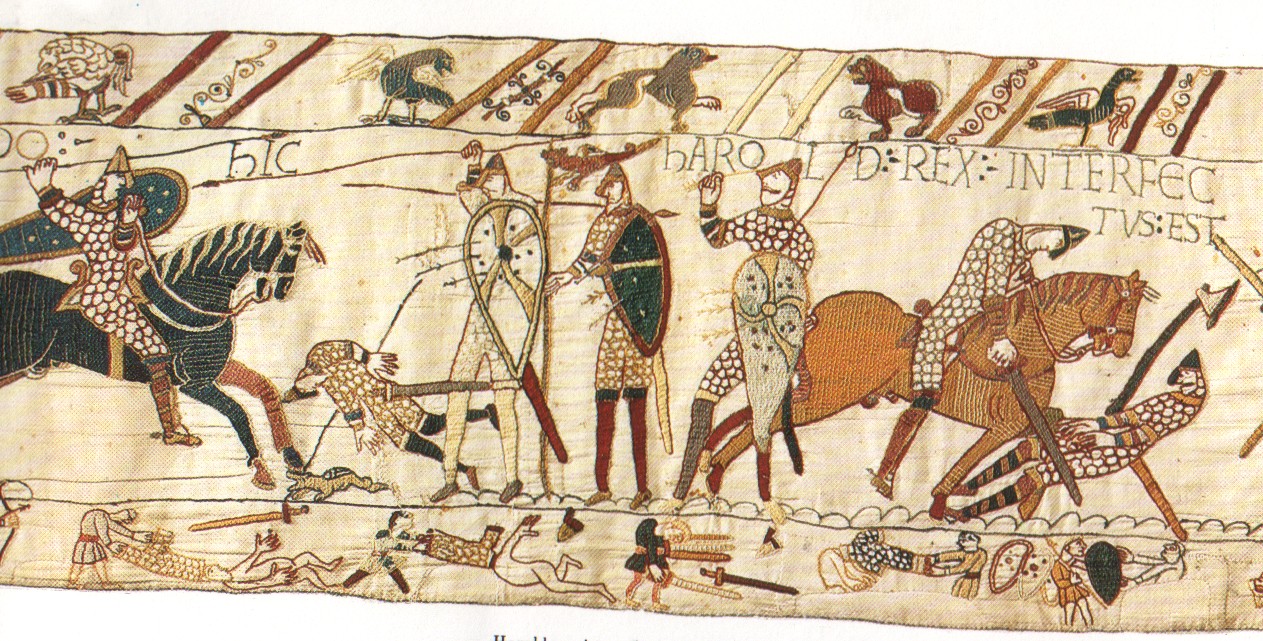
Alfred and the cakes, Cnut and the waves, and Eadmer the flying monk: Anglo-Saxon history is full of anecdotes. On this blog I will regularly highlight some amusing and/or remarkable episodes from early medieval England, along with a selfmade cartoon. This post discusses the remarkable events leading up to and including the Battle of Fulford in 1066…
As one of the three major battles of the year 1066, the Battle of Fulford is often ignored in favour of the English victory over the Vikings at Stamford Bridge and the English loss against the Normans at Hastings. Yet, this battle that took place on 20 September 1066 deserves our attention as well, if only because a 13th-century, Icelandic source connects this event to several interesting Anglo-Saxon anecdotes. All these anecdotes are found in the Heimskringla, a series of sagas concerning the lives of Norwegian Kings, written by the great Icelandic poet-scholar Snorri Sturluson around the year 1230.
Prophetic dreams of witch-wives
Like William the Conqueror, the Norwegian king Harald Hardrada claimed the throne of England in the year 1066. Snorri reports that, before Harald’s fleet sets off for England, some Vikings had troublesome dreams. One of them was called Gyrd, who dreamed that he was:
standing in the king’s ship and saw a great witch-wife standing on the island, with a fork in one hand and a trough in the other. He thought also that he saw over all the fleet, and that a fowl was sitting upon every ship’s stern. (trans. Laing 1844)
Gyrd’s fork-bearing witch-wife also appeared in the nocturnal vision of another Viking, called Thord:
He dreamt that King Harald’s fleet came to England and he saw a big battle, and before the English army, a huge witch-wife was riding upon a wolf and the wolf had a man’s carcass in his mouth, and the blood was dropping from his jaws; and when he had eaten up one body she threw another into his mouth, and so one after another, and he swallowed them all. And she sang thus:
‘Skade’s eagle eyes
The king’s ill luck espies:
Though glancing shields
Hide the green fields,
The king’s ill luck she spies.
To bode the doom of this great king,
The flesh of bleeding men I fling
To hairy jaw and hungry maw!
To hairy jaw and hungry maw!’ (trans. Laing 1844)
In case you didn’t get that, the witch-wife predicts an ill fate for King Harald Hardrada (who, indeed, died at the Battle of Stamford Bridge, on the 25th of September, 1066).
Dreaming of witch-wives
Pelt them with pitchforks! How the Vikings burned Scarborough
Harald and his Viking army land in England in September, 1066, with some 300 ships and some 9,000 men. The first thing they did was sack Scarborough. Naturally, the town was protected by a town wall of some sorts, but Harald found a way around this, or, rather, over this. His brilliant tactic involved hurling fiery pitchforks:
[Harald] climbed up on to the rock that stands there, and had a huge pyre built on top of it and set alight; when the pyre was ablaze they used long pitchforks to hurl the burning faggots down into the town.
Harald Hardrada and the fiery pitchforks
The Battle at Fulford and a bridge made of people
Later, on the 20th of September, 1066, Harald gloriously defeated an English army at Fulford led by the English earls Morcar and Edwin. The English army was put to flight and Harald Hardrada won the day. To make matters worse, some of the unfortunate English stumbled into a swamp, as Snorri reports:
The English army quickly broke into flight, some fleeing up the river, and others down the river; but most of them fled into the swamp, where the dead piled up so thickly that the Norwegians could cross the swamp dry-shod. (trans. Laing 1844)
Vikings crossing the swamp dry-shod
Snorri’s Heimskringla, naturally, is not the most trustworthy of sources when it comes to the events of the year 1066; nevertheless, I hope that some of the re-enactments in celebration of this year’s 950-year-memorial will feature flying, fiery pitchforks, Vikings crossings swamps over bridges made of people and, who knows, fork-bearing witch-wives riding wolves!
In this blog post, I review five apps that bring the early medieval magic of Old English to your 21st-century smartphone. I am not in any way connected to the developers of these apps. Let’s get early medieval on your smartphone!
#5 English Old English Dictionary
English Old English Dictionary app[screenshots from my LG3s]
What are the Old English words for ‘Chief Justice of the United States’, ‘coffee’ and ‘taekwondo’? If we are to believe this ad-supported dictionary app, the early medieval inhabitants of England would have said: hēahdēmere þāra Geānlǣhtra Rīca, caffiȝ and tæȝcƿondo. Naturally, this is nonsense.
This app is rather clumsily put together – its definition are brief and its list of entries seems rather haphazardly collected (it does have entries for both ‘take a crap’ and ‘take a shit’). No source is indicated for these words and their basic definition, but some of them seem to be derived from Old English Wikipedia pages (such as the one for the Chief Justice of the United States). Despite its potentially interesting functionality of switching between Old English – English and English – Old English, this silly app should be avoided.
Costs: FREE Android app store link: here I have not been able to find an iTunes link
#4 Readings in Early English
Readings in Early English app [screenshots from my LG3s]
If you want to practice your Old English pronunciation or you just love the idea of having someone read to you from The Anglo-Saxon Chronicle or the works of Ælfric of Eynsham, this is the app for you!
Readings in Early English was developed by Brian Aitken of the University of Glasgow and was originally intended as a companion piece to the book Essentials of Early English (1999) by Professor Jeremy J. Smith. This app provides access to various Old English, Middle English and Early Modern English texts with translations, minimal explanatory notes and, more importantly, sound files of Professor Smith reading these texts out to you. This means you can read along and listen to what the text may have sounded like. Highly recommended!
Costs: FREE Link to Google App store: here Linke to iTunes app store: here
#3 Liberation Philology: Old English
Liberation Philology: Old English app [screenshots from my LG3s]
Flappy Bird, Bejeweled, Sewer Run, 2048, Candy Crush… one of the things people use their smartphones for is to play games. Why not spend that time more wisely and train your knowledge of Old English in this quiz app by a company called ‘Liberation Philology’?
This app allows you to spend hours and hours answering multiple-choice questions concerning the parsing of Old English verbs, nouns or pronouns or the translation of words from Old English to Modern English or vice versa. What better way to keep your brains in good shape, improve your grammar skills and master the basic vocabulary of Old English?
The only slight disadvantage to this app I can find is that there is no reward system, other than its keeping track of your average score. Where is my ‘You have answered “–um indicates dative plural five times in a row”-badge!? Also, you have to ‘level up’ manually, rather than advancing to the next level after answering a certain number of questions correctly. For vocabulary, you can go up to level 170; for verbs and nouns you can select specific verbs or noun declensions, or simply select ‘All Verbs: All Forms’ or ‘All Declensions’.
For the polyglots, Liberation Philology also has apps for Gothic, Old Norse and a range of other languages.
Costs: 3,99 EUR/3,99 USD/2,99 GBP Link to Android app store: here Link to iTunes app store: here
#2 Old English Dictionary
Old English Dictionary app [screenshots from my LG3s]
Who wouldn’t want a nifty, portable Old English dictionary that you can use in the train, while walking your dog or being too lazy to pick up a hard copy dictionary (which would cost you at least ten times as much)?
The Old English Dictionary app, developed by Walter M. Shandruk, is essentially a digital version of the 1889 edition of Joseph Bosworth and T. Northcote Toller’s An Anglo-Saxon Dictionary, combined with Toller’s Supplement, published in 1921. The entries do not only contain definitions, but also quotations and references to texts where the word is used. Although there is a freely available online version of this dictionary at http://www.bosworthtoller.com, I rather prefer the app version: you can use it offline; the app has a custom Old English keyboard that includes the runic character æ and þ; and it is much easier to do a full text search to look up words mentioned in definitions (by using the grey search bar on the top).
Although I am quite happy with this app, there are two minor downsides. One: The dictionary is slightly outdated. For the most accurate lexical information for Old English, you had better turn to the Dictionary of Old English (currently developed by University of Toronto; A-G are available behind a paywall) or Clark-Hall’s Concise Anglo-Saxon Dictionary (4th edn., 1960). Two: If your text does not feature the word as spelled in this dictionary, you are not going to find it. This is rather annoying, when you consider that a word with the vowel ‘y’ can typically be found in texts spelled as ‘i’, ‘ie’, ‘e’, ‘u’ and ‘y’.
Overall though, if you are looking for a cheap Old English Dictionary, this app should make you very ‘appy indeed. Thankfully, it does not contain entries for taekwondo or coffee.
Costs: 3,21 EUR/2,99 USD Link to Android app store: here I have not been able to find an iTunes link.
#1 Essentials of Old English
Essentials of Old English app [screenshots from my LG3s]
Of course, the best way to learn Old English is to enlist in a University course and be taught and motivated by an enthusiastic tutor. But for those who want to embark on this quest alone, and on their smartphone, Essentials of Old English offers a full Old English manual and workbook!
This app, like Readings of Early English, was developed by Brian Aitken of the University of Glasgow and features basic and advanced explanations of Old English grammar and, most importantly, challenging exercises that will help you master the material. The app is intended to supplement a University-taught course, but it can also be used on its own: tucked away in its ‘About’ section, there is a ‘study guide’ for autodidact students. That study guide refers to ‘texts’ which you will not be able to find in this app, but they happen to be the Old English texts in the Readings of Early English app – so those two apps are very compatible.
Essentials of Old English app [screenshots from my LG3s]
The majority of the exercises in this app have you substitute a Modern English word or phrase for the properly conjugated or inflected Old English form. This is a sound way to practise and might even help you to compose some Old English of your own. Some of the assignments can be annoying though, since as a reader you do not always know the Old English equivalent of a Modern English word; let alone its grammatical features (e.g., gender, type of noun, etc.). The app’s built-in glossary, regrettably, only works from Old English to Modern English.
Using this app will give you the bare basics of ‘baby Old English’: like many other text books, the Old English has been normalized to reflect a standardized version of the Early West Saxon dialect- once you explore actual Old English texts, you will find that some of those scribes did not follow the ‘rules’. Be that as it may, a very good app and free to boot!
Costs: FREE Android app store: here iTunes app store: here
If you liked this post, why not follow this blog and/or read the following posts about learning Old English?
Alfred and the cakes, Cnut and the waves, and Eadmer the flying monk: Anglo-Saxon history is full of anecdotes. On this blog I will regularly highlight some amusing and/or remarkable episodes from early medieval England, along with a self-made cartoon. In this post, I deal with the remarkable story of a battle of birds in the year 671.
A battle of birds in England, 671
In the thirteenth-century historiographical work Flores historiarum [Flowers of History], Roger of Wendover (d. 1236) collected all sorts of events that caught his interest whilst reading the chronicles of other historians. Interestingly, he notes that he collected these stories for entertainment, as well as (intellectual) ‘profit’:
…that which follows has been taken from the books of catholic writers worthy of credit, just as flowers of various colours are gathered from various fields, to the end that the very variety, noted in the diversity of the colours, may be grateful to the various minds of the readers, and by presenting some which each may relish, may suffice for the profit and entertainment of all (trans. Giles, p. 2)
Among his bouquet of historical anecdotes is a peculiar fight among fowls in the year 671:
“In the year of grace 671, there was an extraordinary battle in England among the birds, insomuch that many thousands were found killed, and it seemed that the foreign birds were put to flight.” (trans. Giles, p. 100)
Xenophobic, English birds ousting foreign fowl…imagine if they had made a tapestry out of that battle!
Chinese whispers from The Anglo-Saxon Chronicle to Roger of Wendover’s Flores Historiarum
The first reference to bird-activity in the year 671 is found in various manuscripts of The Anglo-Saxon Chronicle (initiated during the reign of Alfred the Great [d. 899]):
671: Her wæs þæt micle fugla wæl. (Manuscripts A, B, C and E of the Anglo-Saxon Chronicle, available here)
[671: In this year was a great mortality of birds]
While the Old English word wæl is often used to denote dead bodies after a battle, it is more likely that the word here refers to the death of birds following a natural disaster. This interpretation seems supported by the Latin chronicle of Æthelweard (d. c.988), who reported a foul smell caused by the dead birds:
Itaque post decursu anni unius facta est auium magna ruina, ita ut et in mare et in arida spurcissimus foetor uideretur tam de minutis auibus quam de maioribus.
[After the lapse of one year (i.e. in 671) a great mortality of birds occurred, so that on sea and on land a very foul stench was noticeable from the <carrion of> small birds and larger ones.] (Ed. and trans. Campbell)
Since Æthelweard was writing in the tenth century, he is unlikely to have remembered the smell himself: he probably used a now-lost Old English manuscript of The Anglo-Saxon Chronicle that contained this extra information about the event of 671. The chronicler John of Worcester (d. 1140) also seems to have interpreted the event of 671 as stemming from natural causes and spoke of an “[a]uium strages” [destruction of birds]: the same phrase he used for the deaths of birds caused by a harsh winter in 1111:
Hox anno hyemps asperrima, fames ualida, mortalitas hominum, pestis animalium, agrestium simul et domesticorum, stragesque auium extitit permaxima.
This year there was a very harsh winter, a serious famine, mortality of men, disease among animals, both wild and domestic, and a very great destruction of birds. (ed. Darlington & McGurk; trans. McGurk and Bray)
So far, the most likely interpretation of what went on in 671 is a mass mortality of birds, caused by some disease or harsh weather conditions. So what about Roger of Wendover’s battle?
Matters appear to have gone astray when Henry of Huntingdon (c. 1088–c. 1157), in his Historia Anglorum, tried to make sense of annal 671 in The Anglo-Saxon Chronicle. He erroneously translated Old English wæl with Latin pugna ‘battle, combat’:
Precedenti autem anno fuit maxima pugna uolucrum in Anglia.
[In the preceding year (671) there was a very great battle of birds in England.] (ed. and trans. Greenway)
Henry, realizing that a battle of birds does not sound very likely, then defended himself by relating that a similar fight had broken out in his own days, one with a symbolic meaning:
This seems more credibly because it also happened in Normandy in our own time, in the reign of King Henry. He was the first king of England of this name. This is specified because in the future there may perhaps be another so named. The birds fought openly at Rouen, and thousands of dead birds were discovered and the foreign birds were observed being driven off. This was a sign of the battle that was fought between Henry, lord of England and Normandy, and Louis, king of France, son of Philip. In this battle the strong King Henry emerged the victor and the defeated Louis fled away. (trans. Greenway)
Now it becomes clear what has happened with regard to the Flores Historiarum of Roger of Wendover: Roger had read Henry of Huntingdon’s Historia Anglorum but shortened the text in such a way that the details of the battle of birds in 12h-century Rouen were transposed to the English event of 671. Regrettably, then, we must conclude that in the year 671, in all likelihood, no battle of birds took place in England and that no foreign birds were put to flight that year; some of the flowery anecdotes of the Anglo-Saxon past, it appears, are merely the result of an intriguing game of Chinese whispers!
After fighting their battles, tending to their fields, playing their harps, herding their cows and singing their Psalms, many an Anglo-Saxon would feel the need to put their feet up and their bottoms down. But what exactly would they sit down on? This blog provides a (by no means exhaustive) overview of seating types used in Anglo-Saxon England.
Simple, compact and, most importantly, portable: the folding stool has been the seating accommodation of choice for a very long time. Foldable chairs have been around since c.1500 BC and were not uncommon in early medieval England. Anglo-Saxon monasteries, for instance, certainly had folding stools. This much becomes clear from the Monasteriales Indicia (‘Monastic Signs’), an Old English text which lists 127 signs used by monks during times when the Benedictine Rule forbade them to speak. One of those signs allowed a monk to gesture for a folding stool:
Gyf þu meterædere fyldstol habban wille oþþe oþrum men, þonne clæm þu þine handa togædere and gege hi þam gemete þe þu dest þonne þu hine fyalden wylt
[If you want a folding stool for the mealtime reader or anyone else, then clasp your hands together and move them in the way that you do when you want to fold it.] (ed. and trans. Banham 1996, 30-31)
Today, folding stools are usually equated with cheap, plastic things we use on camping trips. By contrast, a folding chair could be a sign of high social rank among the Anglo-Saxons. The richly furnished burial chamber of the so-called Prittlewell Prince (an Anglo-Saxon nobleman who lived in the 7th century), for example, contained several high-status objects, such as luxurious metal objects, laced with gold and silver, a sword, a lyre and a hanging bowl, but also a seemingly humble folding stool.
Indeed, in the early Middle Ages, curule chairs (a deluxe type of folding stool) could bear the bums of kings: Dagobert I (circa 603–39), king of the Franks 629–34, had a foldable throne, made of bronze that was later reused by other monarchs of France (more info here). Such high-status folding stools would often be beautifully ornamented – the arms of the throne of Dagobert resemble panthers, while the legs are shaped like paws. In the Old English Hexateuch, an early eleventh-century Anglo-Saxon comic strip adaptation of the first six books of the Bible (see this blog here), several high-ranking men recline on similar curule chairs with legs terminating in zoomorphic claws.
2) luxury add-ons:fōt-setl ond set-hrægl ‘footrest and seatcover’
Another type of seat one would find in Anglo-Saxon monasteries is depicted in the portrait of Ezra in the Codex Amiatinus (an 8th-century, Northumbrian copy of the Bible, intended as a gift for the pope). Ezra is shown writing a book, sitting on a small bench. While Ezra’s seating accommodation probably wouldn’t pass a present-day occupational health and safety examination, it is worth pointing out that his seat has at least two optional add-ons. For one, his feet are resting comfortably on a fōt-setl ‘foot-rest’ (literally: foot-chair or foot-seat). In addition, his bench is furbished with a comfy blue cushion. The Monasteriales Idicia once more prove that such pillows were a common sight in an early medieval English monastery:
[When you want a seat cover, then pinch your own clothes with two fingers, spread out your two hands, and move them in the way that you do when you want to fold it.] (ed. and trans. Banham 1996, 30-31)
3) friþ-stōl ‘sanctuary chair’
Frith-stools of Beverley Minster (source) and Hexham Abbey (source)
These uncomfortable looking stone chairs are known as frith-stools (lit. peace-chairs). A frith-stool was placed near the altar of a church and criminals could claim sanctuary by sitting in them. The frith-stool appears in various Latin charters from the twelfth century but some (like the ones in Beverley and Hexham) are said to date back to the seventh and eighth centuries (see Simpson 1953-1957). The word “grythstole”, indicating a similar sanctuary chair, appears in a Middle English text that claims to be a charter by King Athelstan (d. 939) for St. Wilfrid’s church in Ripon. Intriguingly, the text is in rhyme:
*Wyttyn al that is and is gan testify
That ik Kyng Attelstane
Has gyven as frelich as ich may
To kyrk and chaptel of seint Wylfray
Of my free *deuocon devotion
Thar *pees at Rypon peace, sanctuary
On *ylke syde the kirke a myle every
For al ille deedes and ilke *gyle guile
And wythinne thay kyrk *yate gate
At the stane that grythstole hatte
Withinne the kyrke dore and the *quere choir
Thay have thayre pees for less and mare.
(Simpson 1953-57; I have added Modern English glosses for the words marked with an asterisk)
4) gif-stōl ‘gift-chair, throne’
William the Conqueror and Edward the Confessor on the Bayeux Tapestry
One of the Old English words for throne is gif-stōl: literally, the seat whence the lord would bestow gifts on his loyal followers. The thrones occupied by Edward the Confessor (d. 1066) and William the Conqueror (d. 1087) on the Bayeux Tapestry both show a zoomorphic design: fashionable animal paws and heads decorate the extremities of their seats.
In Beowulf, we occasionally read about mead-benches and beer-seats. In this world of hardened warriors, we should probably imagine simple, wooden benches: certainly no monkish cushions! A more luxurious (and comfortable) piece of furniture is illustrated in a tenth-century Anglo-Saxon calendar page for the month of April. The illustration depicts ‘feasting’ (this is the ‘Labour of the Month’ for April!) and shows three men enjoying a drink on an elongated seat. The seating part of this drinking-bench is covered with a sheet of some sort and on either end of the seat is the front half of a beast – a lion on the left and a boar(?) with impressive tusks on the right. When it came to fashionable furniture, it seems, animals were all the rage!
Works referred to:
Banham, D., ed. and trans., Monasteriales Indicia: The Anglo-Saxon Monastic Sign Language, exp. edn. Hockwold-cum-Wilton: Anglo-Saxon Books, 1996.
Simpson, J., ‘A Note on the Word Friðstóll‘, Saga-Book of the Viking Society 14 (1953-1957), 200-210.
Since today is #InternationalCatDay, I figured it was time to reboot the following blog post, which appeared three-and-a-half years ago on medievalfragments and is my most succesful blog post so far. In this present blog, I have added the rather entertaining aftermath of the blog post (I was contacted by The International Cat Association!), as well as a better version of the image of the medieval manuscript that was peed over by a mischievous feline in fifteenth-century Deventer…
Paws, Pee and Pests: Cats among Medieval Manuscripts
Everyone who has ever owned a cat will be familiar with their unmannerly feline habit of walking across your keyboard while you are typing. One of the manuscript pictures tweeted by @erik_kwakkel revealed that this is nothing new:
Cat paws in a fifteenth-century manuscript (photo taken at the Dubrovnik archives by @EmirOFilipovic)
Although the medieval owner of this manuscript may have been quite annoyed with these paw marks on his otherwise neat manuscript, another fifteenth-century manuscript reveals that he got off lucky. A Deventer scribe, writing around 1420, found his manuscript ruined by a urine stain left there by a cat the night before. He was forced to leave the rest of the page empty, drew a picture of a cat and cursed the creature with the following words:
“Hic non defectus est, sed cattus minxit desuper nocte quadam. Confundatur pessimus cattus qui minxit super librum istum in nocte Daventrie, et consimiliter omnes alii propter illum. Et cavendum valde ne permittantur libri aperti per noctem ubi catti venire possunt.”
[Here is nothing missing, but a cat urinated on this during a certain night. Cursed be the pesty cat that urinated over this book during the night in Deventer and because of it many others [other cats] too. And beware well not to leave open books at night where cats can come.]
Given their inclination to defile beautiful books, why were cats allowed in medieval libraries at all? A ninth-century poem, written by an Irish monk about his cat “Pangur Bán”, holds the answer:
I and Pangur Bán my cat,
‘Tis a like task we are at:
Hunting mice is his delight,
Hunting words I sit all night.
The cats were there to keep out the mice. For good reason, because a medieval manuscript offered a tasty treat for the little vermin, as this eleventh-century copy of Boethius’s De consolatione philosophiae illustrates. The manuscript has been all but devoured by rats and mice and every page shows the marks of their teeth.
Aside from their book-endangering eating habits, mice could be an annoying distraction, as illustrated by the twelfth-century scribe Hildebert. The illustration shows how a mouse has climbed up Hildebert’s table and is eating his cheese. Hildebert lifts a stone in an apparent attempt to kill the mouse. In the book that he was writing, we find a curse directed at the cheese-nibbling beast: “Pessime mus, sepius me provocas ad iram; ut te deus perdat” [Most wretched mouse, often you provoke me to anger. May God destroy you!]
So, while at least two cats are responsible for leaving their unwanted marks on manuscripts, the cat’s mouse-catching abilities may have saved a large number of manuscripts from ending up in a mouse’s belly and may have enabled many a scribe to focus on his work, knowing that his lunch would remain untouched.
The aftermath: My first paw-reviewed article
The blog post above was ridiculously succesful and has been viewed over 75,000 times over the last three-and-a-half years. Various bits of the blog post have also been floating around on the internet, including my own translation of the Latin along with the image of the cat-pee manuscript (sometimes with, but more often without attribution!). The success of the blog post, obviously, boils down to a mix of popular ingredients. The internet has always had a unique relationship with cats, with several websites being devoted only to clips and pictures of our feline friends. The Middle Ages, too, are gaining in popularity with the ongoing success of medieval fantasy series such as Game of Thrones and Vikings. People are fascinated by medieval culture and like learning more about the world of our ancestors a thousand years ago. Combining medieval stuff with cats? The key to success!
About two years ago, the blog post reached its apex of fame, when I received an e-mail from The International Cat Association (TICA). Apparently, they had read my blog post and now wanted to publish it in their magazine. This magazine, TICA TREND with its tagline ‘For Fabulous Felines, Fun and Friendships!’, is shipped to over five thousand cat owners worldwide! My piece was indeed published in the June/July issue of 2015, which also featured the winner of the 2013-2014 Best Household Pet Kitten of the Year’ (you can read it here).
The TICA Trend magazine. My cat Cnut was most pleased to read the magazine ‘for fabulous felines, fun and friendship’; Breca the Pug was not impressed.
While I am aware that the little publication in TICA TREND is not an academic achievement worth boasting too much about, it does introduce the fascinating world of medieval manuscripts to an audience outside of academia. In all, therefore, I am quite pleased with my first ‘paw-reviewed’ article, even if something appears to have gone wrong in the printing process. The article’s title in the magazine reads ‘Paws, Pee and Pests: Cats among Medieval Century Manuscripts’ and the word ‘Century’ obviously shouldn’t have been there. Perhaps, the error was caused by a cat walking all over the editor’s keyboard – a problem a medieval scribe could relate to!
A better image of the cat-pee manuscript
The image of the manuscript with the scribe’s apology for feline urine that has circulated the Internet for the past three-and-a-half-years was taken with my IPhone from a photographic reproduction of the manuscript in a book. I was pleased to learn that the manuscript has since been digitzed (you can access it here), allowing me to present the Internet with a better quality image. Enjoy:
At the end of the nineteenth century, Dutch schoolmaster G. J. P. J. Bolland studied older Germanic languages with a particular interest in Old English. He studied under Eduard Sievers in Jena, Germany, and spend close to a year in England, where he interacted with prominent scholars of Old English, such as Richard Morris and Henry Sweet. On the basis of his studies, Bolland tried to write a chronological survey of English literature for the use in Dutch class rooms. While the work would never be published, his hand-written drafts are of interest, since they may contain one of the earliest student summaries of Beowulf…
Bolland and Beowulf: Inglorious youths
When Beowulf returns home to Geatland and is rewarded for his deeds in Denmark, the Anglo-Saxonpoet remarks the following about his hero’s inglorious youth:
Hean wæs lange,
swa hyne Geata bearn godne ne tealdon,
ne hyne on medo-bence micles wyrðne
dryhten Wedera gedon wolde;
swyðe wendon þæt he sleac wære,
æðeling unfrom.
[For a long time he (Beowulf) had been lowly, as the sons of the Geats had not thought him good, nor had the lord of the Weders cared to put him in possession of much on the mead-bench; they had rather thought that he was shiftless, a slack lordling.] (Beowulf, ll. 2183b-2188a, ed. and trans. Fulk 2010)
The younger years of G. J. P. J. Bolland (9 June, 1854 – 11 February, 1922) were equally devoid of promise. Born to a family of peddlers in Groningen, Bolland lost his father at a young age, which forced his mother to make a living as a prostitute. As a boy of 14 or 15 years old and having enjoyed little education, he joined the army in 1868. Bolland proved to be a problematic recruit: he was convicted for cursing and foul language on several occasions, as well as for singing illicit songs. In May 1872, he spent half a month in jail, because he had sold his underpants and lied about this to his commanding officer. In January the next year, he physically assaulted a high-ranking sergeant and was convicted for insubordination: the Groningen-born Bolland would spend the next three years in a Leiden jail-house.
His jail-time in Leiden proved to be a turn-around in Bolland’s life: he began reading books and, following his release from prison, studied hard to become a teacher. As a schoolmaster, first in Groningen, then in Katwijk, Bolland became interested in the study of older languages (Gothic, Old English, Old High German) – his Katwijk students called him ‘Meester Sanskretans’, because he would occassionally teach them about Sanskrit!
Bolland got acquainted with P. J. Cosijn (1840-1899), Professor of Germanic philology at Leiden University and a specialist in the field of Old English. Under Cosijn’s guidance (as well as his financial support), Bolland continued his studies of Old English. He spent close to a year in London and a brief period in Jena, Germany, developing his expertise. Bolland showed great promise as a Germanic philologist, but a series of events led to his departure for Batavia, where he became a teacher once more. Upon his return to The Netherlands in 1896, Bolland was made a professor of Philosophy at Leiden University and he would never return to the study of Old Germanic languages. For the next twenty-five years, Bolland would be one of Holland’s most prominent and influential philosophers (the standard biography of Bolland is Otterspeer 1995). Quite a reversal of fortunes! Or, in the words of the Beowulf poet:
Edwenden cwom
tir-eadigum menn torna gehwylces
[A reversal of fortune for all his troubles came to the man blessed with glory.] (Beowulf, ll. 2188b-2189, ed. and trans. Fulk 2010)
Bolland as young schoolmaster in Katwijk, the Netherlands; Bolland as student in Jena, Germany; Bolland as professor of Philosophy at Leiden University (Bolland Archive, UB Leiden)
Bolland and Moritz Heyne’s Beovulf
Despite being an autodidact student and the absence of Dutch translations of Beowulf (the first one appeared in 1896), Bolland was a serious and highly critical reader of the Old English poem. He owned several editions of Beowulf, which included those by Alfred Holder (1882-1884) and Benjamin Thorpe (2nd edn., 1875); of the latter he wrote to Cosijn “I will show you that I have every reason to despise Thorpe’s horrible edition of Beowulf“, pointing out several of misprints in the Old English text. Bolland’s Beowulf edition of choice appears to have been the one by Moritz Heyne, Beovulf: Angelsächsisches Heldengedicht (3d imprint, 1873), which according to Niles (2015) “was long admired as the most authoritative edition of Beowulf” (p. 245).
Bolland’s own copy was donated to the University Library of Leiden and features ample hand-written notes in Bolland’s hand (see image below). These notes reveal that Bolland added Dutch glosses to many of the words, grammatical analyses (providing case and number for nouns, etc.) as well as interpretations (noting, for instance, that “se fróda fäder Óhteres” [Beowulf, l. 2929] referred to Ongentheow). He was also able to add five corrigenda to Moritz’s list of “bemerkte Druckfehler im Texte” [noticed printing-errors in the text], probably on the basis of other editions. A thoughtful and diligent reader, indeed!
Annotations by G. J. P. J. Bolland in Heyne’s edition of Beowulf (Bolland Archive, UB Leiden)
“A conspicuous specimen of Anglosaxon poetry”: Beowulf in Bolland’s ‘Early English Literature’
Upon returning from his studies in London in 1880, Bolland wrote to a friend about the possibilities of publishing “A short Chronological List of English Literature, with analyses and explanatory notes, being intended as a help for the memory of all who teach or study English literature”. Regrettably for Bolland, this late nineteenth-century version of SparkNotes was never published. Two hand-written drafts related to this work have survived, however, and are currently held at Leiden University Library.
The first draft is found in a little student notebook with the title ‘Early English Literature’. In this notebook, two essays, on Old English Literature and Transitional English [Middle English], precede a brief survey entitled “Landmarks for a chronological survey of Literature in North-America”; lists of English expressions and proverbs; and a chronological overview of Arthurian literature. The essay on Old English features a brief analysis of Beowulf:
Pages 2-3 from G. J. P. J. Bolland’s ‘Early English Literature’ (Bolland Archive, UB Leiden)
A conspicuous specimen of Anglosaxon poetry is the epic poem of Beowulf, which consists of far more than three thousand lines. It is the oldest extant epic in any Germanic language and strongly tastes of ancient heathenism, in spite of a few traces of Christianity, which may be later interpolations. Its hero sails from a land of the Goths to a land of the Danes, where he frees a chief of the names of Hrôthgar from the attacks of the marshfiends Grendel and his mother, two monsters lurking in neighbouring fens and moors. In course of time Beowulf comes to be a ruler himself, and in this capacity is deadly wounded at last in a struggle with a fire-spitting dragon that had infested the environs of his residence. He is buried in great statue under a great barrow on a promontory which rises high above the sea.
This fine, brief summary of Beowulf, is followed by an evaluation of the historical value of the poem, which lies in its depiction of “actual life of ancient Germanic leaders”:
Real events have been transformed into legendary marvels in this story of old Teutonic exploits, but the actual life of ancient Germanic leaders is vividly painted. We read of feasts in the mead-hall, of the leader and his hearth-sharers, of their customs and manners, and of rude beginnings of a courtly ceremony. There is much boastful talk and reliance upon strength of hand in the poem, and a practical spirit of adventure that seeks peril as a commercial speculation. For the hero is undisguisedly a tradesman in his sword.
Following Daniel Haigh (1819-1879) (for which, see Shippey & Haarder 1998, pp. 315-317), Bolland then situates the scenery of Beowulf in Yorkshire:
The original scene of the story was probable a corner of the isle of Saeland opposite to Gothland, but though England is never mentioned it seems that the scenery for its existing English shape as taken from the coast of Yorkshire, between Whitby and Bowlby Cliff.
Next, Bolland rounds up his analysis with a few words about the Beowulf manuscript (London, British Library, Cotton Vitellius A.xv):
The manuscript in which the poem has been preserved belongs to the Cottonian library in the British Museum and is held to have been written in the tenth century. It has been much damaged in course of time and shows many gaps; especially the 32d, the 33d, and the 44th or last canto have come down to us in a fragmentary state.
Bolland, obviously, had nothing new to add to the scholarship of Beowulf, but it is interesting to see that he gave the poem such a prominent place in his survey – the analysis of Beowulf precedes his discussion of Caedmon, for instance.
Bolland’s summary of Beowulf in A short Chronological List of English Literature (1880)
Bolland’s hand-written version of A short Chronological List of English Literature (1880) expands over 400 pages and features a chronological list of landmark publications, interspersed with summaries of well-known works, such as Milton’s Paradise Lost, Spencer’s Faerie Queene and Thomas More’s Utopia. For the Anglo-Saxon period, Bolland dwells at length on Beowulf, providing a 5-page summary. I provide his full text below (with added white lines for legibility):
Pages 10-11 of G. J. P. J. Bolland’s A short chronological list of English literature (Bolland Archive, UB Leiden)
Hrôdhgâr, a Danish King and descendant of Scild Scefing, the mighty warrior, causes a grand hall to be built, to which he gives the name of Heorot. This hall is soon made a scene of slaugter by the mighty attacks of Grendel, a fiendish being, that lives in gloomy marshes and carries off at one time no less than thirty thanes, whom he devours in his retreat. These dreadful visitations continue for a period of twelve years. Intelligence of this calamity having reached Bêowulf, the valiant son of Ecgthêow and a nephew to Hygelâc the King of the Geats, he sets out to rid the Danes of the monster. In company with fifteen other warriors he sails from home. When reaching Hrôdhgâr’s realm he is desired by an outpost standing on the extreme point of the land to give his name and tell the reason of his coming. After a parley Bêowulf and his companions are brought before Hrôdhgâr, who recapitulates all that he has suffered from Grendel; all then sit down to drink. During their potations Hunferth, a quarrelsome and envious courtier, taunts Bêowulf on the subject of a swimming match between the latter and Breca, prince of the Brontings. Bêowulf however retorts effectually and related the perils he underwent at the bottom of the sea in his struggles with the nickers. Wealhthêow, Hrôdhgâr’s queen, then stepping in, presents the mead-cup to the guests; after a while she and her consort retire to rest, leaving Bêowulf & his companions in the hall.
Whilst the other warriors are snoring Bêowulf awaits the coming of Grendel. At last the latter suddenly appears and gets hold of a sleeping warrior whom he devours. He then is caught by Bêowulf, whose companions run to his assistance; but they find that the monster’s carcass is proof against their weapons. Bêowulf, however, grasps him & tears his arm from his shoulder; so mutilated Grendel succedes in escaping to his fen-dwelling. All the people are eager to behold Grendel’s hand & arm; the praises of Bêowulf are sung and one of the King’s thanes recites the heroic deeds of Sigemund Waelsing & Fitela his son & nephew. After this a horse race is held. Heorot is restored to its former splendour and at a great feast Bêowulf & his companions are munificently rewarded for their services. A glee-man having sung some heroic deeds Bêowulf is presented with a rich dress & golden collar.
When the warriors have betaken themselves to sleep Grendel’s mother, bent on vengeance for her dead son, enters the hall; the warriors rousing themselves she hastens back, not however without taking with her Aeschere, an old friend of Hrôdghâr’s. When hearing of this new disaster Beowulf courageously resolves to attack the monsters in their own retreat, and accompanied by Hrôdhgâr he sets out on an exploring expedition towards the marshes. On their way they find Aesc-here’s head lying on the bank of a lake. Notwithstanding its horrid aspect and the monstrous beings it contains, Bêowulf makes up his mind for a descent, armed as he is with a famous sword named Hrunting, lent him by Hunferth. Having plunged into the water he encounters Grendel’s mother, and an awful struggle ensues. After an anxious suspense Hrodhgâr sees the brave Gêat reappear a victor, with Grendel’s head for a trophy, which is borne before Bêowulf in triumph. Bêowulf presents Hrôdhgâr with the hilt of a magic sword found by him in the sub-marine cave; the blade of this goodly weapon melted away when he slew the witch, through the heat and venom of her blood. The monsters now being destroyed once for all, the Danish King & Beowulf take leave of each other. Richly endowed with presents Bêowulf and his warriors return home. They find a welcome reception, and Bêowulf relates his story to Hygelâc, his kinsman.
By a series of subsequent events Bêowulf becomes the successor on the throne of the Gêats; in the latter part of his reign a dragon begins to sorely invest the neighbourhood of the residence. This monster is the keeper of a treasure hid in a mound and laid down there by some prince in by-gone days. He has been enraged by the theft committed by a subject of Bêo-wulf’s, who, having to meet the demands of his master, has ventured in his despair to invade the spell-bound cave. The dragon begins to vomit forth glowing embers and devastates the whole neighborhood. If the dreadful foe is not to lay waste every particle of land the old king must make an effort to overcome him. Bêowulf accordingly prepares for the conflict. In the ensuing struggle the old hero is reduced to great straits; valiantly the noble Wiglaf, his kinsman comes to his help, notwithstanding the cowardice of the followers of the King, who seized by a panic, have fled to a wood.
The fight continues; Bêowulf’s sword, Naegling, snaps asunder and the dragon clutches the aged hero in his talons. Wiglâf having wounded the dragon, Bêowulf draws his knife with which he puts an end to the struggle by cutting the monster through the middle. But though a victor now he feels his own death too to be at hand, the dragon having infused his venom into his veins. Sitting on a stone he bids Wiglâf go and bring the treasure from the cave, that, having looked at it, he may die in peace. Coming back from this mission Wiglâf finds his lord dying; and Bêowulf breathes his last after having given his faithful kinsman his directions for the funeral. Bitterly are the king’s men reproached by Wiglaf having left their prince in the lurch at the time of his need, after having received so many favors at his hands. The funeral pile is constructed according to the wishes of the dying king, and a mound is erected in Hrones-naes as a token of remembrance, that the sailors who will afterwards pass by it, call it Bêowulf’s mount.
His incorrect notion that the dragon clutches Beowulf in its talons and infuses him with its venom notwithstanding (the dragon fatally bites Beowulfin the neck), Bolland provides an accurate and fairly detailed summary of Beowulf. The text holds few surprises for readers who are familiar with the poem, but it is as useful today as it would have been in the 1880s. Bolland’s interesting use of slightly archaic and highly idiomatic English is noteworthy – not bad for a Dutch autodidact student, who spent the first twenty-five years of his life in the gutter of Groningen and a Leiden jailhouse!
Pikachus,Togepis, Flareons, Charmanders and Bulbasaurs. These days, the World seems obsessed with Pokémon GO. However, this fancy for exotic monsters with special powers is nothing new: in the early Middle Ages, people also showed a keen interest in remarkable creatures from faraway. The author of ‘The Marvels of the East’ collected various monsters that could rival Pokémon’s finest, as this blog post reveals…
The Marvels of the East
The Marvels of the East (also known as The Wonders of the East) is something of a liber monstrorum, ‘abook of monsters’. The text, which survives in Old English and Latin, list various beings and places located in the East (Babylonia, Egypt, India, etc.). These oriental things are particularly extraordinary: dogs with boar-tusks breathing fire, bearded women hunting with tigers and pearls growing from vines! Each creature and place is described with what appears to be factual information (length, height, colour for most of the fauna; geographical distance from known places for the flora). Since races of half-human-half-donkeys, polyglot cannibals and giant gold-stealing ants probably never roamed the Earth, we can be sure that most of the beings listed in The Marvels of the East stem from fantastical traditions (although the text also lists Ethiopeans among its remarkable humanoids). Nevertheless, the text had some popularity and can be found in three medieval manuscripts: Cotton Vitellius A.xv (c. 1000-1015; a.k.a. the Beowulf Manuscript); Cotton Tiberius B.v (c. 1050) and MS Bodley 614 (1100-1200). In these manuscripts, the descriptions are accompanied by illustrations.
The combination of information about wonderful beings, along with illustrations, may remind some of a Pokédex. For the non-enlightened, a Pokédex is a digital, illustrated encyclopaedia, which lists all sort of information about the various Pokémon that you can catch and train in games of the Pokémon franchise (more info here). Indeed, some of the marvellous creatures mentioned in The Marvels of the East show (faint) parallels to specific Pokémon. I provide seven examples below. Information about most of the Pokémon is from Bulbapedia; the Old English text and translation are taken from Orchard 1995.
Seven Pokémon and their early medieval doppelgangers
Your local Pokémon centre will tell you that Torchic is an orange Fire Pokémon that resembles a chick (its first evolution, Combusken, resembles a chicken – this makes perfect sense). As a Fire Pokémon, Torchic is warm to the touch, as Bulbapedia explains: “Somewhere in its belly, this Pokémon has a place where it keeps a flame. This internal flame causes Torchic to feel warm if hugged.” The Marvels of the East makes mention of a similarly fiery fowl, though hugging it may not be the best idea:
Sum stow is ðonne mon færð to ðare Readan Sæ, seo is gehaten Lentibelsinea. On ðan beoð henna akende gelice ðam þe mid us beoð reades hiwes. 7 gyf hi hwylc mon niman wile oððe hyra æthrineð ðonne forbærnað hi sona eall his lic. Þæt syndon ungefregelicu lyblac.
[As you go towards the Red Sea there is a place called Lentibeisinea, where there are hens born like ours, red in colour. If any one tries to take or touch them, they immediately burn up all his body. That is extraordinary magic.]
2) Terlard and the two-headed snakes of Hascellentia
A Terlard is a Dragon/Ground Pokémon with a serpentine body and two heads. Since each head has its own brain, Terlard’s two heads often get into a fight with each other, making this Pokémon particularly aggressive and hard to train (according to its entry in the Pokémon Uranium Wikia). Two-headed snakes also make an appearance in The Marvels of the East:
Þæt land is eallum godum gefylled. Ðeos steow næddran hafað. Þa næddran habbað twa heafda, ðæra eagan scinað nihtes swa leohte swa blacern.
[That land is filled with all good things. This place contains serpents. The serpents have two heads, whose eyes shine at night as brightly as lanterns.]
Judging by the manuscript image in Cotton Tiberius B.v, the heads of these snakes, like those of Terlard, do not always see eye to eye.
3) Kricketune and the camel-eating ant-grasshopper-hybrids
The red-and-black insectoid with the fancy moustache is Kricketune, a Bug-type Pokémon. As its name suggests, Kricketune is based, in part, on the cricket or grasshopper. The Marvels of the East features another red-and-black, cricket-ish insectoid: dog-sized grasshopper-ants with an appetite for camels!
Þær beoð akende æmættan swa micle swa hundas. Hi habbað fet swylce græshoppan, hi syndon reades hiwes 7 blaces. Þa æmettan delfað gold up of eorðan fram forannihte oð ða fiftan tid dæges. Ða menn ðe to ðam dyrstige beoð þæt hi þæt gold nimen, þonne lædað hi mid him olfenda myran mid hyra folan 7 stedan. Þa folan hi getigað ær hi ofer þa ea faran. Þæt gold hi gefætað on ða myran 7 hi sylfe onsittað 7 þa stedan þær forlætað. Ðonne ða æmettan hi onfindað, 7 þa hwile ðe þa æmettan ymbe ða stedan abiscode beoð, þonne ða men mid þam myran 7 þam golde ofer ða ea farað. Hi beoð to þam swifte þæt ða men wenað þæt hi fleogende syn.
[Ants are born there as big as dogs, which have feet like grasshoppers, and are of red and black colour. The ants dig up gold from the ground from before night to the fifth hour of the day. People who are bold enough to take the gold bring with them male camels, and females with their young. They tie up the young before they cross the river. They load the gold onto the females, and mount them themselves, and leave the males there. Then the ants detect the males, and while the ants are occupied with the males, the men cross over the river with the females and the gold. They are so swift that one would think that they were flying.]
The Ho-Oh is a Legendary Pokémon that can resurrect the dead and create rainbows by flapping its wings. In terms of its appearance, the Ho-Oh combines features of the peacock and the Phoenix. A peacockesque Phoenix is also found in The Marvels of the East:
On þære ylcan stowe byð oðer fugelcynn Fenix hatte. Þa habbað cambas on heafde swa pawan, 7 hyra nest þætte hi wyrcaþ of ðam deorweorðestan wyrtgemangum þe man cinnamomum hateð. 7 of his æðme æfter þusend gearum he fyr onæleð 7 þonne geong upp of þam yselum eft ariseþ.
[In the same place is another kind of bird called Phoenix. They have crests on their heads like peacocks, and they build their nests from the most precious spices, which are called cinnamon; and from its breath, after a thousand years, it kindles a flame, and then rises up young again from the ashes.]
As a Legendary Pokémon, the Ho-Oh is naturally hard to find. Judging by the entry for the rather similar Phoenix in The Marvels of the East, ambitious Poké-trainers could try and follow the scent of cinnamon!
Lopunny is a Normal-type Pokémon that looks like a bipedal, oversized bunny with overly long ears. Lopunny is proud of its ears and rightly so, since they come in handy when danger rears its ugly head: Bulbapedia notes “Lopunny is a timid Pokémon that will cloak its body with its ears or spring away when it senses danger.” Interestingly, Lopunny’s timidity and tendency to covering its body with its ears parallel the behaviour of a long-eared race of doubtful humans in The Marvels of the East:
Hi habbað micle heafda 7 earan swa fann. Oþer eare hi him on niht underbredað, 7 mid oðran hy wreoð him. Beoð þa earan swiðe leohte 7 hi beoð an lichoman swa hwite swa meolc. 7 gif hi hwylcne mann on ðam landum geseoð oðþe ongytað, þonne nimað hi heora earan on hand 7 feorriað hi 7 fleoð, swa hrædlice swa is wen þætte hi fleogen
[They have large heads and ears like fans. They spread one ear beneath them at night, and they wrap themselves with the other. Their ears are very light and their bodies are as white as milk. And if they see or perceive anyone in those lands, they take their ears in their hands and go far and flee, so swiftly one might think that they flew.]
Onix is a snake-like, Rock/Ground Pokémon with a rocky spine on its head. One of Onix’s special moves, tunnelling through the ground, links it to the Corsiae: the pepper-hoarding, horned snakes of The Marvels of the East, which also go underground:
… ðæra næddrena mænigeo … þa hattan Corsias. Ða habbað swa micle hornas swa weðeras. Gyf hi hwylcne monn sleað oððe æthrinað þonne swylt he sona. On ðam londum byð piperes genihtsumnys. Þone pipor þa næddran healdað on hyra geornfulnysse. Ðone pipor mon swa nimeð þæt mon þa stowe mid fyre onæleð 7 þonne ða næddran of dune on eorðan þæt hi fleoð; forðan se pipor byð sweart.
[… the multitude of snakes called Corsiae … . They have horns as big as rams. If they strike or touch anyone, he immediately dies. In those lands there is an abundance of pepper. The snakes keep the pepper in their eagerness. In order to take the pepper, people set fire to the place and then the snakes flee from the high ground into the earth; because of this the pepper is black.]
Jigglypuff may be the cutest Pokémon out there, with its round balloon-like body and blue, puppy-dog eyes. Jigglypuff is particularly known for singing sleep-inducing lullabies (the lyrics are, if I am not mistaken, “Jigglypuff, Jigglypuff, Jigglypuff!”). The fact that Jigglypuff does not seem to have a head that separates it from its body reminded me of the headless people we find in The Marvels of the East:
Ðonne is oðer ealand suð fram Brixonte on þam beoð menn akende butan heafdum, þa habbaþ on heora breostum heora eagan 7 muð. Hi syndan eahta fota lange 7 eahta fota brade.
[Then there is another island, south of the Brixontes, on which there are born men without heads who have their eyes and mouth in their chests. They are eight feet tall and eight feet wide.]
On the basis of the text we could imagine a tribe of gigantic Jigglypuffs south of the Brixontes – the Anglo-Saxon artists that illustrated Cotton Tiberius B.v and Cotton Vitellius A.xv, however, appear to have preferred more humanoid beings, showing off their genitalia. Given the choice, I’d choose you, Jigglypuff!
*UPDATE* One of my students rightly pointed out that the Pokémon Hitmonlee is a much better parallel for the headless people south of the Brixontes – he has a point!
Naturally, there is absolutely no one-on-one relation between the ‘monsters’ described in The Marvels of the East and Pokémon. However, both cultural products seem to derive from a similar interest in marvellous beings – beings which resemble our own fauna to some extent but are made special through the attribution of extraordinary traits. Information about these creatures is well worth collecting, the early medieval compiler of The Marvels of the East thought. So, the next time someone complains when you are going out to play Pokémon GO in order to expand your Pokédex, you can tell them you are following a long-standing tradition that stretches back at least a thousand years!
Works referred to:
Orchard, Andy. 1995. Pride and Prodigies: Studies in the Monsters of the Beowulf-manuscript (Cambridge: D.S. Brewer)
During the early Middle Ages, several Anglo-Saxons made their way to what is now the Low Countries, as missionaries, pilgrims, mercenaries and refugees. On this blog, I will regularly shed light on places in The Netherlands and Belgium associated with these visitors from early medieval England. This post focuses on the early medieval town Dorestad (present-day Wijk bij Duurstede, The Netherlands), which was visited as well as shunned by various Anglo-Saxons. In particular, this post reports on the exhibition ‘Boniface in Dorestad 716-2016’ in Museum Dorestad (18 June-7 December, 2016).
“Boniface arrives in Dorestad A.D. 716” – Memorial plaque celebrating 1300-year anniversary of Boniface’s landing in Dorestad, installed May 2016, in the wall of the Grote Kerk, Wijk bij Duurstede
Dorestad: Flourishing Frisian trade centre that fell prey to Vikings?
Modern-day Wijk bij Duurstede is a relatively small Dutch town south of Utrecht and little recalls the grandeur of this place some thousands years ago, when it was known as ‘Dorestad’. During the early Middle Ages, the docks would have been crawling with international traders, shipping wine, stones and slaves along the important rivers Rhine and Lek. Its inhabitants, first the Frisians and later the Franks, used Dorestad as a trading hub that connected the Rhineland and the North Sea.
Dorestad’s status as a successful merchant town came to an end in the ninth century. Generations of Dutch school children have been told how the Vikings ransacked Dorestad, inspired by a famous educational plate by J.H. Isings (1927; see below). The local museum, Museum Dorestad, notes that this is only part of the story: apart from Viking incursions, Dorestad also had to deal with a declining economy, as well as Frankish rulers who began to favour other trading towns (Tiel and Deventer) for geo-political reasons. You can find a lot more information about medieval Dorestad on this website, which is affiliated with the museum. In the remainder of this post, I will focus on the Anglo-Saxon visitors to Dorestad.
“Vikings sack Dorestad” – Famous educational plate made by J. H. Isings in 1927
Anglo-Saxons in Dorestad: Scholars, traders and missionaries
Nam tibi Hadda prior nocte non amplius una
In Traiect mel compultimque buturque ministrat :
Utpute non oleum nec vinum Fresia fundit.
Hinc tua vela leva, fugiens Dorstada relinque:
Non tibi forte niger Hrotberct parat hospita tecta (Alcuin, Cartula, perge cito, ll. 8-12)
[Because prior Hadda will provide for you no more than one night, in Utrecht, he serves honey, porridge and butter, since Frisia does not produce oil or wine. Hoist your sails away from here, leaving and ignore Dorestad, for the black Hrotberct really will not prepare hospitable houses for you]
In his poem Cartula, perge cito [Little map, move quickly], the Anglo-Saxon scholar Alcuin of York (d. 804) recounts a journey he had made along the river Rhine. The poem is full of interesting, local details, such as his report that, in Utrecht, honey, porridge and butter were served in lieu of oil and wine. Notably, Alcuin told his readers to shun Dorestad, since a particularly nasty and greedy trader Hrotberct lived there.
Despite Alcuin’s advice, Anglo-Saxons regularly visited Dorestad, primarily for trade. This much becomes clear from numismatic evidence. Coins minted in Dorestad, for instance, have been found in England. In 2007, a gold tremissis bearing the inscriptions DORESTATE and RIMOALDUS M was found in North Yorkshire – a seventh-century coin apparently made in Dorestad by a man named Rimwald(us). Similar golden coins from Dorestad, made by one Madelinus, have also been unearthed in England, as well as in Norway and Belgium – attesting to Dorestad’s status as an international trade hub (see overview here). Vice versa, a silver sceat from Kent was found in Dorestad and is now on display in Museum Dorestad. Browsing the Portable Antiquities Scheme website (a great resource, documenting small finds by amateur archaeologists in England and Wales), I was able to identify a version of the exact same coin: found in 2013, in Barnham, Kent (see below). The two coins are so similar they may well have been struck with the same coin die!
Aside from Anglo-Saxon traders, Anglo-Saxon missionaries also visited Dorestad. The greatest of these may have been St. Boniface (d. 754), who first set foot in Dorestad 1300 years ago, in 716. His visit is commemorated this year (2016), with an exhibition in the local museum, Museum Dorestad.
Boniface in Dorestad 716-2016: From bishop-martyr to USB stick
The exhibition, on the top floor of the small museum, consists of one, well-packed room. Along its walls, informative posters relate Boniface’s life story: Born as Wynfreth in the south-west of England (possibly Crediton), he became a monk and would lead various missions to Frisia and Germany. The first of these missions, in 716, brought Wynfreth to Dorestad, but his efforts to convert the pagan Frisians had little success. He returned a few years later and, with great zeal, preached the Gospel, cut down holy oaks and founded various monasteries and churches among the German peoples. His efforts earned him the title of ‘Apostle of the Germans’, as well as his new Roman name ‘Bonifatius’, or Boniface. When Boniface was well in his seventies, he still travelled to Frisia to continue his missionary activities, until, in 754, he was murdered, possibly near Dokkum. The story of his death is well known: ambushed by Frisian robberts, the elderly Boniface iconically shielded his head from the blows with his Gospel-book. Alas! The book was to no avail and Boniface died by the hands of the pagans. A martyr was born and Boniface was soon venerated as a saint. The exhibition in Museum Dorestad is illustrated nicely with altar pieces and plates showing scenes from the life of the Anglo-Saxon saint. A particular highlight of this part of the exhibition was a little star-shaped reliquary with a tiny piece of Boniface-bone inside. I have never been this close to an Anglo-Saxon!
I may have enjoyed the second part of the exhibition even more than the first. This part dealt with the Nachleben of Boniface – his afterlife. After the Middle Ages, people generally seem to have forgotten about Boniface (apart from some local cults), even though he was the patron saint of brewers, tailors, bookshop keepers, traders and vile makers! However, the Anglo-Saxon saint made a comeback at the end of the nineteenth century. Specifically, German nationalism adopted Boniface as the ‘Apostle of the Germans’; monuments and events in honour of Boniface also celebrated German nationhood. More recently, the Anglo-Saxon saint was adopted for more commercial means. The exhibition showed a Boniface cigar box, Boniface delftware plates, Boniface mints and even a Boniface USB stick! Naturally, the patron saint of brewers also has his own brand of beers: Boniface beer! (Note: Boniface wasn’t the only Anglo-Saxon missionary to be celebrated in beer, see this blog)
Some highlights of the exhibition. Top left: miniscule relic of Boniface; Top middle: Boniface on a delftware plate; Right: Flyer for Boniface beer; Bottom left: Boniface USB stick
The attention for this commercial side to Boniface in the Dorestad Museum exhibition need not surprise us: apparently, the inhabitants of Wijk bij Duurstede have inherited some of the mercantile interests of their early medieval predecessors!
While it is a well-known fact that Cnut the Great is “known in English as Canute” (Hanks, Hardcastle & Hodges 2006: s.v. ‘Knut’), the origin of the disyllabic spelling <Canute> is uncertain. According to Edward Freeman, the Latin form <Canutus> was introduced by the early twelfth-century Pope Paschal II, because he could not pronounce <Cnut> (Freeman 1867-1876: 442, n. 1). Later scholars have argued that <Canute> is typically English, possibly introduced to retain the proper pronunciation of the name after the consonant cluster /kn/ was simplified to /n/ in English – naturally, we would want to avoid calling him ‘King Nut the Great’! A third hypothesis is based on the principle of taboo deflection: Allan & Burridge (2006: 45) suggest that the spelling variant <Canute> originated to avoid confusion with vulgar <cunt>.
However, the three hypotheses mentioned above are all unsatisfactory as disyllabic spellings for the Viking king’s name are found well before the proposed triggers. The first recorded disyllabic spelling, <Chanut>, is contemporary to the Viking king and is found in two of his own charters (Sawyer 1968: nos. 949, 982). As such, it is recorded some seventy years before Paschal II was inaugurated, and occurs at least six centuries before the simplification of /kn/ to /n/ in English, a process which probably took place over the course of the seventeenth and eighteenth centuries (Kökeritz 1945: 77-86). The disyllabic form also pre-dates the first recorded instance of the word cunt, which, according to the OED, is found in 1230, in the street name “Gropecuntelane” (a name for London’s red light district – a place where you could literally grope cunts…). On its own, the word cunt occurs first in 1325, i.e. three centuries after we find a disyllabic spelling for Cnut’s name. Neither Paschal II’s speech impediment, nor the simplification of /kn/ to /n/, nor the confusion with <cunt>, therefore, can account for the change from <Cnut> to <Canute>.
French or Norman origins of <Canute>
In an article I published with Jodie Mann in the journal NOWELE: North-Western Language Evolution 67 (2014), we surveyed all historical texts from the eleventh to thirteenth centuries which mentioned Cnut the Great (d. 1035). We noted that the earliest texts to feature a disyllabic spelling of the king’s name were in Latin and of French/Norman origin: e.g., Adémar of Chabannes, Historia Francorum (1025–1029; “Canotus”); Rodulf Glaber, Historiarum Libri Quinque (1030–1046; “Canoc”); and William of Jumièges, Gesta Normannorum Ducum (1050–1067; “Chunutus”). The two charters that read “Chanut” (Sawyer 1968: nos. 949, 982) were also written in Latin, at Fécamp Abbey, Normandy. By contrast, English chroniclers writing in Latin, such as Herman the Archdeacon, De miraculis sancti Edmundi (c. 1095), Symeon of Durham, Historia Dunelmensis ecclesie (1104–1109) and William of Malmesbury, Gesta Regum Anglorum (1125–1140), spelled the name as “Cnutus”. Similarly, documents in English, such as the Anglo-Saxon Chronicle, Cnut’s law codes and letters, simply give monosyllabic forms:”Cnut”.
French taunter from Monty Python and the Holy Grail
Evidently, the origin for the “Canute” spelling lies in Latin writings from France or Normandy. A French or Norman origin for the disyllabic spelling may be related to difficulties in pronunciation and makes phonological sense: Speakers of Romance languages, such as (Anglo-) Norman, Old French and Latin, cannot pronounce the sequence /kn/ and one way to remedy this is to insert an epenthetic vowel between the velar and the nasal consonants (Lincoln Canfield & Cary Davies 1975; Minkova 2003: 337); rather like the French taunter in Monty Python and the Holy Grail saying ‘kuhnnigits” rather than “knights”!
<Canute> in English
The evidence presented in our article makes clear that the disyllabic forms ultimately derive from French or Norman authors writing in Latin. Eventually, English chroniclers writing in Latin adopted this practice (e.g., Geoffrey of Monmouth, Historia regum Brittaniae (1135–1139); “Canutus”) and when these Latin chronicles were finally translated into English, <Cnut> became <Canute> in English. The latter development is illustrated by the first occurrence of a disyllabic form in a text in English. In his translation of Ranulf Higden’s Polychronicon (1387), John of Trevisa wrote “Afterward, aboute Lenten, þe kyng comynge hastely drof Canut out of Lyndeseie” and probably based the spelling <Canut> on Higden’s Latin original: “Postmodum rex circa quadrages imam festine adveniens, Canutum de Lindeseya profugavit” (Lumby 1865–1886: VII, 98–99).
King Nut the Great; King Cunt the Great (source); and King Cnut the Great (source)
In conclusion, while the traditional hypotheses may explain why <Canute> remains the preferred spelling of Cnut’s name – negating as it does the possibility of him being called King Nut the Great or King Cunt the Great – they cannot be seen as explanations for the origin of this spelling variety. Rather than an anglicisation or taboo deflection, the spelling <Canute> should be regarded as a romanisation of <Cnut>; in other words, it is one more thing for which we can blame the French!
This is a shortened and reworked version of the following article: Thijs Porck & Jodie E. V. Mann ‘How Cnut became Canute (and how Harthacnut became Airdeconut)’, NOWELE: North-Western European Language Evolution 67 (2014), 237–243 , which you can read in full here (behind a paywall) or here (Open Access post-print PDF).
Works referred to:
Allan, K. & K. Burridge. 2006. Forbidden Words: Taboo and the Censoring of Language. Cambridge: Cambridge University Press.
Freeman, E.A. 1867–1876. The History of the Norman Conquest of England: Its Causes and its Results. Oxford: Clarendon Press.
Hanks, P., K. Hardcastle & F. Hodges. 2006. A Dictionary of First Names. Oxford: Oxford University Press.
Kokeritz, H. 1945. ‘The Reduction of Initial /kn/ and /gn/ in English’. Language 21.77–86.
Lincoln Canfield, D. & J. Cary Davies. 1975. An Introduction to Romance Linguistics. Carbondale: Southern Illinois University Press.
Alfred and the cakes, Cnut and the waves, and Eadmer the flying monk: Anglo-Saxon history is full of anecdotes. On this blog I will regularly highlight some amusing and/or remarkable episodes from early medieval England, along with a selfmade cartoon. This post discusses the remarkable ways the Anglo-Saxon inhabitants of Chester managed to defeat a Viking siege in c. 907..
The eleventh-century Fragmentary Annals of Ireland records an intriguing tale of how the Vikings from Denmark and Norway laid siege to Chester around the year 907 and how the Anglo-Saxons, advised by their lord Æthelred (d. 911) and lady Æthelflaed (d. 918), defeated them. The original text is in Middle Irish, but I will quote from the Modern English translation by Radner (1978).
Feigning a retreat and a treaty
When the Danes and Norwegians first laid siege to Chester, the inhabitants sent word to their king and queen, who advise them to use a “feigned retreat”:
When the troops who were in the city saw, from the city wall, the many hosts of the Danes and Norwegians coming to attack them, they sent messengers to the King of the Saxons, who was sick and on the verge of death at that time, to ask his advice and the advice of the Queen. What he advised was that they do battle outside, near the city, with the gate of the city open, and that they choose a troop of horsemen to be concealed on the inside; and those of the people of the city who would be strongest in battle should flee back into the city as if defeated, and when most of the army of the Norwegians had come in through the gate of the city, the troop that was in hiding beyond should close the gate after that horde, and without pretending any more they should attack the throng that had come into the city and kill them all. (trans. Randler, p. 171)
Although this tactic proved very effective, the Viking attacks prolonged. Luckily, the king and queen had another trick up their sleeves. They sent word to the Irish and asked them to pretend to want to make a treaty with the Danish part of the Viking army. Explaining:
If they will make terms for that, bring them to swear an oath in a place where it would be convenient to kill them, and when they are taking the oath on their swords and their shields, as is their custom, they will put aside all their good shooting weapons. (trans. Randler, p. 173)
All went according to plan: when the Danes laid down their weapons and shields to take their oaths, the inhabitants of Chester killed them by hurling huge rocks and beams onto their heads!
Burn them in beer and send in the bees!
Defeating the Norwegian part of the Viking army would take a bit more effort, since these savages had come up with a new game plan: “The Norwegians did not abandon the city, for they were hard and savage; but they all said that they would make many hurdles, and place props under them, and that they would make a hole in the wall underneath them” (trans. Randler, p. 171). The inhabitants of Chester had to turn to extreme measures to ward ff these attacks:
However, the other army, the Norwegians, was under the hurdles, making a hole in the wall. What the Saxons and the Irish who were among them did was to hurl down huge boulders, so that they crushed the hurdles on their heads. What they did to prevent that was to put great columns under the hurdles. What the Saxons did was to put the ale and water they found in the town into the towns cauldrons, and to boil it and throw it over the people who were under the hurdles, so that their skin peeled off them. The Norwegians response to that was to spread hides on top of the hurdles. The Saxons then scattered all the beehives there were in the town on top of the besiegers, which prevented them from moving their feet and hands because of the number of bees stinging them. After that they gave up the city, and left it. (trans. Randler, p. 173)
And that’s how you defeat a Viking siege: when all else fails, burn them in beer and send in the bees!